


Introduction: the syllabus isn’t a wall, it’s a map
Most students meet the IB Math syllabus the same way: a quick glance, a sharp inhale, and the quiet decision to “just start with calculus” because it feels important.
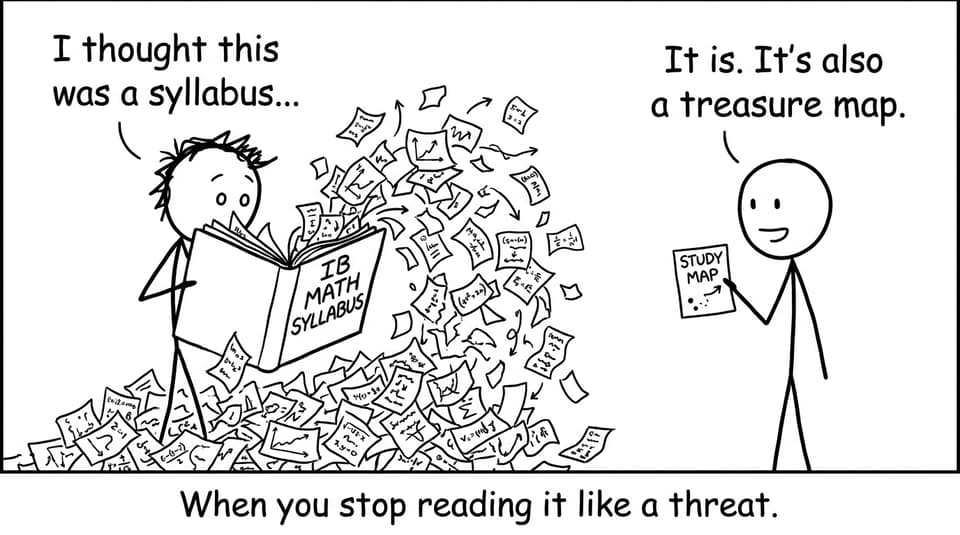
But the syllabus isn’t asking you to feel brave. It’s asking you to be systematic.
When you read the IB Math syllabus like a study map, something shifts. Topics stop feeling like a blur, and your revision starts to resemble a route: learn this, practice that, revisit the weak spots, repeat. That’s how high scores are built, not from heroic all-nighters, but from small, consistent loops.
Quick checklist: make the IB Math syllabus work for you
Use this 10-minute setup once, then reuse it all year:
-
Download or print your IB Math syllabus outline and keep it visible.
-
Label each topic Green / Yellow / Red based on confidence.
-
For each Yellow/Red topic, do: Notes to 10 questions to error log to 10 more questions.
-
Track command terms as you practice (show, hence, justify, interpret).
-
Do one timed set weekly to keep pacing realistic.
If you want a clean starting point, open the right course hub first: IB Mathematics Analysis and Approaches Resources or IB Mathematics Applications & Interpretation Resources.
Choosing your route: AA vs AI (and why it matters)
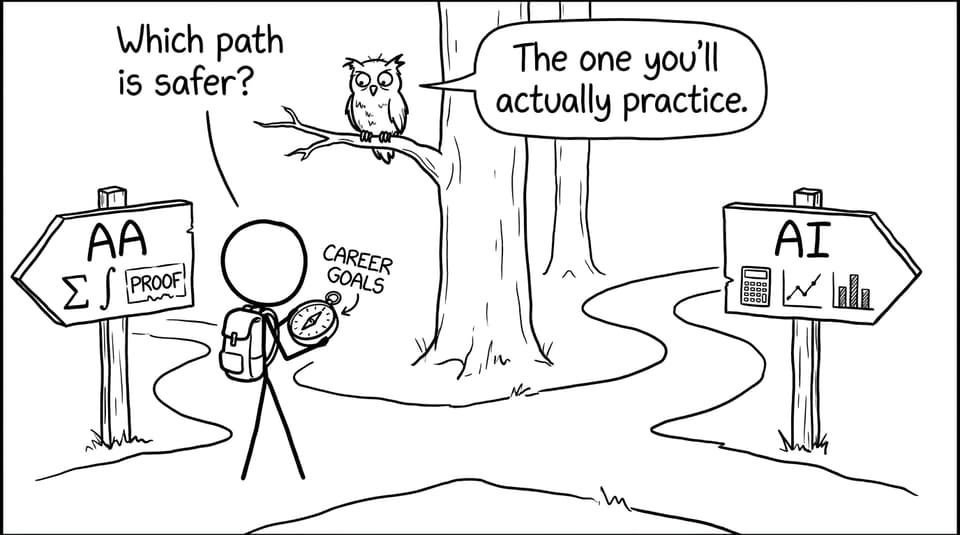
The IB Math syllabus splits into two pathways, and your best strategy depends on which one you’re actually assessed on.
Analysis and Approaches (AA)
Math AA rewards algebraic control and formal reasoning. You’ll spend more time manipulating expressions, proving results, and building technique that holds up without a calculator. If you enjoy structure, symbols, and careful logic, AA often feels satisfying.
If you’re unsure how this course behaves in real exams, read: IB Mathematics: Analysis and Approaches (AA).
Applications and Interpretation (AI)
Math AI is built around modeling, statistics, technology, and interpretation. The calculations matter, but the “what does this mean?” matters more. If you like using math to explain real situations (data, finance, social science, biology), AI tends to click.
For a clear comparison in student language, see: Is IB Math AI More Practical or Theoretical?.
The IB Math syllabus topics (the five big rooms)
No matter your pathway, the IB Math syllabus is organized into five core areas. Think of them as five rooms you must be able to walk through calmly under time pressure.
Number and algebra
This is where fluency lives: sequences and series, exponentials and logarithms, algebraic manipulation, and the kind of foundational technique that quietly shows up everywhere else.
A strong way to train this is by drilling one micro-skill at a time in a question bank. If you’re in AI, this is a useful entry point: Number and Algebra - IB Questionbank.
Functions
Functions are the “language layer” of IB Math. Graph transformations, inverses, composition, trigonometric functions, and (in AA especially) a lot of algebraic control. When function skills are weak, everything feels harder than it should.
Geometry and trigonometry
Vectors, coordinate geometry, trig identities and rules, topics that often feel fine in homework and then strangely slippery in exams. Geometry and trig usually improve fastest when you practice the same skill in many different disguises.
Statistics and probability
This is where many students leak marks through interpretation. It’s rarely the calculation that hurts you; it’s the sentence after the calculation.
If you want structured content and practice in one place, use the topic hub: IB Math AA Statistics and Probability or, for AI emphasis, IB Math AI Statistics and Probability.
Calculus
Differentiation and integration are the headline acts in IB Math, but they’re also where students over-focus. Calculus is high yield, yes. But it’s only one room in the house.
For targeted calculus drilling, you can jump straight into: IB Math AI Calculus Questionbank or the AA calculus question bank hub: IB Math AA Calculus Questionbank.
How exams reflect the IB Math syllabus
A useful way to think about exams is this: the syllabus is what you learn; the papers are how the syllabus is disguised.
-
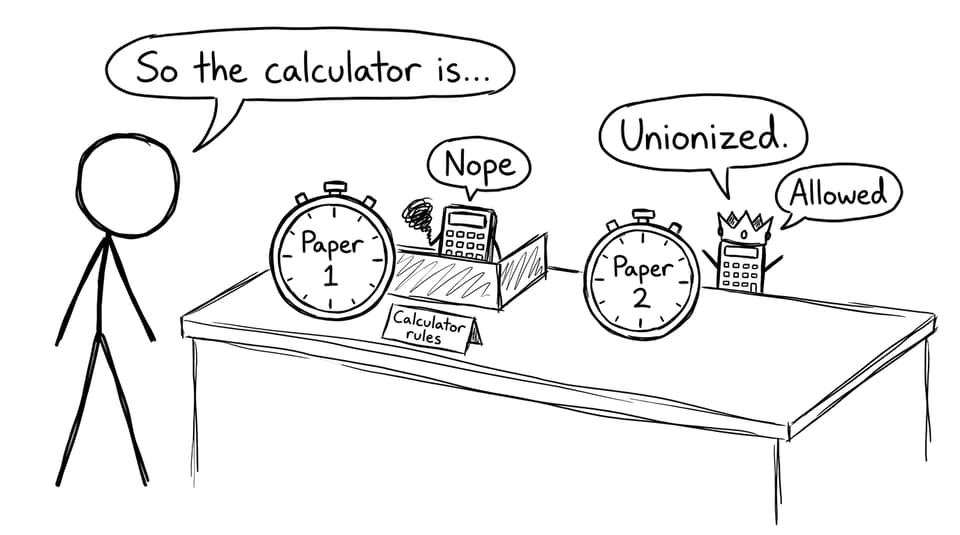
Paper 1 (AA route and some formats): often focuses on non-calculator fluency, method marks, and symbolic control.
-
Paper 2: calculator-active problem solving and interpretation.
-
Paper 3 (HL): extended reasoning and unfamiliar setups that reward calm structure.
-
Internal Assessment (IA): a personal exploration where syllabus ideas become your toolkit.
If you want a clean strategy for one of the most stressful components, use: IB Math AA Paper 1: Step-by-Step Strategy to Master It.
How to turn the IB Math syllabus into a weekly revision system
Here’s the workflow that tends to work when motivation doesn’t.
Use the syllabus as a tracker (not a document)
Make a one-page grid of the five areas, then list subtopics underneath. Your goal is not to “finish the book.” Your goal is to move subtopics from Red to Yellow to Green.
Pair every subtopic with immediate practice
The fastest improvement in IB Math usually comes from this loop:
-
Learn the method quickly (Study Notes)
-
Practice immediately (Questionbank)
-
Fix what broke (AI feedback + markscheme logic)
-
Reattempt 24-48 hours later (Flashcards + short set)
RevisionDojo is built around that exact loop: Study Notes, Questionbank, Flashcards, AI Chat, and Grading tools for feedback that feels like an examiner, not a vague hint.
For a deeper walkthrough, use: How to Revise IB Math AA and AI Effectively.
Practice like you’re collecting mistakes
A quiet secret of IB Math: your score is often the shape of your recurring errors.
When you miss a question, write one line:
- What type of mistake was it (algebra slip, wrong method, misread command term, interpretation)?
Then build your next practice set around that. This is exactly why targeted practice matters: How to Use the Questionbank for Targeted Math Revision.
FAQ
Is the IB Math syllabus the same worldwide?
Yes, the IB Math syllabus is standardized for all IB schools, which is part of what makes it fair. A student in Singapore and a student in Spain are assessed against the same published course framework and the same style of expectations. That said, teachers may sequence topics differently, and schools may emphasize different practice routines. This is why using the syllabus as your personal checklist matters more than following your class order perfectly. When you anchor revision to the IB Math syllabus, you reduce the risk of discovering a gap too late. It also makes your practice sessions easier to measure, because progress becomes topic-based, not mood-based.
Should I study topics that aren’t on the IB Math syllabus?
In general, no, not until you are genuinely secure on the syllabus. In IB Math, marks come from executing syllabus methods clearly and matching examiner expectations, not from showing extra cleverness. Off-syllabus rabbit holes can feel productive because they’re interesting, but they often don’t translate into exam marks. There is one exception: if you’re doing an IA or an Extended Essay, you may need math beyond the syllabus to explore your question well. Even then, the smartest approach is to master the syllabus first, then expand carefully with support. If you’re working on exploration planning, this guide can help: IB Math IA Ideas for 2025 and Beyond.
How do I choose between AA and AI if I’m undecided?
Start by asking what kind of thinking you’re willing to practice for months, not what sounds impressive. Math AA asks you to build technique, manipulate symbols, and stay comfortable when the calculator is not the hero. Math AI asks you to use technology, read context carefully, and explain what results mean, especially in statistics and modeling. Your future plans matter (many STEM-heavy programs prefer AA HL), but your day-to-day experience matters too, because consistent practice beats perfect intentions. Try a week of each style: do a functions set, a stats set, and a calculus set, then notice which problems you naturally reattempt. If you want RevisionDojo to guide that trial, use the two hubs to compare topic lists and question style: IB Math AA and IB Math AI.
Conclusion: make the IB Math syllabus your advantage
The IB Math syllabus isn’t just what the course contains. It’s what your revision can be built on: a stable structure when everything else feels noisy.
If you want a calm, repeatable way to revise IB Math, let RevisionDojo be your home base: syllabus-aligned Study Notes, a targeted Questionbank, spaced Flashcards, fast help with AI Chat, plus Grading tools, Predicted Papers, Mock Exams, a Coursework Library, and Tutors when you need human guidance. Start by picking your route and turning the syllabus into a tracker; then practice like each session is one small step toward a predictable score.