



Conceptual understanding in IB Math AA starts with a small moment
In IB Math AA, there’s a specific kind of panic that shows up right before you write your first line: you recognize the topic, you remember a formula, but the question is angled differently than your notes. Your brain searches for a matching template and comes back empty.
That moment is the dividing line between memorization and conceptual understanding. In IB exams, the marks usually sit on the other side of that line: your reasoning, your justification, your ability to connect ideas when the surface looks unfamiliar. If you build conceptual understanding, the question can change its outfit and you still know who it is.
RevisionDojo is built for that exact shift. You can learn the idea with Study Notes, pressure-test it with the Questionbank, and then use AI Chat and Grading tools to find what your thinking missed.
A quick checklist for IB conceptual understanding
Use this as your weekly loop for IB Math AA:
-
Start with one concept (not a whole chapter) and define it in plain language.
-
Ask “what changes, what stays?” when parameters or forms shift.
-
Draw a sketch or graph before you calculate.
-
Do 8-12 targeted questions in the Questionbank, then tag mistakes.
-
Write one 3-sentence reflection: what the concept means, where it shows up, and your most common error.
If you want a broader routine around this loop, use The Ultimate IB Math Study Routine for Busy Students.
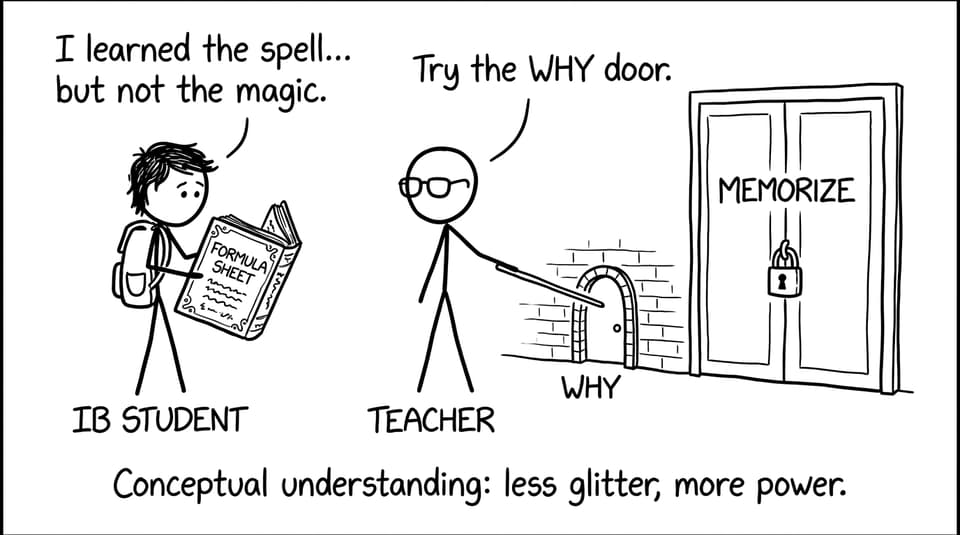
Learn the “why” behind formulas (the IB way)
A formula in IB Math AA is rarely a magic trick. It’s usually a compressed story.
Take differentiation: you can memorize that (\frac{d}{dx}(\sin x)=\cos x). But conceptual understanding comes when you can explain that differentiation measures instantaneous rate of change, and that the limit definition forces the derivative to match the slope behavior of the sine curve.
A useful habit: whenever you meet a new technique, ask:
-
What problem does this technique solve?
-
What would I do without it?
-
What assumptions are hidden inside it?
Build this habit with structured explanations from RevisionDojo’s subject hub: IB Mathematics Analysis and Approaches Resources. Then cement it with topic practice like Calculus Questionbank (Math AA).
Visualize relationships before you compute
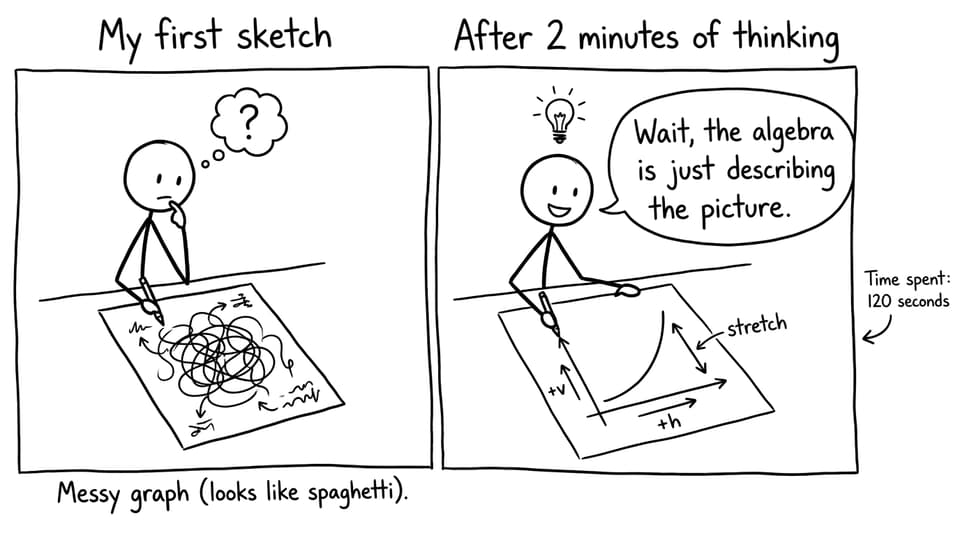
IB questions love to disguise familiar ideas inside unfamiliar forms. Visualization is how you unmask them.
If you’re working with functions and transformations, a 20-second sketch can prevent 10 minutes of algebra going in the wrong direction. If you’re solving an equation, a quick graph tells you how many solutions you should expect. If you’re integrating, a rough area picture reminds you what the sign and size should look like.
A practical rule: sketch first when the problem involves change, intersection, maximum/minimum, or “show that.” Those are conceptual command zones in IB.
RevisionDojo helps here because you can pair explanation with repetition. Learn the idea, then immediately practice it in the Questionbank, and check your reasoning with AI Chat when a graph doesn’t match your algebra.
Connect algebra to geometry (where IB marks hide)
A big leap in IB Math AA conceptual understanding happens when you stop treating algebra and geometry as separate languages.
Try these bridges:
-
When you solve an equation, ask: what does this represent geometrically? (intersection points, tangency, equal areas)
-
When you see an integral, ask: what area or accumulation is it describing?
-
When you see a derivative, ask: what slope or rate is it describing?
This matters because IB loves multi-step questions where the first step is interpreting, not calculating.
To train this skill under exam conditions, mix topics intentionally. Use guidance from How to Revise IB Math AA and AI Effectively, then practice geometry-heavy sets like Geometry and Trigonometry Questionbank (Math AA).
Use “What if?” questions to build IB flexibility
Conceptual understanding shows up when you can predict the effect of a change.
After solving any IB question, run one quick “what if?”:
-
What if the coefficient doubles?
-
What if the function is shifted by (+3) or reflected?
-
What if the domain is restricted?
-
What if I swap (x) and (y) and look for an inverse?
This is how you stop being surprised on exam day. You’re not just learning answers. You’re learning behavior.
When you do this inside RevisionDojo, the workflow is clean: Questionbank for variations, Flashcards for key patterns, and Predicted Papers plus Mock Exams when you want to test the full mix.
If you’re specifically working toward non-calculator reasoning, use How to Prepare for IB Math AA Paper 1 (No Calculator) and How to Master IB Math AA Paper 1: Step-by-Step Strategy.
Turn mistakes into a conceptual map
Most students treat mistakes like something to erase.
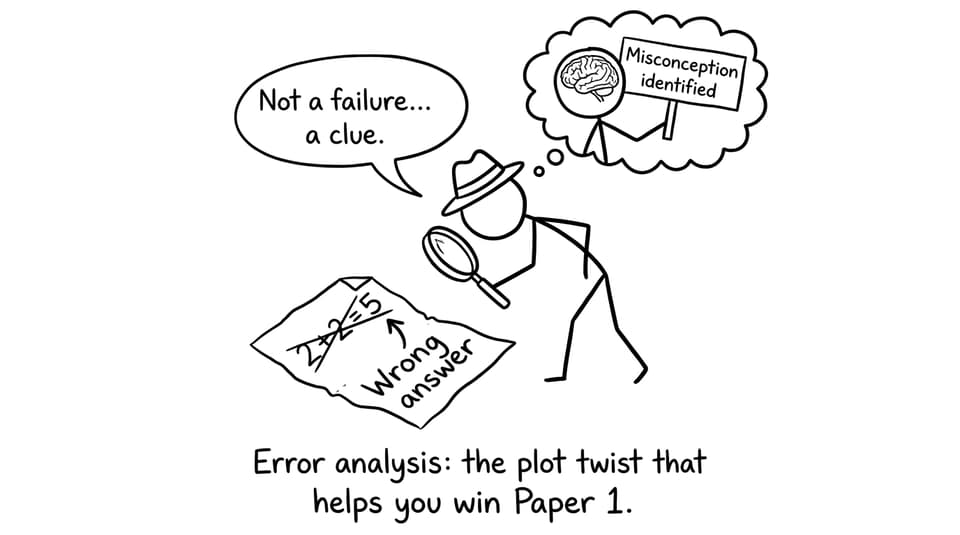
In IB Math AA, mistakes are data. Each one points to a missing concept link.
When you get a question wrong, don’t just write the correct method. Write the reason you chose the wrong one:
-
Misread the command term?
-
Assumed linear behavior?
-
Confused transformation rules?
-
Forgot a restriction (domain, sign, extraneous solutions)?
Then create a micro-drill: 3 questions that target that one misconception.
RevisionDojo’s Grading tools and AI Chat are powerful here because they can mirror IB-style marking language: your final answer matters, but your reasoning is what earns consistent marks across unfamiliar questions.
Use the right RevisionDojo tools to build IB understanding
Conceptual understanding grows fastest when learning and practice are tightly connected. Here’s a simple pairing:
-
Study Notes for definitions, key relationships, and “why this works.”
-
Flashcards for precise recall (identities, rules, common forms) without drowning in memorization.
-
Questionbank to practice one concept in many disguises.
-
AI Chat when you can’t explain a step without hand-waving.
-
Mock Exams to combine everything under timing pressure.
-
Predicted Papers when you want realistic exam-style coverage.
-
Tutors when you need a human to spot patterns in your thinking.
If you’re still deciding whether AA is your best fit (and why it feels the way it does), read IB Math AA vs AI: How to Choose the Right Course or Should I Take IB Math AA or AI? A Realistic Breakdown.
Closing: build IB confidence by building meaning
IB Math AA rewards the student who can walk into a new-looking question and think, “I know what this is.” That confidence doesn’t come from collecting more formulas. It comes from conceptual understanding: sketches, connections, “what if?” thinking, and honest error analysis.
If you want a structured way to build that mindset, use RevisionDojo as your loop: Study Notes and Lessons for meaning, Flashcards for clean recall, the Questionbank for varied practice, AI Chat and Grading tools for feedback, and Mock Exams plus Predicted Papers for exam realism. Start today with one concept, one explanation, and one targeted set. In IB, that’s how momentum begins.