

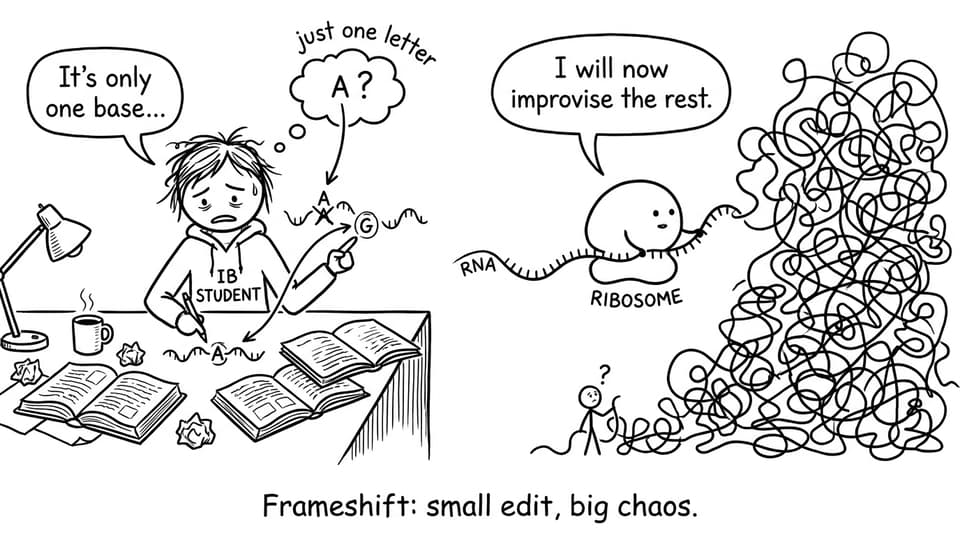
In IB Biology, there’s a moment every student recognizes: you change something tiny and the whole answer collapses.
Insertions and deletions feel like that. One missing base. One extra base. And suddenly a protein that should fold neatly becomes a biological improv show.
The IB Biology idea you’re actually being tested on
In IB Biology, insertions and deletions (often grouped as “indels”) matter because they connect three examinable layers:
-
DNA sequence changes (the mutation)
-
mRNA codons (how the message is read)
-
Polypeptide sequence and folding (what the protein becomes)
If you want the syllabus-aligned version, start with Consequences of insertions and deletions (D1.3.3), then connect it back to Protein synthesis (D1.2) so you can explain why the ribosome “reads wrong.”
Quick checklist for exam answers
When you see an insertion/deletion question in IB Biology, check:
-
Is the change a multiple of 3?
-
Where is it located: early or late in the coding sequence?
-
Does it create a premature stop codon?
-
Which protein region is affected: active site, binding domain, signal peptide, transmembrane region?
-
Predict the consequence: altered primary structure, leading to altered folding and function.
In-frame insertions and deletions: the frame stays, the meaning shifts
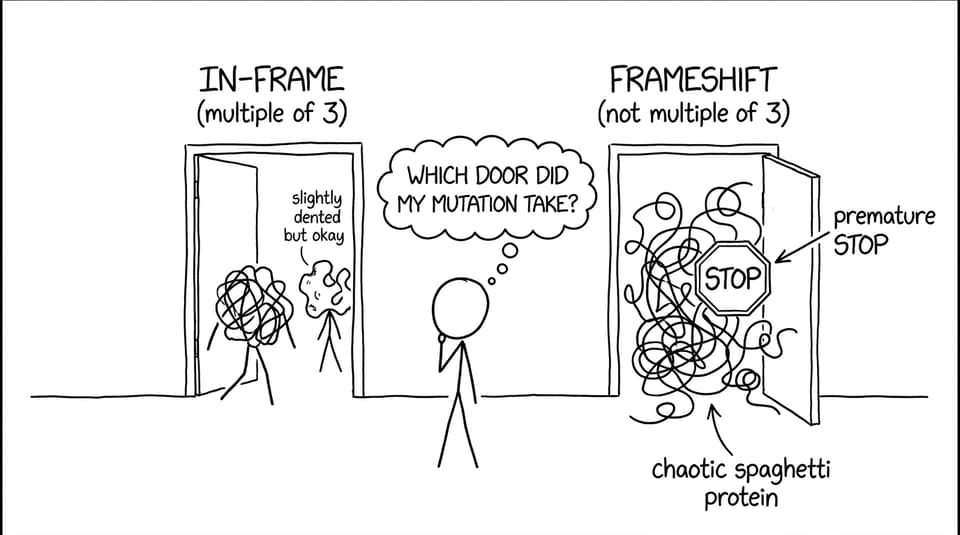
An in-frame insertion or deletion adds/removes nucleotides in multiples of three. The ribosome still groups codons correctly, so the downstream message is mostly intact.
That sounds “safe,” but IB Biology questions often push you to be more precise: removing just one amino acid can still be disastrous if it hits a critical region. Think of an enzyme active site where shape matters more than size.
This is where it helps to revise protein structure alongside mutation logic. Pair this topic with Why amino acid sequence controls protein structure and, for core protein content, B1.2 Proteins.
Frameshift insertions and deletions: the domino effect
A frameshift happens when the insertion/deletion is not a multiple of three. Now every codon downstream changes.
In IB Biology, this is the classic “small cause, huge effect” mutation. The amino acid sequence after the mutation becomes unrelated to the original, and that often means:
-
Incorrect amino acids are added
-
Folding signals are disrupted
-
A stop codon appears earlier than expected
-
Translation ends early, producing a truncated protein
To strengthen your explanations, connect this to broader mutation categories in How coding mutations change polypeptides and the wider comparison in Chromosomal vs gene-level mutations.
Why protein folding and targeting often fail after indels
IB Biology isn’t only about the codon table. It’s about consequences.
Even if translation still produces a chain, insertions and deletions can disrupt:
-
Secondary structure (alpha helices/beta sheets) if the new sequence breaks hydrogen bonding patterns
-
Tertiary structure if hydrophobic/hydrophilic placement changes, or disulfide bridges become impossible
-
Targeting/localization if a signal peptide is deleted or a transmembrane region is distorted
You can reinforce the folding vocabulary with Secondary structure notes (B1.2.8) and gene expression context with Gene expression notes (D2.2.1).
How to practice this fast on RevisionDojo
The quickest way to make this automatic in IB Biology is to practice mixed questions until you stop hesitating at “multiple of three.”
-
Use the D1.3 Questionbank to train the exam pattern.
-
Lock in definitions with D1.2 Flashcards.
-
If you’re stuck mid-explanation, RevisionDojo’s AI Chat helps you rebuild the chain of reasoning step by step.
-
Then validate your understanding with Mock Exams, Predicted Papers, and the Grading tools so your wording matches examiner expectations.
Bringing it home for IB Biology exam prep
Insertions and deletions test whether you can think like a translator: triplets, reading frames, stop codons, then structure and function. That’s why IB Biology questions on indels can feel brutal but predictable.
If you want this topic to become easy under time pressure, use RevisionDojo’s Study Notes, Questionbank, and Flashcards, then pressure-test your explanations with Mock Exams and Predicted Papers. You’ll walk into exams knowing exactly how insertions and deletions affect proteins in IB Biology, and how to write it in examiner-friendly language.