
If you have ever stared at a DNA sequence and thought, “It is just one letter,” you have already met the most common trap in IB Biology. In real cells, one letter can be a shrug, a full stop, or a domino line that knocks over every amino acid that follows. Coding mutations matter because the coding region is the recipe the ribosome actually cooks from. Change the recipe, and the polypeptide can change shape, stability, and function.
For the exam, the goal is simple: link DNA change to mRNA codons to amino acids to protein structure and phenotype. This article gives you the exact mental model IB Biology questions reward.
Quick exam checklist for IB Biology
-
Identify the mutation type: base substitution, insertion/deletion, or splice-site change
-
Predict the codon consequence: same codon meaning, different amino acid, or stop codon
-
Decide how much of the polypeptide changes: one position vs everything downstream
-
Connect to structure: folding, active site, stability, or truncated product
-
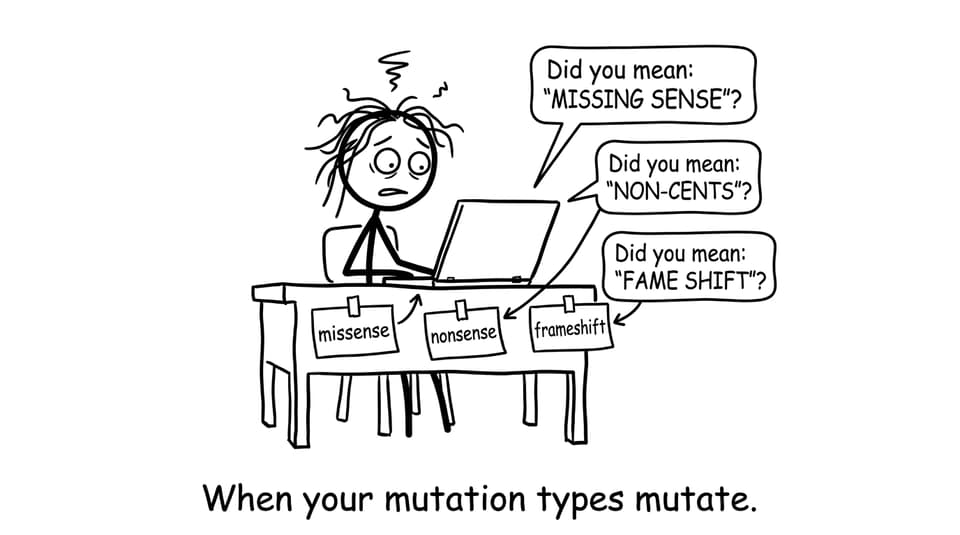
Use correct terms: missense, nonsense, silent, frameshift, alternative splicing
For targeted practice, pair this with RevisionDojo’s syllabus pages on D1.3 Mutations and gene editing and D1.2 Protein synthesis.
IB Biology: Point mutations and polypeptide outcomes
A point mutation is a single base substitution. In IB Biology, you are usually expected to classify the outcome as missense, nonsense, or silent.
Missense mutations: same length, different chemistry
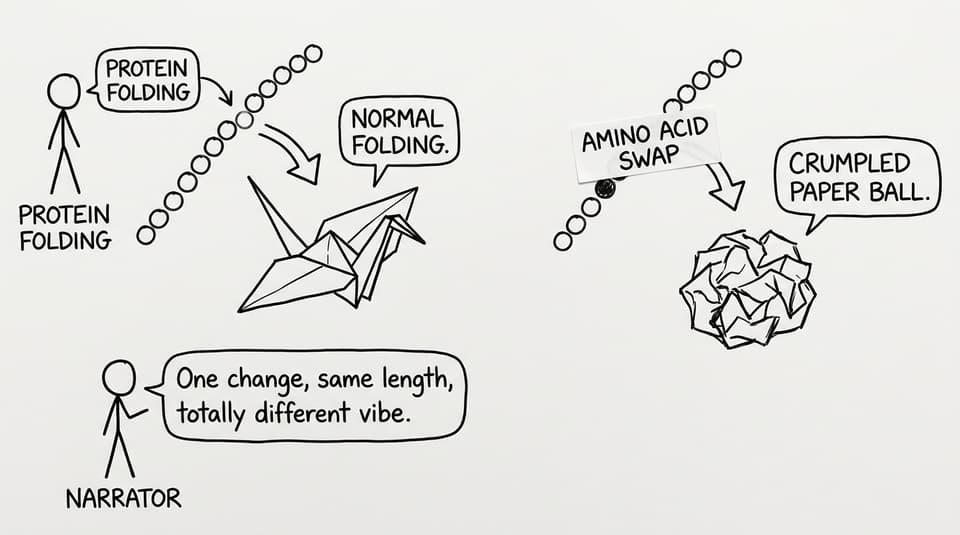
A missense mutation changes one codon so it codes for a different amino acid. That sounds small, but proteins are picky about chemistry: swapping a hydrophobic amino acid for a charged one can disrupt folding or change an active site. The polypeptide length stays the same, yet the function can shift dramatically.
A classic example referenced in many courses is sickle cell disease, where one amino acid substitution changes hemoglobin behavior. For the clean syllabus framing, review 3.1 Genes Notes and D1.3.1 Gene mutations notes.
Nonsense mutations: the premature stop problem
A nonsense mutation turns a codon into a stop codon. Translation ends early, producing a truncated polypeptide that is usually nonfunctional. In exam markschemes, the key idea is that the protein is shorter, often unstable, and frequently lacks essential domains.
Silent mutations: “no change” to amino acids, but stay cautious
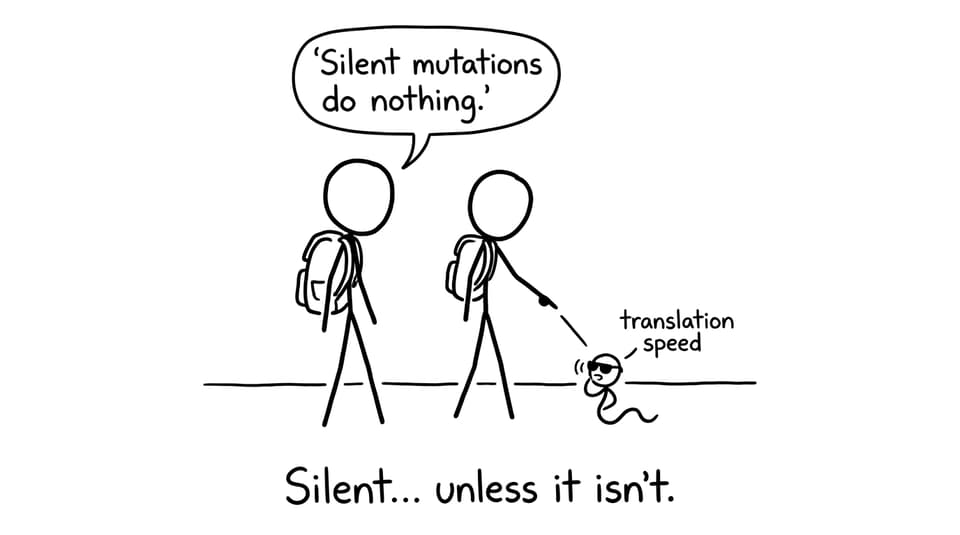
Silent mutations do not change the amino acid because the genetic code is redundant. In most IB Biology contexts, you can say “no change to primary structure.” But higher-level thinking recognizes that silent changes can sometimes affect translation rate or mRNA stability, which can still influence folding and expression.
IB Biology: Frameshift mutations and downstream chaos
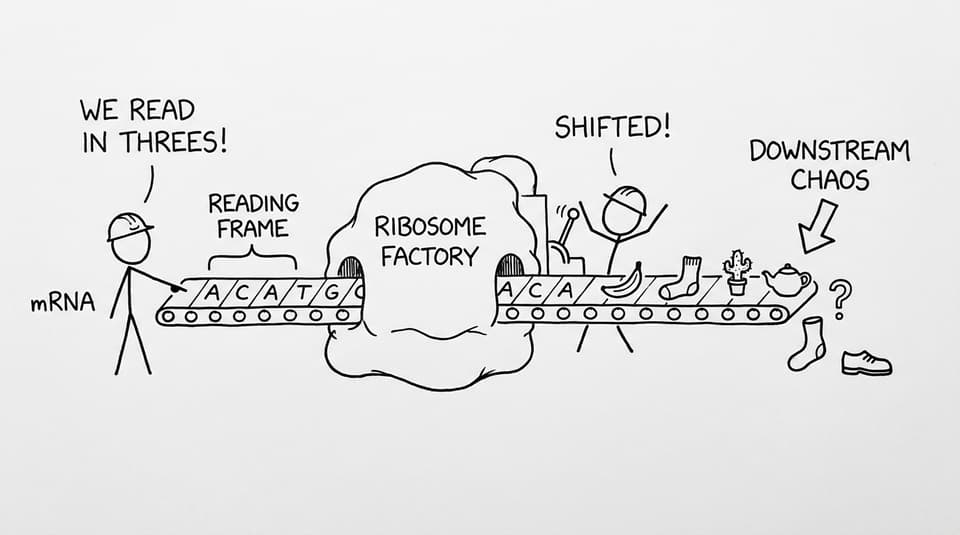
Insertions or deletions that are not in multiples of three shift the reading frame. Because ribosomes read codons in triplets, a frameshift changes every codon downstream. That usually means a radically altered amino acid sequence, plus a high chance of an early stop codon appearing soon after.
This is why frameshift mutations are often severe: the polypeptide is not just “a bit different,” it is a different sequence altogether.
Splice-site mutations: when the mRNA edit goes wrong
Not all impactful mutations are simple substitutions. If a mutation alters splice sites, the cell may remove the wrong segments or retain introns. That changes the mature mRNA and therefore the codons presented to the ribosome. The result can be missing amino acid regions, added nonsense sequences, or no successful translation.
This connects naturally to the protein synthesis unit. If you want the wider pathway in one place, use 2.7 DNA replication, transcription and translation Notes.
When mutations help: variation, adaptation, evolution
Many students unconsciously equate mutation with harm. IB Biology is more balanced: mutations can be harmful, neutral, or beneficial. A beneficial change might improve enzyme efficiency, change binding affinity, or create new phenotypes that selection can act on. That is why mutation is a source of genetic variation in populations.
For the syllabus language, see D1.3.7 Mutation as a source of genetic variation Notes.
Study coding mutations with RevisionDojo
If you want these ideas to stick under time pressure, RevisionDojo is built for it: use the D1.3 Questionbank to drill mutation-to-polypeptide predictions, then reinforce with Study Notes, Flashcards, and AI Chat for quick clarification. When you are ready to simulate exam conditions, combine Mock Exams, Predicted Papers, and Grading tools to spot weak phrasing before the real paper. And if you want feedback that feels human, the Tutors and Coursework Library help you connect molecular details to clear explanations.
Coding mutations stop feeling random when you always ask the same question: What happens to the codons, and what happens to the polypeptide? That habit is pure IB Biology scoring power, and RevisionDojo is where you can practice it until it is automatic.