


A small moment that decides a big IB grade
In the first two minutes of an IB Paper 1 source analysis, you can usually see the ending.
One student starts writing instantly, sprinting into a paragraph powered by memory and adrenaline. Another sits still, rereads the question, and quietly boxes three words: purpose, perspective, usefulness. They are both smart. But only one is doing what Paper 1 actually rewards.
Paper 1 is distinctive across several IB subjects (especially History and Global Politics) because it tests judgment under pressure: reading carefully, selecting evidence, and evaluating sources without drifting into an essay.
This guide is written for IB students preparing for exams, but it is also a window into what strong teachers do: they turn “source analysis” from a vague talent into a repeatable routine.
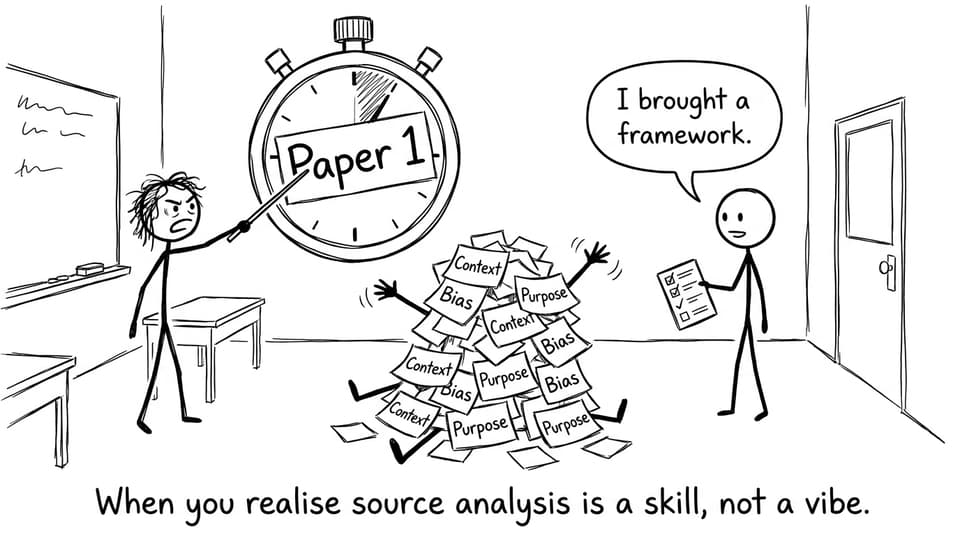
A quick classroom checklist (steal this)
If you want a simple plan that works in almost any IB source analysis lesson, use this:
-
Teach source types early (written, visual, data/statistical; primary vs secondary)
-
Use one consistent framework (OPCVL/OPVL or similar) until it becomes automatic
-
Run short timed drills weekly, not just full papers occasionally
-
Show annotated exemplars and reverse-engineer why they score
-
Train comparison language (link sources, do not isolate them)
-
Give fast, criteria-linked feedback students can act on next time
-
Track progress with a system (class data beats intuition)
For teachers managing a whole cohort, tools like RevisionDojo for Schools make it easier to assign practice, monitor improvement, and keep Paper 1 routines consistent across classes.
What IB Paper 1 source analysis is really testing
Most students assume Paper 1 is about knowledge. In reality, IB Paper 1 source analysis is closer to a driving test than a trivia quiz. Knowing the rules matters, but performance is about what you do in the moment.
Paper 1 typically rewards students who can:
-
Identify explicit and implicit messages in a source
-
Explain perspective, motive, and audience
-
Evaluate reliability/usefulness with reasons grounded in the source
-
Synthesize across multiple sources (agreement, contradiction, emphasis, omission)
-
Stay focused on the question under timed conditions
If you keep accidentally writing mini-essays, you are not “bad at IB.” You are answering a different exam.
For History students, it helps to keep the broader course context clear using the IB History resources hub. Global Politics students can do the same with the IB Global Politics resources hub.
Teach source literacy first (before the framework)
The fastest way to raise IB Paper 1 source analysis marks is to make sources feel familiar. Not the topic, but the source-as-an-object.
Strong teachers build “source literacy” with tiny, repeatable habits:
Build a source-type radar
Students should be able to say, quickly:
-
What type of source is this?
-
What does this type usually do well?
-
What does this type usually hide?
A political speech often reveals priorities and persuasion methods, but not private doubts. A statistics table may look objective but can still be selective (definitions, missing categories, time window).
If you are doing IB History Paper 1, RevisionDojo’s focused guidance on sources helps you name these patterns clearly. The article What Is a Primary Source? IB History Source Guide is a useful reset when “primary vs secondary” starts to blur under exam stress.
Use OPCVL, but teach it like a reflex
OPCVL (Origin, Purpose, Content, Value, Limitation) works because it gives IB students a checklist that matches what examiners reward.
But the framework only helps if it becomes fast. If OPCVL turns into five long paragraphs, it collapses under time.
The “two-sentence OPCVL” drill
To make OPCVL exam-ready, practise compressing it:
-
Sentence 1: Origin + Purpose + one key content detail (quote/stat/feature)
-
Sentence 2: Value + Limitation linked to the question
Do this repeatedly with short sources (a paragraph, a chart, a cartoon) until students can do it in under 90 seconds.
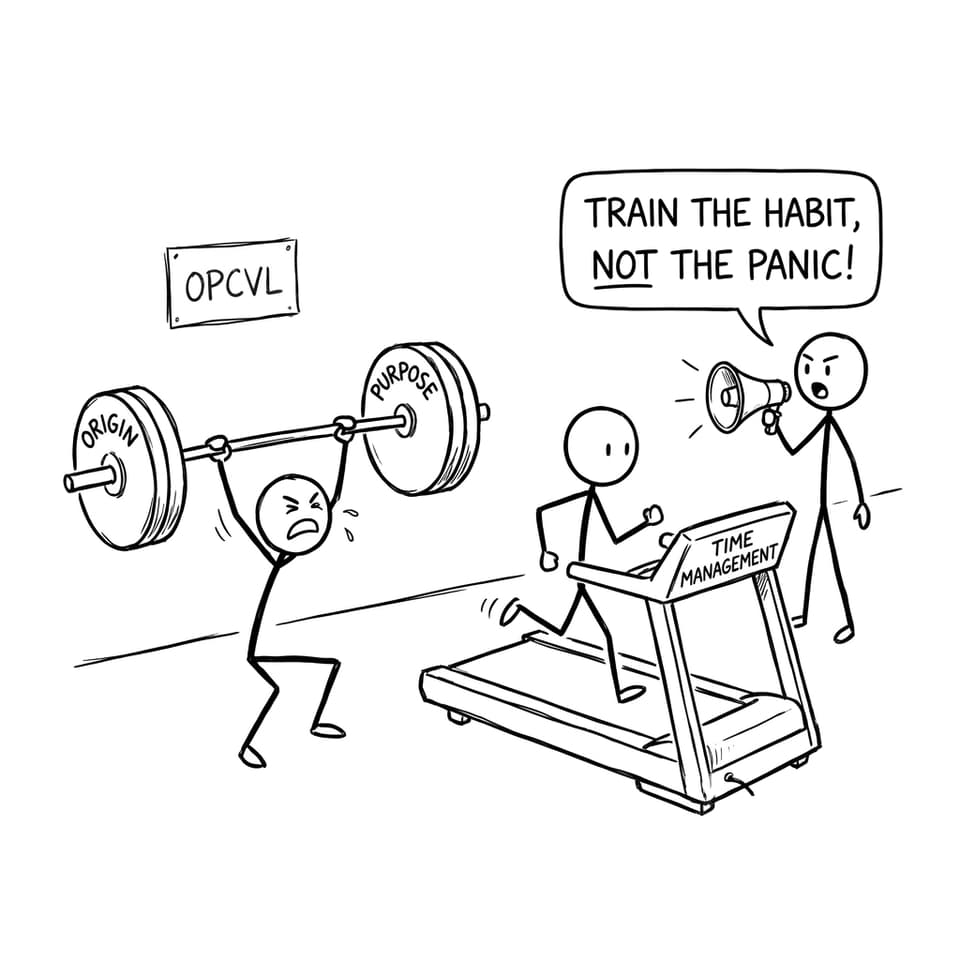
For students who want a clearer breakdown of Paper 1 expectations and question styles, these RevisionDojo guides are worth keeping open while you practise:
Model the thinking, not just the answer
The best IB Paper 1 source analysis lessons include teacher “think-alouds.” Not polished paragraphs, but live decision-making.
A useful script is:
-
“What is the source doing?” (informing, persuading, justifying, warning)
-
“What does it assume the audience already believes?”
-
“Which detail in the source proves my point fastest?”
When teachers narrate these choices, students learn that high marks come from selection and control, not from writing more.
Train synthesis with linking sentences
Paper 1 punishes students who treat sources like separate islands. High-scoring IB answers connect sources like a map.
A simple comparison toolkit
Practise sentence stems that force synthesis:
-
“Both sources suggest ___, but they differ in ___ because ___.”
-
“Source A is more useful for ___, while Source B better supports ___.”
-
“The omission of ___ in Source B matters because ___.”
If you study IB History and want more exam-structure guidance across papers, Ace IB History Paper 1 + Paper 2: Tips + Free Resources is a practical companion.
Time management: make it visible, make it normal
Time pressure is where IB Paper 1 source analysis falls apart. Not because students are slow, but because they are doing expensive things: rewriting the source, adding unnecessary context, or building an essay introduction nobody asked for.
A reliable pacing routine
-
Read questions first (so your reading has a purpose)
-
Annotate with symbols (P = purpose, POV = perspective, E = evidence)
-
Write in focused chunks (no introduction, no conclusion)
-
Quote or point to specific features (a phrase, a statistic, a visual cue)
The goal is to make speed feel like structure, not like panic.
Feedback that actually changes the next attempt
A lot of Paper 1 feedback is too broad: “more evaluation,” “be more specific.” Students can’t act on that.
Better IB Paper 1 source analysis feedback is tagged to a move:
-
“Your value is generic, so name the audience and link to the question.”
-
“You explained content but didn’t evaluate limitation; what would this author avoid saying?”
-
“Your comparison lists differences; add a reason why they differ.”
RevisionDojo supports this kind of improvement loop with tools that feel like a teacher’s workflow: a Questionbank for targeted practice sets, AI Chat for clarifying framework steps, Grading tools for faster marking patterns, Study Notes and Flashcards to keep key terms sharp, plus Mock Exams and Predicted Papers for realistic pressure. If you need human support, the platform also connects students with Tutors, and coursework support lives in the Coursework Library.
For topic-specific practice, students can build focused sets from places like IB History Paper 1: Conflict and Intervention and apply the same source analysis routine repeatedly until it sticks.
FAQ
How can I improve my IB Paper 1 source analysis without writing full papers every time?
You improve faster by practising the smallest repeatable pieces of IB Paper 1 source analysis. Do short drills: one source, one question, five minutes, then review with a markscheme or teacher comments. Alternate between “two-sentence OPCVL” and comparison sentence practice so you train both evaluation and synthesis. Keep a running list of your most common errors (for example: no limitation, generic value, weak linking). Then choose one error to fix per session, not all of them at once. If you have access to RevisionDojo, use the Questionbank to generate short, exam-style sets and the Grading tools to make feedback immediate.
What’s the biggest mistake IB students make in Paper 1 source analysis?
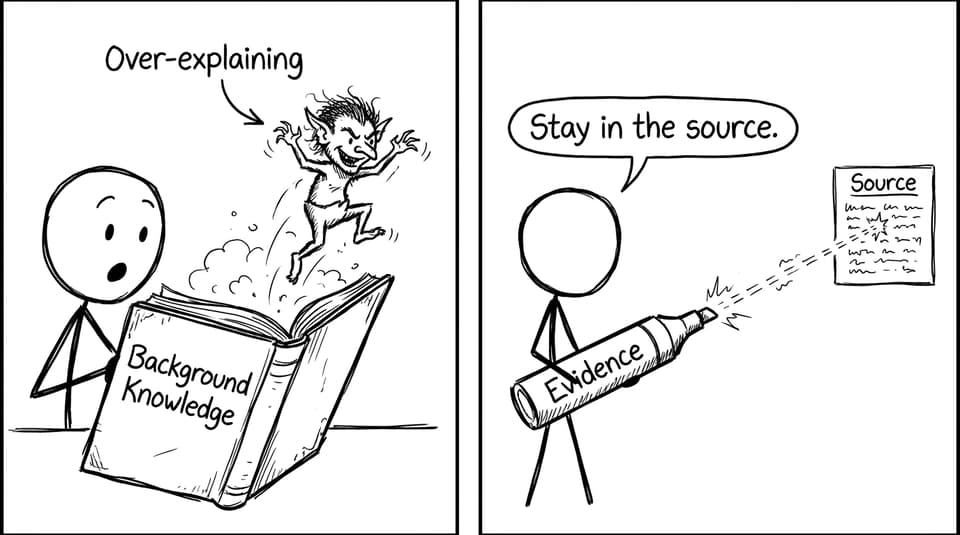
The biggest mistake is leaving the source and writing an essay from memory. In IB Paper 1 source analysis, background knowledge can support a point, but it cannot replace evidence taken directly from the source. Examiners reward precision: a quote, a statistic, a visual feature, a clear inference about purpose or perspective. When you over-explain the historical context, you often stop answering the question you were actually asked. A good self-check is: “Could my paragraph exist without the source?” If yes, it probably won’t score as well as you want.
How do I write evaluation (value and limitation) in a way that earns marks?
Start by making evaluation specific to the question, not just to the source. In IB Paper 1 source analysis, “valuable because it is primary” is rarely enough on its own. Instead, name what the origin and purpose allow you to understand (for example: motives, priorities, public messaging) and then name what that same purpose may distort or omit. Try linking words like “therefore,” “however,” and “this matters because” to force reasoning rather than description. Also, avoid absolutes like “unreliable” unless you explain unreliable for what. Value and limitation are not opposites; they are two sides of how the source can be used.
Bringing it home: make IB Paper 1 feel predictable
The quiet secret of IB Paper 1 source analysis is that it becomes easier when it becomes boring. Not because it’s dull, but because the moves are familiar: identify purpose, select evidence, evaluate usefulness, link sources, manage time.
If you are a student, your job is to practise those moves until they show up automatically on exam day. If you are learning in a class that uses RevisionDojo, take advantage of the system: do short timed sets in the Questionbank, tighten your structure with Study Notes and Flashcards, and pressure-test your routine with Mock Exams and Predicted Papers.
In IB, confidence is often just proof that you have rehearsed the right process enough times. Paper 1 rewards the process.