

Confidence rarely disappears because you suddenly “forgot” the syllabus.
In IB season, confidence usually fades for a quieter reason: the brain starts treating every practice mistake as a prediction. One rough timed response becomes “I’m not ready.” One low-scoring question becomes “I’m going to mess this up.” And the closer the exams get, the more those stories feel like facts.
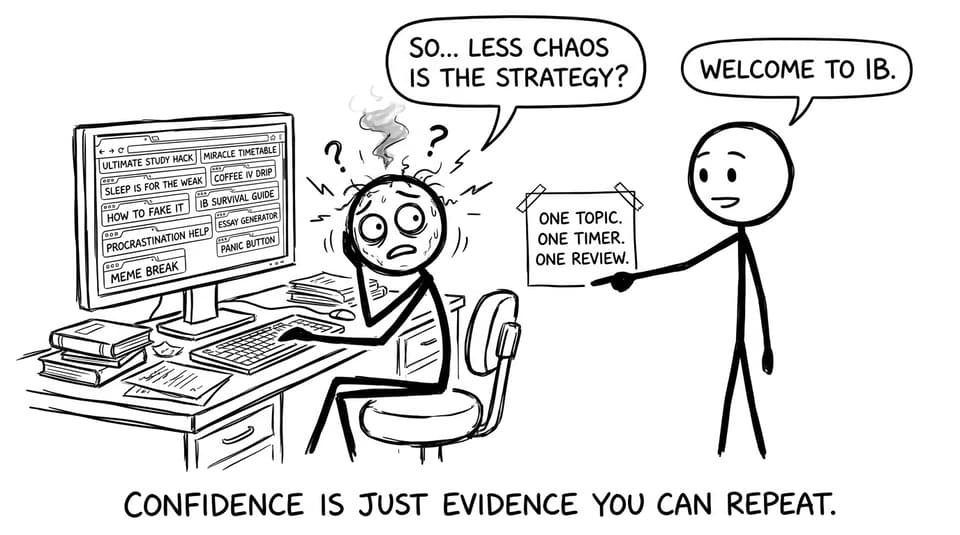
But in IB, confidence is not a personality trait. It’s a form of evidence: repeated proof that you can meet the task under realistic conditions.
Teachers are the people who can help students collect that evidence, calmly, consistently, and without turning revision into a panic festival. This guide is written for IB students preparing for exams, but it’s also a window into what the best IB teachers do behind the scenes to help you walk into the exam hall steadier than you feel.
Quick checklist: what actually builds IB confidence
If you only remember one section, make it this. The fastest IB confidence gains usually come from:
-
One clear weekly routine (not a giant motivational speech)
-
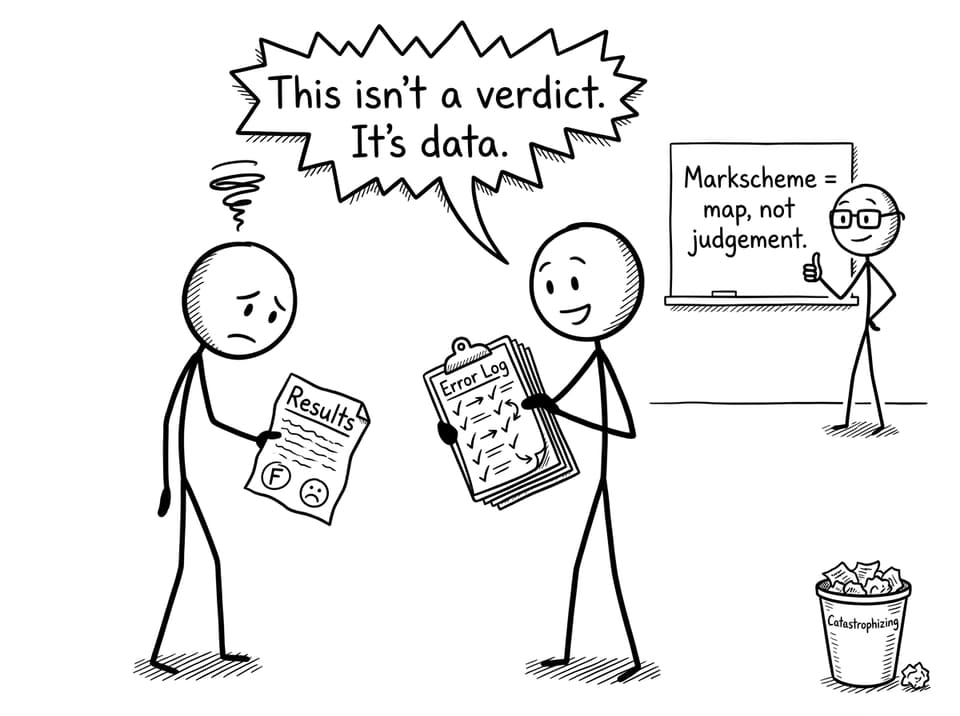
Mistakes treated as data, not identity
-
Feedback that gives a next step you can do in 20-40 minutes
-
Timed practice that starts small and grows (so pressure becomes familiar)
-
Visible progress tracking (so you can see improvement, not guess)
-
Tools that shorten the “stuck” moments, so you keep moving
RevisionDojo is built around this evidence loop: Study Notes for quick clarity, Flashcards for daily recall, Questionbank for exam-style practice, AI Chat (Jojo) for instant help, Grading tools for rubric-aware feedback, Predicted Papers and Mock Exams for realistic rehearsal, plus a Coursework Library and Tutors when you need human support.
Why confidence matters for IB exams (and why it wobbles)
In IB exams, anxiety isn’t just an emotion. It changes decisions.
When you’re confident, you interpret a hard question as normal: “This is the part where I choose a method, show reasoning, and keep going.” When confidence is low, the same question feels like danger: “This proves I’m behind.” The result is predictable: rushed reading, command terms misread, time lost to second-guessing, and answers that don’t show what you actually know.
Good IB teaching protects you from that spiral by making the exam feel familiar before it’s real.
If you’re curious what that looks like in a student’s day-to-day routine, see How to Build Confidence During IB (Without Faking It).
Reframe mistakes as learning data, not a verdict
A smart IB teacher does something that feels small but changes everything: they make mistakes emotionally safe.
That doesn’t mean lowering standards. It means changing the meaning of an error. Instead of “wrong equals failure,” the classroom becomes “wrong equals information.” The teacher models the habit of asking:
-
What did the examiner want here?
-
What did you do instead?
-
Which decision caused the mark loss?
-
What rule will you use next time?
That last question is the confidence builder. A rule is repeatable. And repeatable is what IB rewards.
RevisionDojo supports this mindset with exam-style feedback loops: drill a topic in the Questionbank, check the markscheme logic, then immediately reattempt while the mistake pattern is still fresh.
Build confidence through process goals (not just grades)
In IB, many students feel confident only when a number goes up. That’s fragile confidence, because it depends on outcomes you can’t fully control.
Strong IB teachers widen the target. They praise process in a way that’s specific enough to repeat:
-
“Your definition was precise, so you earned the method marks fast.”
-
“Your paragraph structure matched the command term.”
-
“You didn’t freeze when you got stuck, you switched strategies.”
Those comments are powerful because they train you to connect performance to actions. Actions are controllable. Controllable things create calm.
If you want an example of process-driven routines, read IB Exam Confidence: Build It Through Consistent Practice.
Use mock exams to normalize pressure (strategically)
Mock exams can either build confidence or crush it. The difference is how the teacher uses them.
A confidence-building mock has three parts:
Before: teach a timing plan
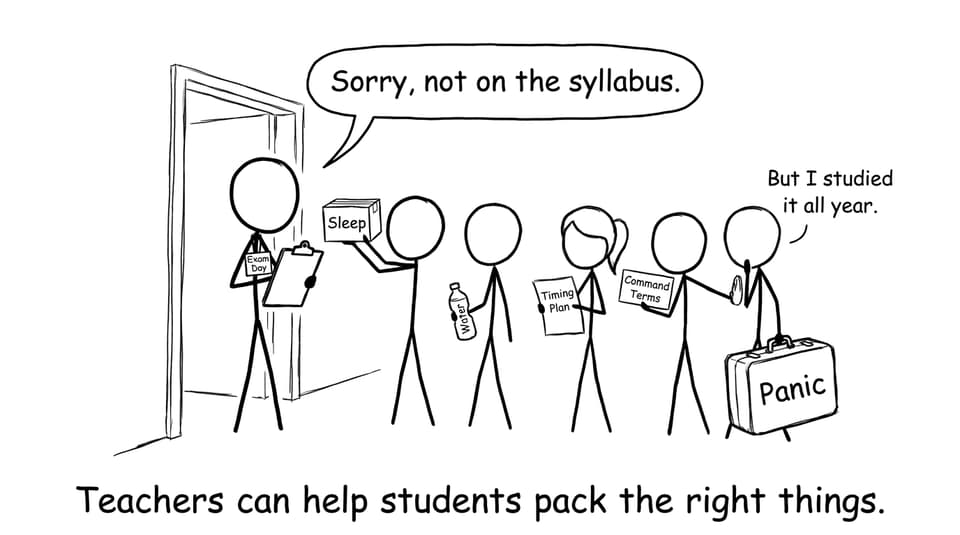
Teachers help students walk in with a simple pacing strategy, not vague hope. Even a basic plan, “skim, pick confident questions first, leave a marker, return with time,” reduces panic.
During: simulate real conditions
Consistency matters. Same timing, same permitted materials, same quiet. The goal is to make exam conditions boring.
After: debrief what went well first
A good debrief starts with strengths: where you were efficient, where your structure earned marks, where your method was solid. Then it narrows to one or two fixable patterns.
RevisionDojo makes this easier because students can practice realistic rehearsal with IB Predicted Papers and then follow up with targeted practice sets. If you’re choosing how to rehearse, IB Predicted vs Specimen Papers: What They Mean clarifies the purpose of each.
For students who want mock practice to feel less lonely (and more structured), Collaborative IB Mock Exams: Study with Friends Online is a useful model.
Teach self-regulation like it’s part of the syllabus
The best IB teachers don’t treat nerves as a character flaw. They treat it as a skill gap.
That means practicing regulation in normal lessons, so it’s automatic under stress:
-
30 seconds of breathing before timed work
-
A routine for “blank mind moments” (read the question, underline command term, write one sentence plan)
-
A short script for self-talk that’s realistic: “This is hard, and I’ve handled hard before.”
If your teacher hasn’t taught this explicitly, you can still borrow it. Ask for a pre-exam routine. Most teachers will gladly help, because calm students show their knowledge more accurately.
When you need instant clarification without waiting for the next lesson, RevisionDojo’s Jojo AI can act like a 24/7 support channel to reduce the “I’m stuck and spiraling” moments.
Make confidence social: peer explanation and shared patterns
IB revision gets darker when it becomes private. You start thinking you’re the only one confused, the only one behind, the only one who can’t finish on time.
Teachers can fix that by building structured peer routines:
-
Short “teach-back” moments where students explain a concept in 60 seconds
-
Peer marking with a checklist focused on one skill (command terms, structure, evidence)
-
Group debriefs that share mistake patterns (not scores)
Explaining is a form of proof. When you can teach it, your brain updates: “I know this.” That update is confidence.
For memory-heavy gaps, teachers often push daily recall. Tools like IB Flashcards with Spaced Repetition (SRS) help turn “I understood it once” into “I can recall it under time.”
Give feedback that creates a next step (fast)
Vague feedback feels kind, but it doesn’t build confidence. “Good effort” and “needs more analysis” don’t tell you what to do tomorrow.
Confidence-building IB feedback has three parts:
-
What earned marks (specific)
-
What lost marks (specific)
-
The smallest next action to fix it (doable)
That final part matters most. A next step you can complete in one session creates momentum. Momentum becomes belief.
RevisionDojo’s ecosystem supports this by connecting learning and fixing: use Study Notes for the missing concept, Questionbank for targeted drills, Grading tools to understand how marks are awarded, and then a timed retest using Mock Exams or Predicted Papers.
If your school is coordinating revision across classes, RevisionDojo for Schools is designed to centralize that progress tracking so improvement is visible rather than whispered.
FAQ
What can my IB teachers do if I’m prepared but still feel anxious?
They can help you separate preparation from performance anxiety by giving you controlled exposure to exam conditions. That means more short, timed sets early, not one giant high-stakes mock at the end. They can also teach a pre-question routine: read, underline the command term, write a one-sentence plan, then start. Over time, that routine becomes a safety rail your brain trusts. They should also debrief anxiety as a pattern, not a flaw: “Where did you freeze, and what decision will you use next time?” Finally, they can help you collect evidence with visible tracking so you don’t rely on feelings alone. In IB, feelings are noisy; data is calming.
How do mock exams improve IB confidence without destroying it?
Mock exams work when they are treated as rehearsals, not judgements. Your teacher can set one or two goals for the sitting (timing plan, command terms, structure) so you’re not trying to fix everything at once. After the mock, the debrief should begin with what went well, because confidence grows from strengths you can repeat. Then you pick a small number of patterns to repair and retest within 48 hours, while the memory is fresh. That quick retest is the confidence moment: it proves mistakes are fixable. Tools like RevisionDojo’s Mock Exams and Grading tools make that loop faster, which matters when IB deadlines are tight.
What should teachers say (or not say) to build IB student confidence?
They should avoid turning scores into identity: “You’re a 5 student” is confidence poison. Instead, they can name behaviors that produce marks: “Your evaluation linked back to the question,” or “You showed working clearly, so method marks were secure.” They should also normalize struggle as part of the course: IB is designed to be challenging, so difficulty is not evidence you’re failing. When giving criticism, they should attach it to a next step you can do tomorrow, not a vague future ideal. And they should model calm language themselves; students borrow teacher tone under pressure. The goal is not hype. The goal is steady, practical belief built from repeatable actions.
Closing: confidence is built, then it carries you
A few weeks before exams, most IB students don’t need more motivational quotes. They need a system that turns effort into proof.
Great IB teachers build that system: mistakes become data, feedback becomes next steps, timed practice becomes familiar, and progress becomes visible. That’s how you walk into an IB exam with calm confidence, not because you “feel ready,” but because you’ve rehearsed readiness.
If you want your revision to feel structured instead of scattered, use RevisionDojo as your evidence engine: Study Notes, Flashcards, Questionbank, AI Chat (Jojo), Grading tools, Predicted Papers, Mock Exams, plus the Coursework Library and Tutors when you need extra support. Build the loop, repeat it, and let the repetition do what pep talks can’t.