


You notice it first in small moments.
A lecturer assigns a reading and says, “Bring an argument.” A seminar leader asks you to defend a claim you’re not fully sure you believe. A group project forces you to negotiate meaning with people who think in totally different ways.
This is where IB Digital Society quietly pays you back.
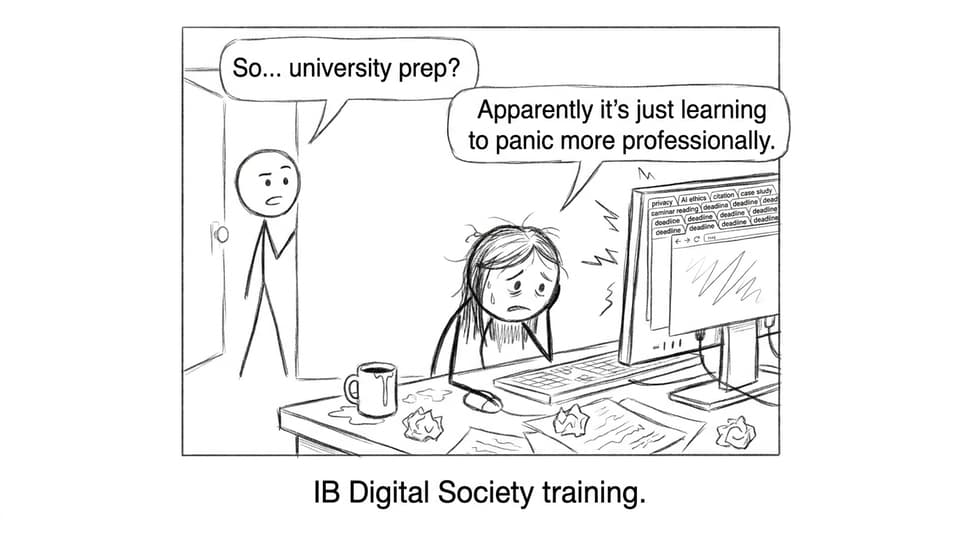
Because IB Digital Society isn’t only “a subject.” It’s training for the way university actually works: uncertain questions, messy evidence, and the constant pressure to turn ideas into clear writing.
Quick checklist: What IB Digital Society gives you for university
If you want a fast way to audit your readiness, IB Digital Society strengthens five university-level habits:
-
Building arguments from evidence, not vibes
-
Reading sources skeptically (credibility, bias, context)
-
Writing structured essays with clear evaluation
-
Speaking in seminars with balance and precision
-
Using digital tools thoughtfully (not passively)
To keep your content and case studies organized while revising, start with the IB Digital Society Resources hub on RevisionDojo.
Research and writing: the skill university assumes you already have
University rewards independence. Not independence as a personality trait, but independence as a workflow: find sources, decide which ones matter, and build a line of reasoning that can survive criticism.
That’s exactly what IB Digital Society pushes you toward.
You practice moving beyond description (“this technology exists”) into analysis (“who benefits, who loses, and why?”). You get used to grounding claims in examples and linking them to concepts like power, change, and ethics. And you learn that good writing isn’t about sounding complicated. It’s about being unmistakably clear.
If you’re working on coursework skills alongside exam prep, the RevisionDojo guide on IB Coursework Strengths Analysis helps you identify what’s already working so you don’t rewrite yourself into weaker work.
For day-to-day revision, the easiest university-prep move is simple: revise one idea, then write one paragraph about it. RevisionDojo’s Study Notes and Flashcards make that loop fast and repeatable.
Critical thinking that works in seminars (and in exams)
A common shock in first-year university is realizing that “having an opinion” isn’t the same as having an argument. You need assumptions, counterarguments, limitations, and a justified conclusion.
IB Digital Society makes that mental structure familiar.
In class discussions you learn to test claims: What evidence supports this? What’s the trade-off? What would change my mind? That habit maps perfectly onto high-mark exam writing, where the examiner is essentially asking for disciplined thinking under time pressure.
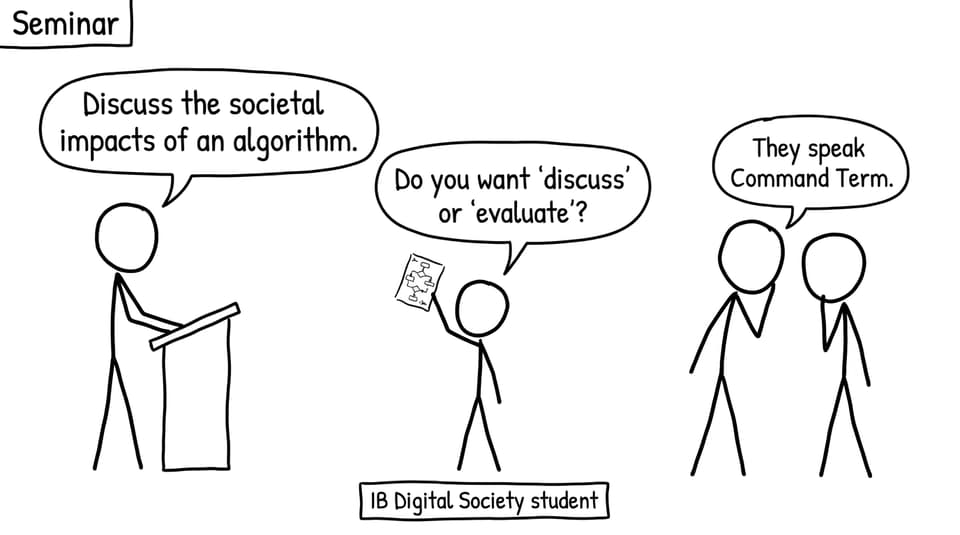
One of the quickest ways to upgrade both seminar answers and exam responses is to master command terms. Keep this bookmarked: How to Use Command Terms Effectively in IB Exams. The wording changes across questions, but the thinking pattern repeats.
Global awareness and interdisciplinary thinking that professors love
University courses often assume you can move between disciplines without panicking: politics leaks into tech, ethics leaks into business, culture leaks into data.
That’s the natural habitat of IB Digital Society.
When you study how digital systems affect communities, you’re forced to think in layers. A single case can touch economics (incentives), psychology (behavior), politics (regulation), and philosophy (rights). Over time, you stop treating subjects like separate boxes. You start treating them like different lenses.
This kind of readiness overlaps strongly with what universities look for in other essay-based disciplines too. For comparison, see What Universities Look For in IB History HL Students and notice how often “argument + evidence + evaluation” shows up.
To deepen your conceptual toolkit for exams, use RevisionDojo’s topic pages like IB Digital Society Topic 3: Content and IB Digital Society Topic 4: Contexts to keep examples connected to the syllabus.
Digital literacy for modern academic work (beyond just “being online”)
University is built on systems: databases, learning portals, citation managers, shared documents, feedback tools, AI policies, and more. Being “good with technology” isn’t the point. Being intentional with technology is.
IB Digital Society teaches you to treat tools as choices with consequences.
That matters when you’re running literature searches, evaluating sources, and presenting findings clearly. It also matters when your workload spikes and you need a system for practice, feedback, and improvement.
RevisionDojo is designed for that reality: Questionbank practice with AI feedback, Study Notes for fast concept review, Flashcards for active recall, AI Chat for clarifying arguments, Grading tools for essay structure, Predicted Papers and Mock Exams for timed stamina, plus a Coursework Library and Tutors when you need high-leverage support.
For a helpful overview of why digital-first studying works (especially when time is tight), read Digital IB Study Notes: Access Anywhere, Anytime.
Communication and group-work: the hidden university curriculum
A lot of university marks come from communication: presentations, seminar contributions, group projects, and written clarity.
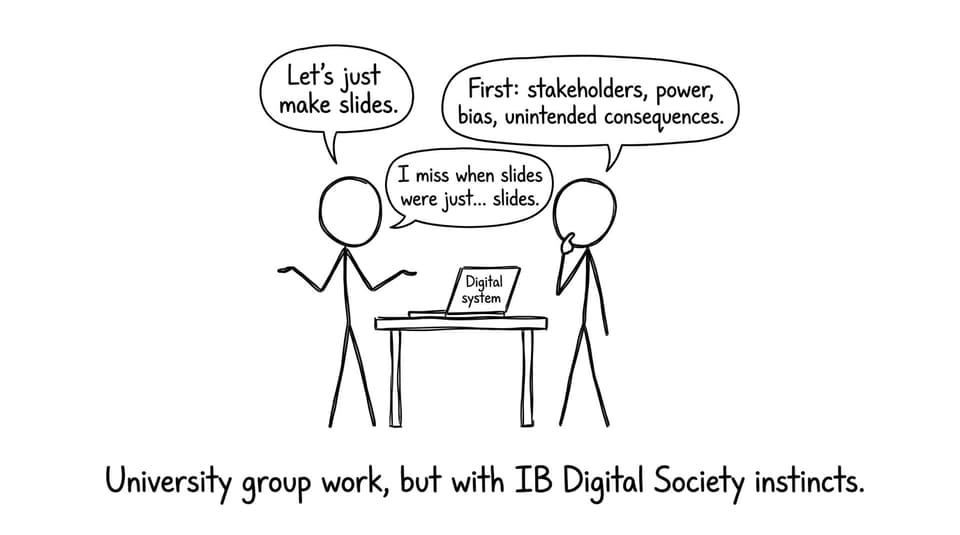
In IB Digital Society, you practice communicating complex ideas in a way that is both human and precise. You learn to define your terms, set scope, and make judgments that are justified rather than dramatic.
That’s also why the course can feel “hard” to some students: it doesn’t reward memorization as much as disciplined thinking. If that resonates, this is worth reading during revision season: Is IB Digital Society Hard? Honest Expectations Explained.
Conclusion: Let IB Digital Society be your advantage
The best part about IB Digital Society is that it trains you for the world you’re about to enter: arguments over certainty, evidence over noise, and clear communication over clever-sounding confusion.
If you’re revising now, treat university preparation as something you can practice today. Use IB Digital Society concepts to write one strong paragraph a day, drill command terms, and practice timed responses until structure feels automatic.
And if you want one place to run that whole system, RevisionDojo brings it together: Questionbank, Study Notes, Flashcards, AI Chat, Grading tools, Predicted Papers, Mock Exams, Coursework Library, and Tutors--built to help IB Digital Society students turn effort into marks and marks into momentum.
