

A quick story about a “best-seller” that quietly loses money
In IB Business Management, you learn that the most dangerous products are not the ones that fail loudly. It’s the “popular” ones that fail silently. Imagine a café’s new iced drink goes viral at school. The line is long, the Instagram posts are constant, and the manager feels like a genius.
Then they check the numbers and realize something unsettling: every cup sold barely pays for the ingredients and packaging. The hype is real, but the cash isn’t.
That’s exactly why businesses use contribution to decide whether a product is worth selling. Contribution tells you what each unit actually adds toward paying fixed costs (rent, salaries, insurance) and, eventually, profit.
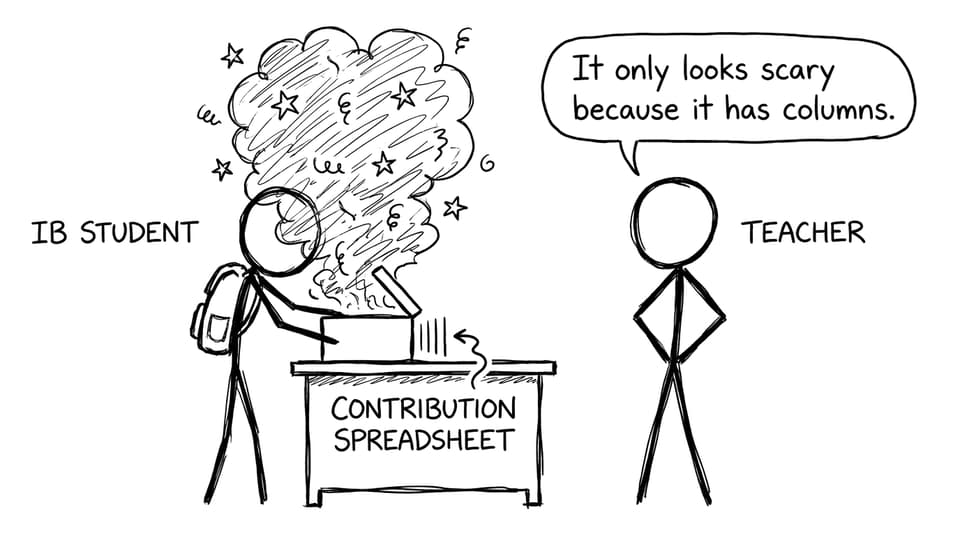
Contribution checklist (the exam-friendly version)
If you’re revising IB Business Management, here’s the fast checklist businesses use:
-
Contribution per unit = selling price per unit minus variable cost per unit
-
If contribution per unit is positive, selling more units helps cover fixed costs
-
If contribution per unit is negative, every sale increases the loss
-
Higher contribution often means a lower break-even point
-
Contribution supports decisions on pricing, special orders, and dropping products
For the syllabus definitions and formulas, keep the IB Business Management Key Definitions nearby.
How businesses use contribution to decide if a product is worth selling
Contribution per unit: the “is this even helping?” test
In IB Business Management, contribution per unit is the first reality check. It isolates what’s controllable in the short run: the selling price and variable costs (materials, direct labor, packaging).
If a product sells for $10 and variable costs are $7, the contribution per unit is $3. That $3 doesn’t mean profit. It means $3 is available to cover fixed costs. Only after fixed costs are fully covered does profit begin.
If you want a deeper explanation with examples, use What Is Contribution, and Why Is It Essential for Understanding Profit.
Comparing products: popularity vs contribution margin
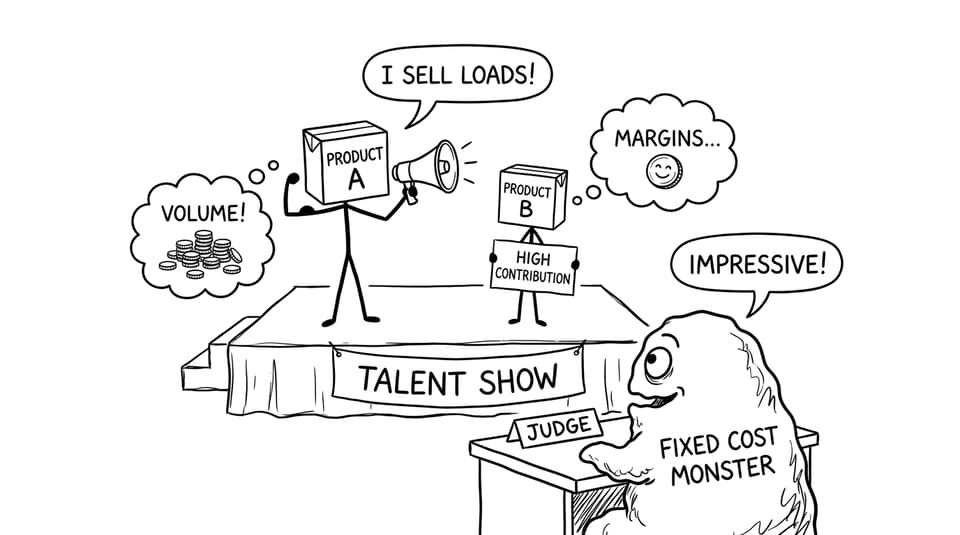
Sometimes the product with the most sales is not the product that helps the business most. A high-volume item can have thin margins, while a lower-volume item can have strong contribution.
Businesses use contribution to compare products, especially when resources are limited (machine time, shelf space, staff hours). In exam terms, this is a classic “recommendation with justification” moment: allocate scarce resources to the option that strengthens the business’s ability to cover fixed costs.
To practice how this shows up in calculations and prompts, go to 5.5 Break-even analysis and try the Break-even analysis Questionbank.
Keep it or drop it: contribution and product continuation
A product can be emotionally hard to remove. It may have loyal customers, a strong brand story, or “strategic” value. But in IB Business Management, if contribution stays weak and the product consumes resources, the opportunity cost becomes the real problem.
Contribution helps managers ask: if we stop producing this, what could we produce instead? Dropping a low-contribution product can free capacity for a higher-contribution line.
For the HL-specific treatment, see Contribution (HL only) Notes and reinforce the terms with Contribution (HL only) Flashcards.
Special orders: “lower price” doesn’t automatically mean “bad deal”
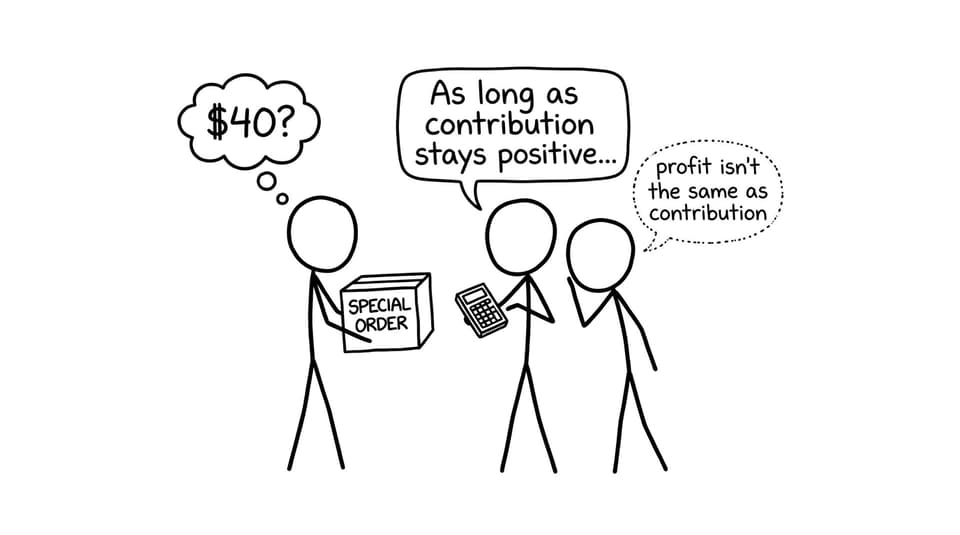
Businesses sometimes accept a one-off order at a discounted price. Contribution makes the logic simple: if the special order still creates a positive contribution and the business has spare capacity, it can help pay fixed costs.
This is where students confuse profit with contribution. The special order might reduce profit margins, but it can still increase total contribution in the short run.
Quick exam tip: link contribution to break-even
In IB Business Management, examiners love when you connect tools. Contribution feeds straight into break-even:
- Break-even quantity = fixed costs / contribution per unit
If contribution per unit rises, break-even falls (less risk). If variable costs rise or price falls, contribution shrinks (more risk). Use 5.5.2 Aspects of a Break-Even Chart Notes and 5.5.3 Effects of Changes in Price or Cost on Break-Even Notes to revise the language you’ll need.
Closing: make contribution your default lens
Contribution is the calm, practical lens businesses use before they get distracted by buzz, volume, or headlines. In IB Business Management, it helps you decide if a product is truly worth selling, compare options, justify discontinuation, and evaluate special orders with confidence.
If you want to turn this into marks, use RevisionDojo’s Study Notes, Flashcards, and Questionbank to drill calculations and explanations, then build stamina with Mock Exams, Predicted Papers, and Grading tools. When you get stuck, AI Chat can walk you through the logic step by step, and the Tutors and Coursework Library help you stay sharp across the whole course. Start here: IB Business Management Resources.