

The uncomfortable truth about your IA
The moment you submit an IA, there's a small emotional switch that flips: Finally, it's out of my hands.
Then someone mentions "IB moderation," and your mind does the opposite. It grabs the work back, replays every sentence, and asks the question you actually came here to ask:
How accurate is IB moderation?
Not "how does it work" in a diagram sense. Not "what is moderation" in a glossary sense. But: Will moderation understand what my teacher understood? Will it be fair? Will my IA mark survive contact with the outside world?
The most honest answer is this: IB moderation is usually accurate at the cohort level, but it can feel unpredictable at the individual level. And that gap between "system accuracy" and "personal certainty" is where student anxiety lives.
This guide makes that gap smaller. We'll walk through what moderation is checking, why marks move, what "accuracy" actually means here, and how to make your IA resilient.
Quick checklist: what you should know about IA moderation
Before the details, here's a simple checklist you can hold in your head:
- Your IA is marked by your teacher first, using IB criteria.
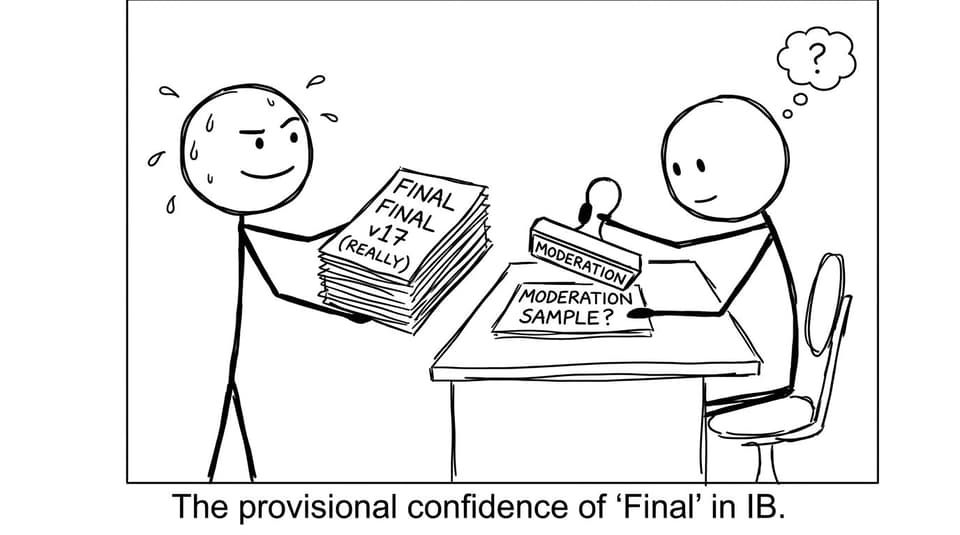
- The IB then moderates a sample from your class to judge your teacher's marking accuracy.
- If the teacher's marking is consistently high or low versus IB standards, marks can be shifted for the cohort.
- Moderation is designed for fairness across schools, not for "re-marking everyone."
- You can't control the moderation process, but you can control whether your IA is easy to justify against the rubric.
If you want the mechanics in a clean step-by-step, read: How IB Internal Assessment (IA) Moderation Works: A Clear Guide.
What "accurate" means in IB moderation (and what it doesn't)
When students say "accurate," they usually mean: Will I personally get the mark I deserve?
When the IB says "accurate," they mean something more statistical: Are schools applying standards consistently worldwide?
That difference matters.
Moderation is built to catch systematic bias:
- A teacher who is consistently generous (everyone is marked a bit too high).
- A teacher who is consistently harsh (everyone is marked a bit too low).
- A department interpreting criteria differently than global standards.
So yes, moderation is "accurate" at detecting patterns in marking alignment. It is less about the fine-grained story of one IA and more about whether the teacher's whole marking scale matches IB expectations.
If you're wondering who actually marks your IA, and why it's not final until later, this helps: Who grades the IAs?.
How IB moderation actually checks your IA
Here's the mental model that reduces confusion:
Teachers mark first (and their marks are provisional)
Your teacher assesses your IA using the published criteria and markbands. Ideally, they annotate and justify marks. In strong departments, teachers also standardize internally so two teachers don't mark two similar IAs differently.
The IB moderates a sample, not the whole class
The IB requests a sample that represents the cohort range. Moderators compare the teacher's awarded marks to what the IB standard suggests.
The IB decides whether your teacher is "in line"
If the sample shows the teacher is aligned, your IA mark is likely to stay stable.
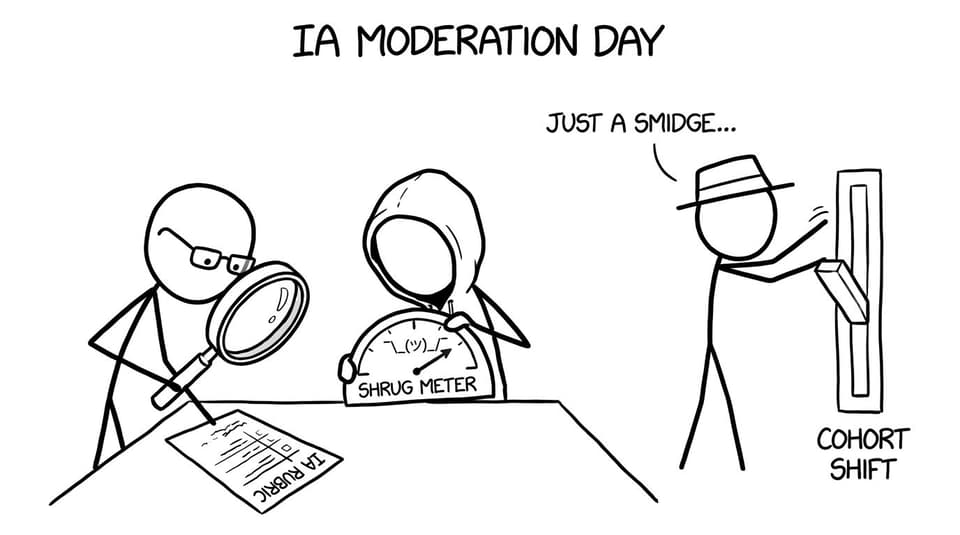
If it shows consistent over- or under-marking, the IB can apply an adjustment.
This is why moderation can feel oddly impersonal: it is trying to correct calibration, not interrogate every nuance of your argument.
Why your IA mark can change during moderation
Students sometimes assume a mark change means someone "disagreed" with their work. Sometimes that's true. Often it's not.
Here are the most common reasons moderation shifts IA marks:
Your teacher's marking is slightly off-standard
This is the core purpose of moderation. Even good teachers drift over time, especially when they see the same cohort every day and naturally develop expectations around them.
The rubric was applied generously to presentation instead of evidence
A polished IA can look convincing. But moderation rewards criterion evidence, not vibes. If an IA reads smoothly but lacks justified analysis, or if methodology claims aren't supported by data handling, marks can drop.
The teacher's comments don't justify the marks
Moderators look for a defensible match between what's on the page and the awarded levels. If the work is strong but the reasoning for marks is unclear, that can create risk.
Internal standardization didn't happen (or wasn't tight)
When multiple teachers mark the same component, differences in interpretation can create inconsistency. That inconsistency is exactly what moderation is built to detect.
Is moderation fair to individual students?
Fairness is the hardest part to talk about because it depends on what you mean.
At a global level, moderation is one of the IB's best tools for fairness. It prevents a school with overly generous marking from inflating grades, and it protects students in stricter schools from being penalized for conservative marking.
But at an individual level, moderation can feel blunt. If the IB applies a cohort shift because the sample shows misalignment, an individual student's IA might move even if their specific work would have matched IB standards perfectly. That's not "unfair" within the system's design, but it can feel unfair emotionally.
The way to respond is not panic. It's precision: make your IA so clearly aligned to the criteria that it survives different readers.
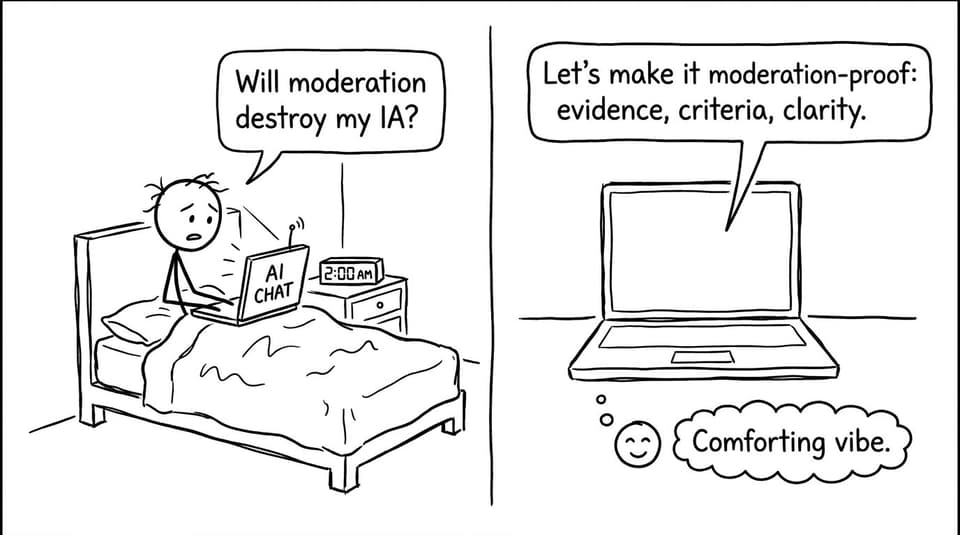
How to make your IA "moderation-proof" (practically)
You can't control who moderates. You can control how easy it is to award you marks.
Write like the moderator is tired (because they are)
This isn't cynical. It's compassionate and effective.
A moderator reads fast. They look for:
- Clear structure that maps to criteria
- Explicit justification of choices
- Evidence that matches claims
- Evaluation that acknowledges limitations
The best IA is not the one that sounds smartest. It's the one that makes marking feel obvious.
Build a "criterion evidence trail"
For each criterion, ask: What sentence, table, graph, or paragraph proves I deserve this level?
If you can't point to it, it's probably missing.
Avoid rubric cosplay
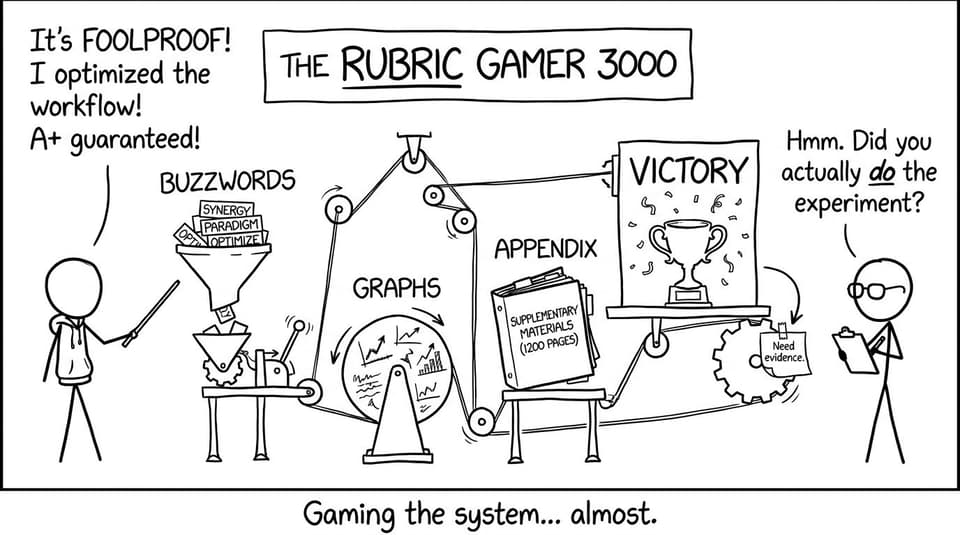
It's tempting to sprinkle keywords, add extra graphs, and attach an appendix that looks like a small textbook. Moderation doesn't reward decoration.
It rewards relevance.
Use exemplars to calibrate your instincts
Most students don't struggle because they're lazy. They struggle because they don't have a reliable picture of what "good" looks like.
RevisionDojo's Coursework Library helps you see what high-scoring work actually does on the page:
Use exemplars like you'd use a map. Not to copy, but to notice patterns: clarity, justification, and criteria alignment.
Get rubric-aligned feedback early, not emotionally late
The biggest moderation risk is waiting until the end to discover you interpreted a criterion differently.
RevisionDojo's grading tools are built for earlier feedback loops:
- Upload a draft to the IB IA/EE/TOK Grader to see criterion-level strengths and gaps.
- Use RevisionDojo App: The Smarter Way to Prep for IB Exams to connect coursework feedback with your study routine, so your IA doesn't hijack exam prep.
And when you get stuck on "what does the criterion actually want," use AI Chat inside RevisionDojo to interrogate your own writing without waiting for office hours.
How moderation affects your final grade (and why it matters during exams)
Even if you're in exam season mode, the IA still matters because it's a meaningful percentage of your final grade in many subjects.
If you want the weightings and why they change your strategy, read: The Impact of Internal Assessments (IA) on Your Final IB Grade.
The practical point is this: don't treat the IA as a side quest you can rush through. But also don't treat it like it's the only thing that matters.
The calm strategy is a loop:
- Stabilize your IA with rubric-aligned feedback
- Then protect exam marks with active recall and timed practice
RevisionDojo is designed for that balance: Study Notes for clarity, Flashcards for daily recall, Questionbank for exam-shaped practice, Mock Exams and Predicted Papers for pressure training, and Tutors when you need a human to raise your level.
If you want a simple structure for timed practice, see: How to Run Timed IB Mock Exams in RevisionDojo (Exam Mode + Test Builder).
The bottom line: how accurate is IB moderation?
IB moderation is accurate at what it's trying to do: keep standards consistent across schools by checking whether teacher marking matches the global rubric.
What makes it feel scary is that it's not primarily designed to deliver perfect individualized justice for every single IA. It's designed to prevent systematic unfairness.
So the best strategy isn't to guess what moderation will do. It's to write an IA that's easy to mark: clear structure, explicit evidence, and criteria alignment that doesn't require the reader to be charitable.
If you want one place to make that happen without burning out before exams, use RevisionDojo as your control panel: the Coursework Library to calibrate, Grading tools to tighten the IA, AI Chat to unblock confusion fast, then Study Notes, Flashcards, and the Questionbank to finish the year strong with timed Mock Exams and Predicted Papers.
Your IA shouldn't feel like a coin flip. With the right feedback loop, it becomes something calmer: a document you can justify.