
The first term IB Philosophy experience usually begins with an unsettling discovery: having an interesting opinion is not the same as making a philosophical argument. You may study identity, consciousness, personhood, human nature, or freedom. The deeper task, however, is learning to define concepts, reconstruct reasoning, raise serious objections, and reach justified conclusions.
Your exact sequence depends on your school. Some classes begin with the compulsory core theme, Being human. Others introduce an optional theme or the prescribed philosophical text alongside it. Either way, expect a gradual movement from open discussion into disciplined reading and structured essay writing.
By the end of the term, you may not have many final answers. You should be much better at recognizing what a defensible answer requires.
Your first-term overview
A realistic first term will usually involve:
- distinguishing claims, reasons, assumptions, objections, and conclusions
- beginning the compulsory Being human theme
- reading short philosophical extracts slowly and critically
- keeping precise notes on concepts and thinkers
- writing analytical paragraphs and essay plans
- receiving feedback on clarity, evaluation, and structure
- possibly beginning an optional theme or prescribed text
- learning how the course is assessed
The current IB Philosophy course includes Being human, school-selected optional themes, one prescribed philosophical text, and an internal assessment based on a non-philosophical stimulus. HL students also study a second optional theme and the extension topic Philosophy and contemporary issues. The complete RevisionDojo IB Philosophy guide explains how these elements fit together.
Weeks 1-3: Learning what philosophy asks
The opening weeks can feel deceptively relaxed. Your teacher might ask whether you remain the same person throughout your life, whether machines could be conscious, or whether people are genuinely free. The room fills with opinions, making philosophy appear immediately accessible.
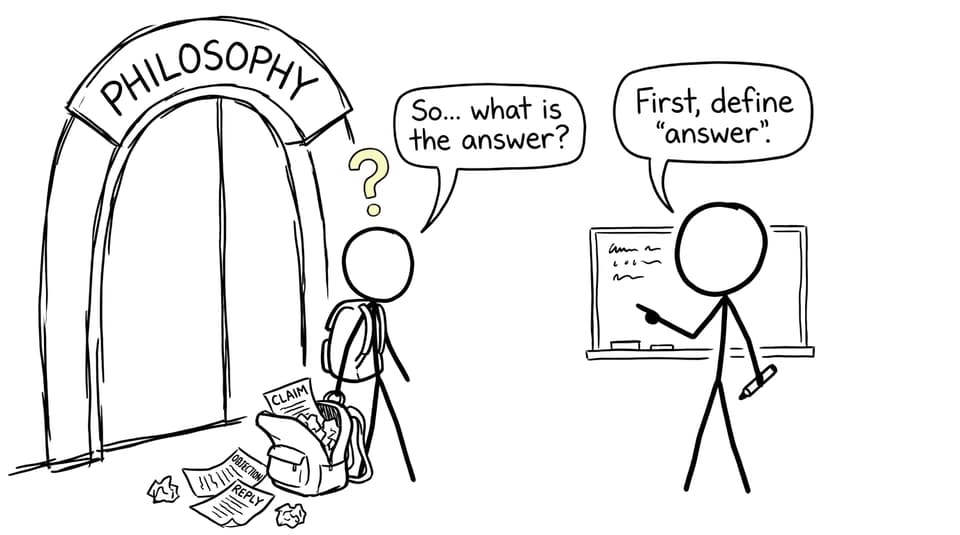
That impression is partly right. You do not need years of background knowledge to enter a philosophical question. But participation soon becomes more demanding. A statement such as “everyone should be free” creates further questions. What counts as freedom? Does it require alternative possibilities? Can social pressure restrict freedom without physical coercion? What supports the original claim?
You begin with broad questions, then slow down to inspect individual words and logical steps. New students are often surprised that a short paragraph can occupy an entire lesson.
Use the IB Philosophy glossary and key definitions to record terms in your own language. A useful definition should help you distinguish positions and apply a concept to an unfamiliar example.
Weeks 4-7: Being human gains depth
Most students spend a significant part of the course on Being human. The official subject brief recommends 45 teaching hours for this compulsory theme, so your class may remain within it beyond the first term. Schools control their teaching order, making any weekly calendar a model rather than a universal schedule.
Early units often ask what makes someone the same person over time, whether the mind is separate from the body, which beings qualify as persons, and whether choices are free or determined. These initially seem like separate topics. Gradually, their connections become visible. A theory of personal identity may depend on consciousness, while a position on determinism may change what moral responsibility means.
The course now becomes denser. You are building a network of positions, objections, and implications rather than collecting isolated facts. IB Philosophy Study Notes can clarify that network, while Paper 1 Philosophy Flashcards support active recall of distinctions that are easy to recognize but harder to explain independently.
Weeks 8-10: Writing becomes the real work
Many students expect reading to be the hardest part. The greater surprise is often writing.
A philosophy essay is not a tour of everything you know. It needs a line of reasoning. You must answer the precise question, explain relevant positions accurately, test them against objections, and reach a judgement. Reporting what two philosophers believed may demonstrate knowledge, but it does not automatically provide evaluation.
Your first assignment may therefore feel disappointing. Your argument seemed clear while you were writing, yet your teacher identifies an undefined term. Perhaps you introduce an objection without deciding whether it succeeds. This is the normal gap between thinking something and making that thinking visible to another reader.
A strong first-term paragraph should state a relevant claim, explain its reasoning, use a precise example, introduce a credible objection, evaluate whether the claim survives, and connect the judgement to the question. The RevisionDojo guide to IB Philosophy revision techniques explains how short plans and comparison exercises build these skills without requiring a full essay every evening.
What the weekly workload feels like
Philosophy does not always produce a towering pile of visible homework. Its workload is quieter. A typical week may include a short reading, vocabulary review, consolidated class notes, and one paragraph or essay plan. Larger essays require more time because planning and revision matter as much as drafting.
A sustainable routine might include 2-3 focused sessions each week, adjusted around your teacher’s assignments:
- 20-30 minutes: revisit the week’s concepts and explain them without notes
- 30-40 minutes: reconstruct one argument by identifying its conclusion, reasons, and assumptions
- 30-45 minutes: plan or write one response, then improve it using feedback
HL can feel faster because the complete course includes an additional optional theme and the extension. This does not mean every early lesson moves rapidly. It means there is less room to leave confusion unresolved.
RevisionDojo’s IB Philosophy resource hub lets you move between Study Notes, Flashcards, and targeted Questionbank practice. AI Chat can help unpack a difficult argument, but you should then restate it independently. Philosophy rewards intellectual ownership, not borrowed fluency.
What surprises new students most
Fewer facts can require greater precision
Philosophy may seem lighter than a content-heavy subject because there are fewer formulas or case studies to memorize. Yet each concept carries considerable weight. Confusing determinism with fatalism, for example, can distort an entire argument.
Disagreement is not evaluation
Writing that another philosopher disagrees does not establish that the first position is weak. You must explain why the objection matters, whether its assumptions are defensible, and how the original view might respond.
Open-book does not mean effortless
The prescribed-text assessment is open-book under the current course and uses a non-annotated copy of the selected text. This reduces the value of memorizing pages, not the need for preparation. You must understand the work well enough to locate relevant passages and use them in a focused argument. Paper 2 Philosophy notes can help organize themes without replacing careful reading.
Discussion and assessed writing differ
A lively speaker may struggle to structure essays, while a quieter student may produce careful written analysis. Both can improve because philosophical performance depends on learnable habits rather than personality.
Finishing the term strongly
Do not measure progress by the number of thinkers you can name. Ask whether you can explain one argument accurately, identify its pressure point, and defend a considered response.
Keep an argument bank with five fields: question, position, reason, objection, and judgement. Use active recall instead of repeated highlighting. When you receive feedback, rewrite one paragraph rather than merely reading the comments. If the same weakness persists, a RevisionDojo Tutor can help diagnose it before it becomes a habit.
The first term is a foundation, not a performance peak. Later, RevisionDojo’s Grading tools and Coursework Library can clarify assessment standards, while the Questionbank, Predicted Papers, and Mock Exams build exam stamina. For now, follow a smaller cycle: learn, question, write, receive feedback, and try again.
That is what your first term actually looks like. The questions become harder, but your thinking becomes less vague. That is the first real sign that philosophy is working.