
The first term IB Language Acquisition experience usually moves from foundations into increasingly independent communication. You will learn thematic vocabulary and grammar, but you will also begin listening to authentic speech, reading unfamiliar texts, writing for specific audiences, and speaking before you feel completely ready.
That last part matters. The course is not simply a longer vocabulary test. It asks whether you can make meaning when your language is still imperfect.
Your sequence will depend on your school, teacher, language, and term length. Language ab initio is designed for beginners and is available at SL, while Language B is intended for students with previous experience and can be taken at SL or HL. Both tend to move from controlled practice toward more independent communication.
Your first-term overview
By the end of the term, expect to have encountered most of these:
- One or two thematic units connected to identity, relationships, experiences, education, culture, or daily life
- Regular vocabulary and grammar review
- Short reading and listening comprehension activities
- Written responses for a defined purpose and audience
- Pair discussions, recorded answers, or brief presentations
- Introduction to text types, register, and cultural context
- Feedback based on communication as well as accuracy
- A unit assessment combining several language skills
You are not expected to sound fluent after one term. You are expected to become more willing and able to communicate with the language you have.
Weeks 1-3: The course finds your real starting point
The opening weeks can feel deceptively familiar. Language B students may revisit grammar studied before the Diploma Programme, while ab initio students often begin with pronunciation, essential verbs, basic sentence patterns, and survival vocabulary.
Revision also serves a diagnostic purpose. Your teacher is discovering what the class can recognize, retrieve, and use spontaneously. Knowing a conjugation on a worksheet is different from selecting it during a conversation.
Early work may cover personal profiles, routines, family, interests, school life, or cultural introductions. You may produce short texts, respond to simple audio, and speak in pairs. Vocabulary arrives quickly because each topic needs enough language for several skills.
Save complete phrases rather than isolated translations. RevisionDojo's IB Language B mastery guide explains how theme-based vocabulary and reusable language patterns make practice more transferable.
Weeks 4-7: Communication becomes the real task
This is often where IB Language Acquisition first-term expectations become clearer. The course begins asking more than, "Is this sentence grammatically correct?" You also need to consider:
- Who is communicating?
- What is the purpose?
- What tone or register fits?
- Which details matter to this audience?
- What cultural context shapes the message?
A diary entry, article, speech, and formal email should not sound identical. Students are often surprised that text type and audience matter so early. Language is treated as purposeful communication, not grammar floating without context.
Listening may also become uncomfortable. Recorded speech can contain unfamiliar accents, natural pacing, and unknown words. The goal is not to understand every syllable. It is to identify the main idea, follow signposts, and recover after missing something. The RevisionDojo guide to Language B listening practice offers a practical gist-first approach.
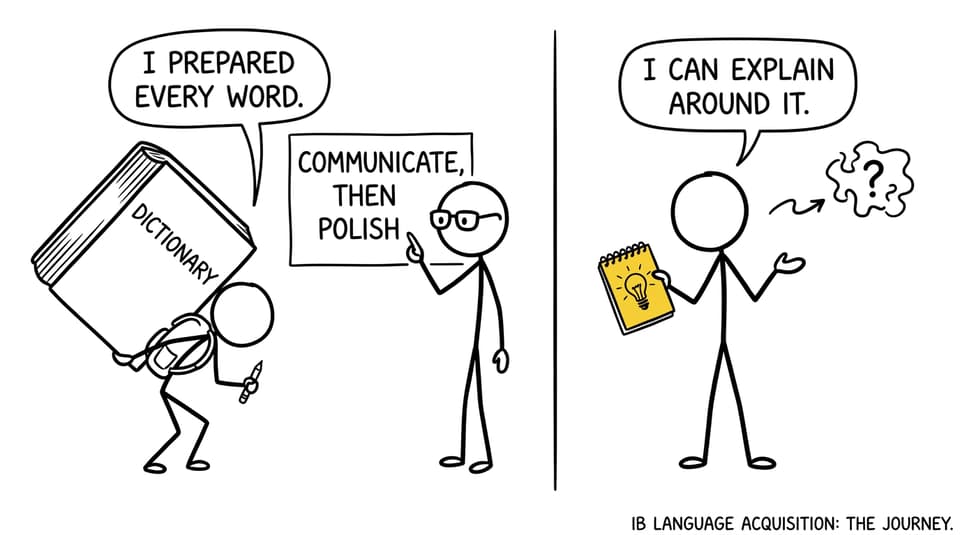
Speaking develops similarly. Your teacher may ask follow-up questions that cannot be answered from a memorized paragraph. What feels like being caught unprepared is training in interaction.
Weeks 8-12: Skills begin to overlap
By the later part of the term, lessons are less likely to isolate one skill. A unit might begin with an audio clip, move into an article, lead to discussion, and finish with purposeful writing.
Current IB Language Acquisition assessment covers productive, receptive, and interactive communication through writing, listening, reading, and an individual oral. Your first-term assessment probably will not reproduce every final component, but it may introduce the decisions those components require.
Language B students work through five prescribed themes: identities, experiences, human ingenuity, social organization, and sharing the planet. A first unit may sit within one theme while building language that returns elsewhere. The Language B syllabus breakdown provides a wider map.
HL students may notice greater expectations for complexity, sustained ideas, and literary engagement. Ab initio students face a different challenge because the foundations are newer. The ab initio confidence guide is useful if the opening weeks feel faster than expected.
What the workload actually feels like
Language Acquisition is rarely dominated by one enormous first-term assignment. Its workload is cumulative. Ten forgotten vocabulary sets can become a larger problem than one difficult evening of homework.
A realistic week may include classroom activities, vocabulary review, a reading or listening task, grammar practice, and occasional written or spoken preparation. A sensible independent baseline is 15-30 focused minutes on most days, adjusted around teacher-set work and your other IB subjects.
A balanced week could include:
- Two short phrase-retrieval sessions
- One focused listening activity
- One short reading with evidence marked
- One paragraph or text-type practice
- One recorded speaking response
- One review of recurring errors
This is not an official timetable. It prevents you from practising only the comfortable skill. The one-year IB Languages study plan can turn that rhythm into a longer routine.
What surprises new students most
Progress feels uneven
You may understand far more than you can produce. Weeks later, a phrase you struggled to remember may appear naturally in conversation. Recognition, recall, and spontaneous use develop at different speeds.
Mistakes are part of successful speaking
Waiting for a perfect sentence usually creates silence. Effective communication often means simplifying, rephrasing, giving an example, or correcting yourself without abandoning the idea. The guide to common Language B problems shows how to turn repeated mistakes into practice targets.
Vocabulary is only one part of control
A large word list cannot compensate for weak awareness of audience, purpose, structure, or register. Clear organization and a smaller bank of reliable phrases can carry a response surprisingly far.
Small practice beats emergency revision
Vocabulary, pronunciation, listening stamina, and speaking confidence resist cramming. They respond better to repeated retrieval and frequent contact.
How to make the term manageable
Use a simple loop: learn, retrieve, apply, receive feedback, and retry. RevisionDojo's IB resource hub brings that cycle together. Use Study Notes to clarify structures, Flashcards to retrieve phrases, and the Questionbank for targeted practice. AI Chat can generate level-appropriate follow-up questions, while Grading tools help identify patterns in written responses.
Keep an error log with three columns: the mistake, the reason, and a corrected example. Revisit the errors that repeat. This turns feedback from a judgement into a plan.
Do not rush into full simulations before you have basic control. Predicted Papers and Mock Exams become more valuable as your skills mature. The Coursework Library can help you notice organization and register where relevant examples are available, while Tutors provide human diagnosis when a persistent habit is difficult to see alone. For exam-aligned practice later in the course, use the RevisionDojo IB Questionbank.
The term is teaching you how to continue
The first term does not prove whether you are "good at languages." It reveals whether your learning system is sustainable.
If you finish with a growing phrase bank, a short error log, regular contact with the language, and greater willingness to speak imperfectly, you have built more than a strong test result. You have created momentum.
RevisionDojo is the ultimate IB resource for protecting that momentum. It connects explanation, retrieval, practice, feedback, simulation, examples, and expert support, so each mistake can become a useful next step.