
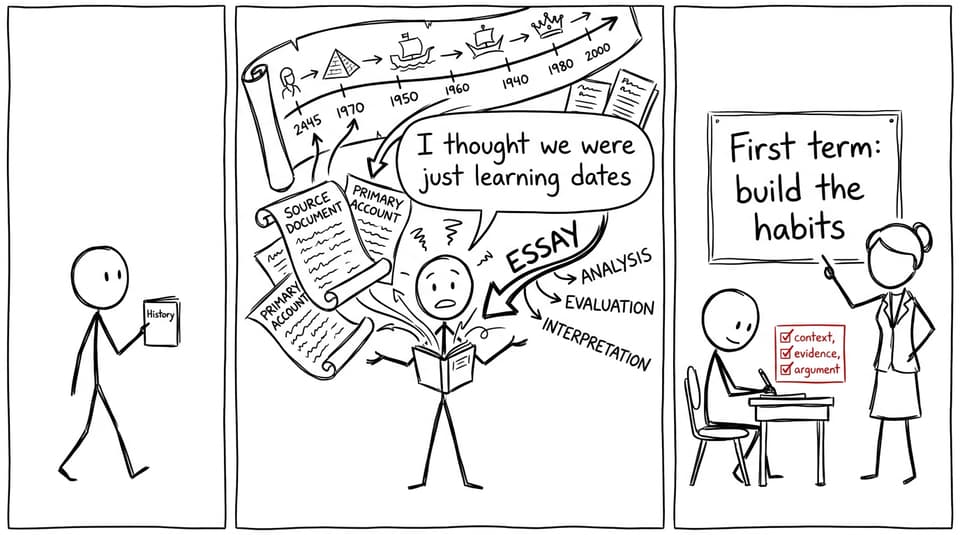
The first term IB History experience usually feels less like entering a harder history class and more like learning a new way to think. You will still study events, individuals, conflicts, and political decisions. But remembering what happened is only the starting point. From the opening weeks, you are expected to examine sources, compare perspectives, and turn evidence into a defensible judgment.
A realistic first term moves through three broad stages. First, you establish historical context and learn the course vocabulary. Next, source analysis and analytical writing become regular activities. By the end of the term, you may be planning or writing timed responses while beginning to understand the historical investigation.
The exact topic order depends on your school. What remains consistent is the shift from knowing history to using history.
Your first-term overview
| Approximate stage | What class may emphasize | What you should build |
|---|---|---|
| Opening weeks | Course structure, context, source types | Organized notes and a working timeline |
| Early middle | Perspectives, causation, source analysis | Short analytical responses and evaluations |
| Late middle | Essay questions, comparisons, command terms | Thesis statements, plans, and precise evidence |
| End of term | Timed work and cumulative assessment | A repeatable study and feedback routine |
This is a model, not an official calendar. Some teachers begin with source-based work, while others establish substantial content first. HL classes may introduce regional depth earlier because they have more material to cover.
The opening weeks feel familiar, then the pace changes
At first, lessons can look familiar. Your teacher introduces a historical setting, you discuss key developments, and you begin making notes. The difference appears when the class stops asking only, “What happened?” and starts asking, “Why does this explanation deserve more weight than another?”
That second question is the real course.
The revised DP History course, introduced for first teaching in August 2026 and first assessed in May 2028, includes focused study, thematic study and, for HL students, regional study. Both SL and HL students complete a historical investigation. Earlier cohorts follow the preceding course structure, so confirm your version with your teacher or DP coordinator. RevisionDojo’s guide to moving from MYP History into DP History explains the transition.
The IB recommends 150 teaching hours for SL and 240 for HL across the course. HL generally involves greater breadth and depth, plus another examination component. See the IB History SL and HL comparison for the practical distinctions.
Content arrives faster than most students expect
One important IB History first term expectation is that you learn context without waiting for every detail to be explained in class. A lesson may cover a political crisis, while your reading introduces the economic pressures, international setting, and groups whose perspectives complicate the story.
The mistake is trying to record everything. Chronological notes can feel productive while leaving you unable to answer an analytical question. Use four layers instead:
- Context: What conditions shaped the issue?
- Evidence: Which dates, policies, decisions, or outcomes matter?
- Interpretation: Why might historians or participants disagree?
- Argument: What conclusion could this evidence support?
After each subtopic, reduce your notes to three claims and the strongest evidence for each. If you cannot explain what a fact proves, it is not yet useful essay evidence. IB History Study Notes can help repair specific gaps without forcing you to restart a unit.
Source analysis becomes a weekly habit
A source is not automatically reliable because it was created at the time. A government speech may reveal political priorities while concealing private doubts. A diary can provide immediacy but represent one person’s experience. A later account may use broader evidence while reflecting the historian’s interpretative choices.
Your teacher may use OPVL, meaning origin, purpose, value, and limitation. The letters matter less than the reasoning. “This source is biased” is weak because it explains almost nothing. A useful evaluation identifies what the source can reveal, what it cannot establish, and why those boundaries matter.
Short drills are common because source work improves through repetition. You might annotate a cartoon, compare extracts, or write one focused evaluation paragraph. The IB History Paper 1 source analysis guide connects these exercises to formal assessment.
Your first essays may feel worse than your old ones
A student who previously earned strong marks through detailed narratives may receive feedback such as “too descriptive” or “needs judgment.” The knowledge is not necessarily the problem. The structure of the thinking is.
An IB History essay responds to a specific historical problem. Your thesis must make a judgment, each paragraph must advance it, and evidence must be selected for relevance. Teachers often isolate these skills during the first term, focusing separately on command terms, thesis statements, paragraph plans, comparison, and counterarguments.
Use this planning sequence:
- Identify the command term, topic, place, and period.
- Write a one-sentence answer that makes a judgment.
- Choose 2-3 arguments that support it.
- Attach precise evidence to each argument.
- Add a counterpoint or limitation.
- Return to the judgment within each paragraph.
The IB History essay-writing guide offers a practical structure for turning knowledge into analysis.
What the workload actually feels like
The IB History workload is usually an accumulation of smaller demands: reading, note consolidation, source practice, vocabulary, essay planning, and assessed writing. Trouble begins when unfinished tasks quietly merge into one weekend.
A manageable weekly routine could include:
- Spend 10-15 minutes after lessons cleaning up notes and identifying the central argument.
- Use one short session to retrieve key evidence without looking at notes.
- Complete one source question, thesis drill, or paragraph plan.
- Keep an error log for recurring problems such as vague evidence or excessive narration.
- Review the week’s material for 30-45 minutes before starting the next topic.
These times are suggestions, not IB requirements. The principle is regular compression. Several short reviews generally create more opportunities for retrieval and correction than one last-minute rescue session.
Begin in the IB History resource hub. Use Study Notes to clarify content, Flashcards to retrieve evidence, and the Questionbank to apply it. AI Chat can help test a thesis or explain an interpretation, while Grading tools identify whether a response is analytical. Later, Predicted Papers and Mock Exams support timed rehearsal. The Coursework Library and Tutors provide further models and focused guidance.
The historical investigation may appear early
Many schools do not require a complete investigation during the first term. Still, teachers may introduce research questions, citation habits, source selection, or historical inquiry. The investigation is compulsory at both SL and HL, and sound research habits take time to develop.
You do not need to choose a perfect topic immediately. Notice which questions interest you and record complete source details, including the author, title, publication information, relevant pages, and potential use. This small habit prevents a large citation problem later. The IB History IA guide explains the process without encouraging a premature question.
Finish the term with a system
A successful first term does not end with every date memorized or every essay mastered. It ends with a dependable process: learn the context, retrieve the evidence, answer a precise question, seek feedback, and revise the weakness that feedback exposes.
Confidence may lag behind improvement. Your work can become more precise before the subject feels comfortable. Historical thinking involves incomplete evidence and competing explanations, so feeling less certain can sometimes mean you are seeing the issue more clearly.
RevisionDojo connects knowledge with practice through its Questionbank, Study Notes, Flashcards, AI Chat, Grading tools, Predicted Papers, Mock Exams, Coursework Library, and Tutors. IB History becomes manageable when you stop trying to carry the whole course at once. Build one argument, evaluate one source, and correct one recurring mistake. By the end of the first term, those small actions begin to resemble historical judgment.