



The first term IB Film experience usually combines close analysis, practical experimentation, film history, technical mistakes, and more reflection than new students expect. You may imagine screenings and ambitious productions. You will probably get both, but the real work lies in explaining how films create meaning and how your creative decisions shape an audience's response.
The exact order varies by school, but most first terms follow a recognizable arc: learn the language, test production roles, connect films to context, then complete a small project that brings those strands together.
Your first-term overview
By the end of the term, you will probably have:
- learned vocabulary for cinematography, editing, sound, and mise-en-scène
- analysed short sequences shot by shot
- studied films beyond your usual genres, countries, or periods
- tried at least one production role
- planned, filmed, or edited a short exercise
- recorded creative decisions, problems, and revisions
- begun exploring the eventual assessment components
The course is built around reading film, contextualizing film, and exploring film production roles. HL students later add collaborative film production. RevisionDojo's complete IB Film syllabus guide explains how these strands connect to assessed work.
Weeks 1-3: Learning to see rather than watch
Opening lessons can feel deceptively comfortable. You watch an extract, discuss what happened, and identify a close-up or piece of music. Then the questions become more precise.
Why does the cut happen at that moment? What does the framing exclude? Is the music heard by the characters or only the audience? How do lighting, blocking, costume, and setting work together?
Film stops being something that passes in front of you and becomes something constructed choice by choice. A useful analytical pattern is:
Technique → evidence → effect → meaning → context
Instead of writing that a scene is tense, identify restricted framing, describe the relevant moment, explain how it limits the audience's knowledge, and connect that limitation to a larger idea. The RevisionDojo guide to textual analysis and cultural context develops this method further. Accurate terminology turns instinct into an argument.
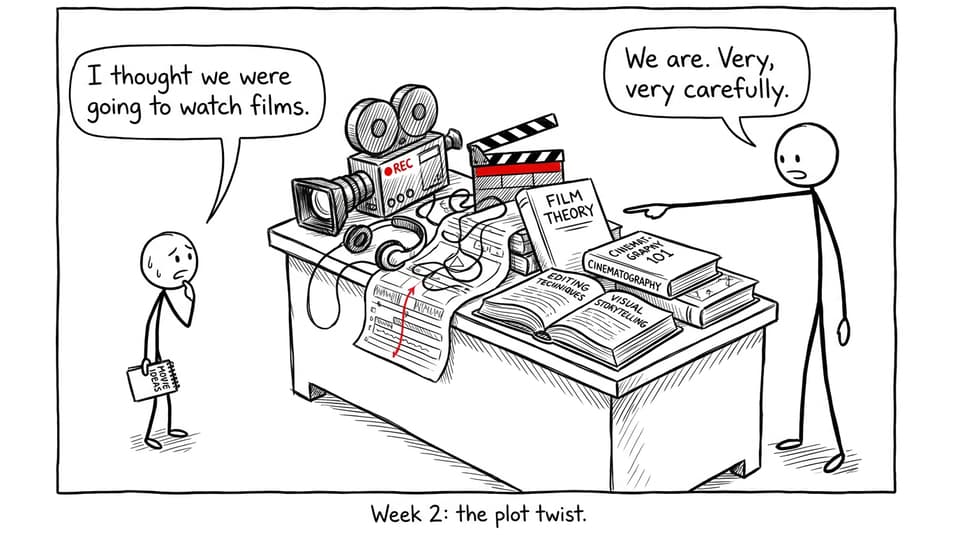
Weeks 4-7: Your first production experiments
Once the analytical foundation is underway, many classes begin practical exercises. You might recreate continuity between shots, build tension through sound, control exposure, experiment with lighting, direct a short performance, or edit the same footage in different ways.
These exercises are usually smaller than students expect. That is useful. A focused 30-second sequence can teach you more than an unfocused five-minute film.
Your teacher may rotate responsibilities so that you experience distinct production roles. SL and HL students eventually present portfolio work across three roles, while HL students also complete a collaborative film project. An early exercise is a chance to test skills, not determine your specialization.
Planning may fit into a lesson, but arranging people, locations, equipment, filming, file transfers, editing, and audio repairs can spill beyond school hours. RevisionDojo's guide to managing an IB Film set is useful before even a modest shoot.
Weeks 8-10: Context changes what you notice
Around the middle of the term, IB Film often becomes broader. You may study a movement, national cinema, genre tradition, historical period, or film theory. The purpose is to understand that style develops inside cultural and industrial conditions, not simply to memorize names and dates.
A handheld camera can suggest immediacy, but its significance depends on the surrounding film. A long take can create realism, tension, distance, or spectacle. Context helps you explain why a choice mattered to a particular audience at a particular time.
This is where comparative work begins to make sense. You learn to place films in conversation instead of writing isolated reviews. RevisionDojo's guide to choosing films for comparative analysis explains why differences in culture, history, and style matter.
Weeks 11 onward: Bringing the course together
Toward the end of term, many teachers set a sustained analytical or production task. You might write a longer sequence analysis, create a video essay, complete a short film exercise, or assemble preliminary portfolio-style evidence.
This is where separate threads connect. A film studied in class influences your lighting. A production failure creates something meaningful to evaluate. Editing your own sequence helps you recognize cutting patterns in professional work.
A realistic production cycle may look like this:
| Stage | What the work involves |
|---|---|
| Intention | Define what the audience should understand or feel |
| Research | Study relevant films, techniques, and contexts |
| Pre-production | Script, storyboard, schedule, test, and assign roles |
| Production | Capture image and sound while solving practical problems |
| Post-production | Select takes, edit, mix sound, refine, and export |
| Reflection | Evaluate choices using evidence from the result |
Do not assume your school will submit final assessed work during the first term. Many schools use early projects as preparation. Check your teacher's calendar and current course guidance.
What the weekly workload really feels like
IB Film becomes difficult because its tasks have different shapes. Analysis works well in focused 30-45 minute blocks. Research can be divided into gathering sources and making notes. Filming and editing usually need longer protected sessions.
A manageable weekly rhythm might include:
- one film-language review using Study Notes or Flashcards
- one sequence-analysis session
- one practical or planning block
- one brief reflection after meaningful production work
- one check of deadlines across all IB subjects
Consistency matters more than a universal number of hours. Production weeks will be heavier, so allow time for unavailable performers, noisy recordings, and failed exports. The IB Film time-management guide and advice on balancing Film with other IB subjects can help you build a durable routine.
What surprises new IB Film students
Watching films becomes active work
You may pause, replay, timestamp, sketch compositions, track sound bridges, and count cuts. A five-minute extract can occupy an entire lesson because analysis depends on precision rather than plot summary.
Sound causes serious problems
New filmmakers naturally focus on images. Yet unclear dialogue, inconsistent room tone, wind, echoes, and background noise can make strong footage feel unfinished. Test sound before recording.
Reflection is part of filmmaking
Saying that a shoot went well is insufficient. Strong reflection identifies an intention, evaluates a specific choice, explains what changed, and considers a better approach. RevisionDojo's IB Film coursework overview shows why evaluation matters alongside the finished result.
Equipment is not the main advantage
Clear intentions, controlled framing, deliberate sound, and thoughtful editing matter more than an impressive camera. Limitations can sharpen decisions by forcing you to identify what a scene needs.
Collaboration requires organization
Group filmmaking involves negotiation, reliability, scheduling, file organization, and constructive disagreement. A good idea only survives when the team can execute it.
How to finish the term strongly
Keep a production journal from the beginning. Save storyboards, shot lists, test footage, research notes, feedback, and reflections in clearly named folders. Learn vocabulary through examples, finish small exercises, and evaluate them honestly.
RevisionDojo can serve as the central workspace for this process. Use Study Notes and Flashcards to secure film language, the Questionbank to practise applying ideas, and AI Chat when an analytical distinction remains unclear. The Coursework Library and Grading tools can help you examine structure and improve evaluation, while Tutors offer focused human guidance. Later, Predicted Papers and Mock Exams help you manage other diploma subjects when production deadlines intensify.
Your first term is not about proving that you are already a filmmaker. It is about becoming deliberate. By the end, you should watch with greater attention, create with clearer intentions, and understand that every meaningful frame results from choices.