
Every IB SEHS student has had that moment: you repeat a skill 30 times, feel busy, and still get the same result. It’s frustrating because effort is supposed to equal improvement.
In IB SEHS, that gap is often explained by one word: feedback. Practice creates attempts. Feedback turns attempts into learning. And when you can explain feedback clearly in IB SEHS, you stop writing vague lines like “feedback helps performance” and start writing answers that sound like an examiner’s markscheme.
IB SEHS feedback: a quick exam checklist
Use this fast checklist when revising IB SEHS motor learning:
-
Define feedback as information about performance or outcome
-
Split feedback into intrinsic and extrinsic
-
For extrinsic feedback, separate knowledge of results (KR) and knowledge of performance (KP)
-
Explain timing and frequency (too much creates dependency)
-
Link feedback needs to stage of learning (cognitive, associative, autonomous)
For deeper context, pair this with What Is Motor Learning? and then practice with C.2.1 Motor learning processes Questionbank.
What feedback means in IB SEHS (and why it works)
In IB SEHS, feedback is the information a performer receives about what just happened. It can tell you whether you achieved the goal, how you moved, or what to change next.
A useful way to remember the point of feedback is this: feedback shortens the time between making an error and knowing how to fix it. That’s why skill learning speeds up when feedback is specific, well-timed, and limited to the biggest issue.
If you want the syllabus-friendly framing, The Role of Feedback in Information Processing Models is a clean reference for IB SEHS phrasing.
Intrinsic feedback in IB SEHS
Intrinsic feedback comes from within the performer. In IB SEHS answers, that typically means sensory information:
-
Visual (what you see)
-
Kinaesthetic/proprioceptive (what you feel in joints and muscles)
-
Auditory (what you hear: rhythm, contact, timing)
As you move toward higher skill levels, intrinsic feedback becomes more powerful because you detect errors faster and correct them without needing someone else to step in.
A practical revision angle: intrinsic feedback is often what separates “I know the theory” from “I can execute under pressure.” That’s why it links well to pedagogy and stages of learning, such as in Pedagogy for Skill (HL) Notes.
Extrinsic feedback in IB SEHS
Extrinsic feedback comes from outside the performer: a teacher, coach, teammate, stopwatch, or video replay. In IB SEHS, it’s most valuable early on because beginners usually can’t diagnose their own errors reliably.
Two examiner-friendly categories of extrinsic feedback are:
-
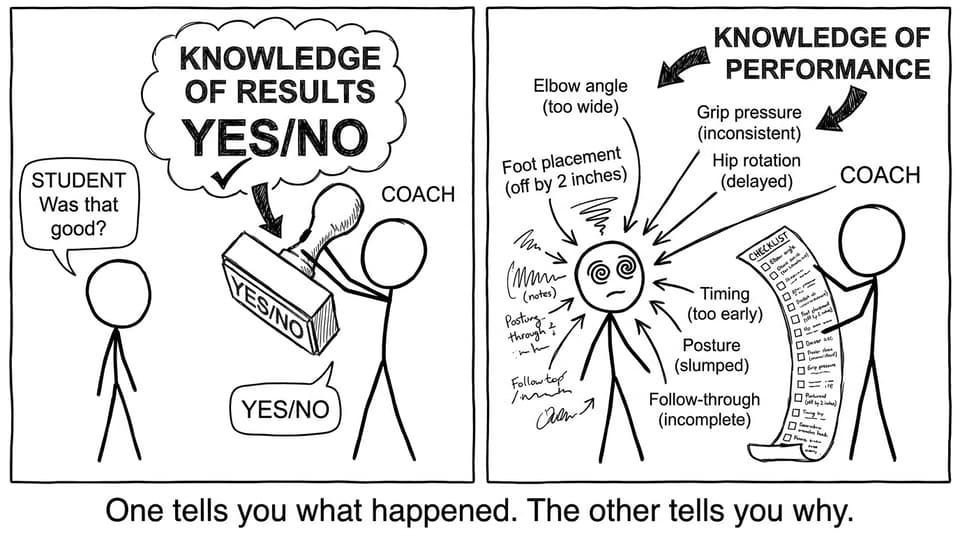
Knowledge of results (KR): outcome-focused (e.g., “the shot missed left”)
-
Knowledge of performance (KP): technique-focused (e.g., “your elbow dropped in the release”)
KP tends to improve movement quality more directly, which is why it often earns more credit when the question asks about refining technique.
For extra detail that can strengthen evaluation points in IB SEHS, see 5.2.14 Outline the role of feedback with the learning process.
Timing and frequency: the IB SEHS trap
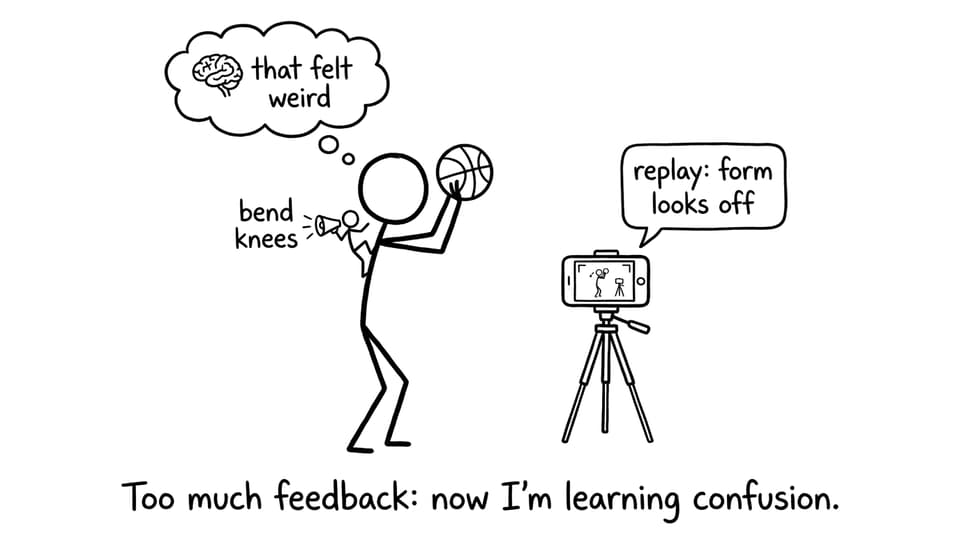
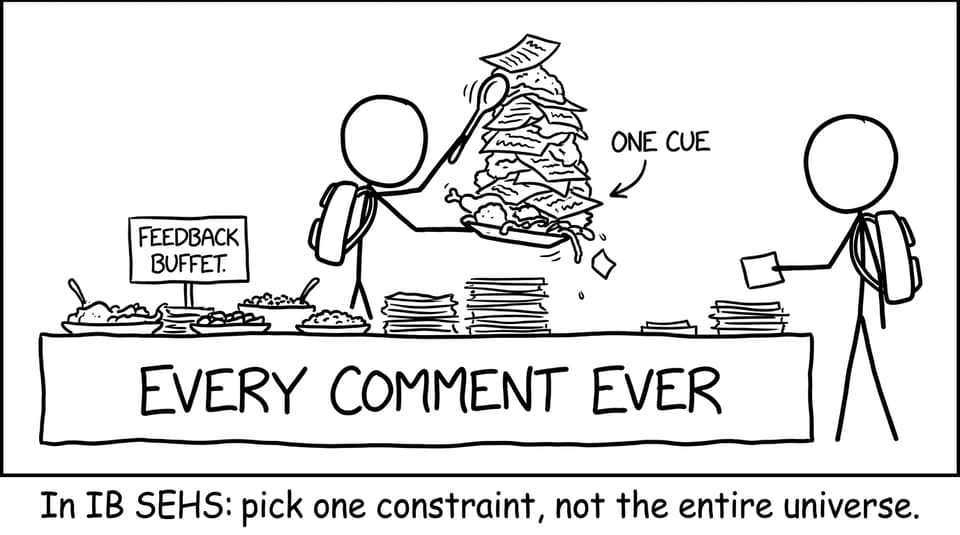
A common IB SEHS trap is assuming “more feedback = faster learning.” Too much feedback can create dependence, where the performer waits to be corrected instead of building error-detection.
A high-quality exam line looks like this: frequent feedback can improve short-term performance, but reduced feedback can support long-term learning by strengthening intrinsic feedback.
If you want to drill this with exam-style prompts, use Questionbank | RevisionDojo and target motor learning questions until your explanations feel automatic.
How feedback links to stages of learning in IB SEHS
In IB SEHS, linking feedback to learning stages upgrades your answer from “descriptive” to “applied”:
-
Cognitive stage: frequent, clear extrinsic feedback (KP is especially helpful)
-
Associative stage: more specific feedback, reduced frequency, encourage self-correction
-
Autonomous stage: minimal external feedback, mostly intrinsic feedback and fine-tuning
This is also where RevisionDojo’s AI Chat can help: you can paste a practice scenario and ask for ways to apply intrinsic vs extrinsic feedback without drifting off-syllabus.
Using RevisionDojo to turn IB SEHS feedback into marks
Knowing IB SEHS feedback concepts is step one. Using them under time pressure is step two.
RevisionDojo helps you bridge that gap with Study Notes, Flashcards, and the SEHS Questionbank for spaced repetition, plus Grading tools that make your phrasing more markscheme-aligned. When you’re ready to test the full topic mix, add Predicted Papers and Mock Exams to simulate pressure. And if you’re working on coursework, the Coursework Library and Tutors help you tighten language and structure.
To broaden your SEHS revision context, explore IB Sports, exercise and health science Resources and connect feedback to motivation via Intrinsic vs Extrinsic Motivation.
Conclusion: IB SEHS feedback is the shortcut you’re allowed to take
Feedback in IB SEHS isn’t “extra coaching.” It’s the mechanism that turns repetition into real skill improvement. When you can explain intrinsic vs extrinsic feedback, KR vs KP, and why timing matters, you don’t just learn motor learning; you learn how to score on it.
If you want to lock this in before exams, use RevisionDojo’s SEHS Questionbank, Study Notes, and Flashcards, then pressure-test your explanations with Mock Exams and Predicted Papers. Your future self will thank you when IB SEHS questions feel familiar instead of chaotic.