
If you have ever stared at a blank page in TOK, you know the feeling: you have a real-life situation, a bold opinion, maybe even a quote that sounds intelligent… and then your teacher asks, “What’s your knowledge question?”
In that moment, TOK stops being “thinking about stuff” and becomes something sharper: thinking about how we know, why we trust it, and what changes when context shifts. A good TOK knowledge question is like a compass. It doesn’t give you the answer. It gives you a direction worth walking.
What a TOK knowledge question really is
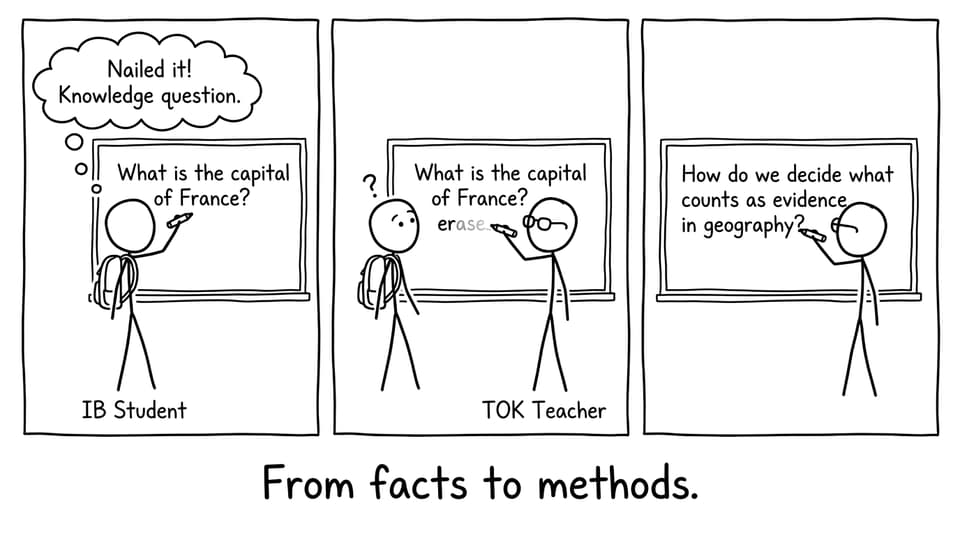
A TOK knowledge question (often called a KQ) is an open-ended question about knowledge itself. It does not test whether you know information. It tests whether you can examine how knowledge is produced, justified, shared, and challenged.
In practical terms, TOK knowledge questions tend to:
-
Start with How, To what extent, Under what conditions, or Why
-
Use conceptual language like evidence, certainty, interpretation, bias, truth, reliability, or authority
-
Stay debatable, not factual
-
Transfer beyond one example, so you can apply the TOK lens across different contexts
If you want a solid reference point while you work, RevisionDojo’s IB Theory of Knowledge (TOK) resources are built around exactly these skills: turning messy ideas into clean, analyzable TOK questions.
A quick TOK checklist before you commit to a question
Before you lock in your TOK knowledge question, run it through this quick filter:
-
Is it open-ended? (If it can be answered with a date, definition, or yes/no, it’s not TOK.)
-
Is the focus on knowledge, not the topic? (Knowledge about vaccines is not the same as knowledge questions about medical evidence.)
-
Does it invite claims and counterclaims? (You should be able to argue both sides honestly.)
-
Can it connect to an AOK and a WOK? (Even loosely.)
-
Is it clear enough to guide an essay paragraph? (If it’s too vague, it won’t steer your analysis.)
When students struggle in TOK, it’s usually not because they lack intelligence. It’s because their question is doing the wrong job.
How to turn a topic into a TOK knowledge question
Most TOK drafts begin with a topic that feels “important”:
-
misinformation
-
AI
-
art censorship
-
historical propaganda
-
statistical claims in the news
The trick is to step back one level. Ask not “what happened?” but “what makes us confident about what happened?”
Here is a simple TOK conversion method:
Start with a claim you hear people make
Example: “Science is objective.”
Identify the hidden method
What makes it ‘objective’? Experiments? Peer review? Measurement?
Add a TOK pressure test
Where might it fail? Bias? Funding? Interpretation? Limits of instruments?
Draft your knowledge question
To what extent can scientific methods produce objective knowledge, given the influence of human interpretation?
If you are working from prescribed titles, you’ll see this process in action in Breaking Down TOK Essay Titles: What Are Knowledge Questions and the more exam-specific Using Knowledge Questions in Your TOK May 2026 Essay.
Examples of strong TOK knowledge questions (with why they work)
Good TOK examples feel broad, but not blurry. They can travel across more than one situation without losing meaning.
Evidence and History
How does the selection of evidence shape what we accept as historical knowledge?
Why it works in TOK: it focuses on method (selection), invites counterclaims (some evidence may be systematically excluded), and naturally connects to perspectives and bias.
Language and Reality
To what extent does language limit what can be known or understood?
Why it works in TOK: language is not just a tool; it can shape categories, concepts, and even what counts as a valid explanation.
Ethics and the sciences
Under what conditions can scientific evidence meaningfully inform ethical decisions?
Why it works in TOK: it forces you to separate descriptive claims (what is) from normative claims (what ought to be), while still allowing real-life examples.
For more examples sorted by themes and TOK framing, see Examples of Strong TOK Knowledge Questions.
Linking TOK knowledge questions to AOKs and WOKs without forcing it
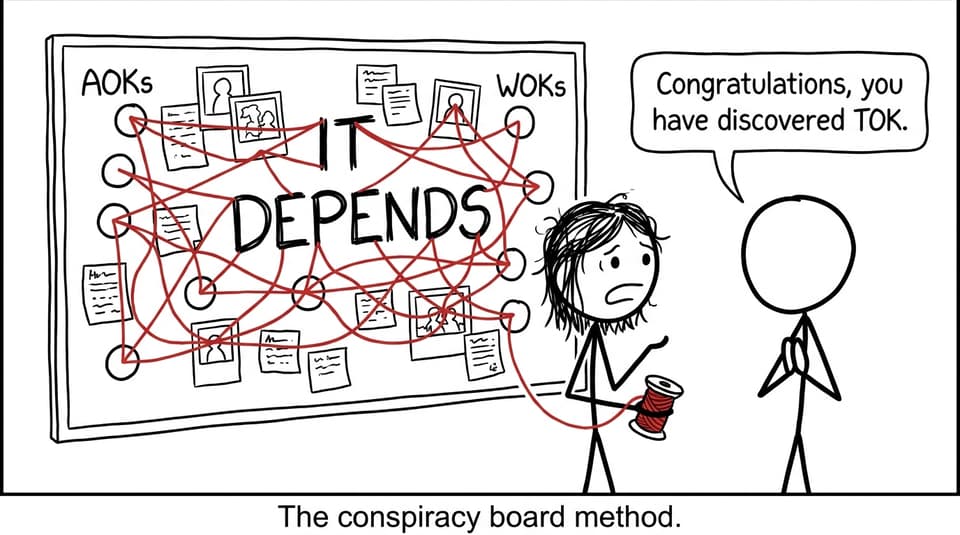
TOK gets easier when you stop treating AOKs and WOKs like boxes to tick and start treating them like angles of analysis.
-
Areas of Knowledge (AOKs) are where knowledge is built (history, natural sciences, the arts, human sciences, mathematics, ethics, etc.).
-
Ways of Knowing (WOKs) are how we process and evaluate knowledge (language, reason, emotion, perception, imagination, intuition, memory).
A practical approach:
-
Pick one AOK where your example lives.
-
Choose a second AOK that disagrees in method.
-
Add one WOK that could strengthen or distort the process.
Example pairing:
-
AOK 1: History (interpretation of sources)
-
AOK 2: Natural sciences (controlled experiments)
-
WOK: Language (framing, classification)
Now a TOK knowledge question like “How does language influence what counts as evidence?” becomes much easier to explore in a structured way.
If you want to see how TOK-style questioning shows up in subject thinking too, browse IB Global Politics resources or IB English A: Lang & Lit resources. Both subjects reward the same habit: questioning assumptions, sources, and interpretation.
Claims and counterclaims: the TOK engine room
A TOK knowledge question becomes powerful when it generates a balanced argument.
A simple template:
-
Claim: A method of knowing is reliable.
-
Counterclaim: That reliability depends on context, perspective, or limitations.
-
Implication: So the “strength” of knowledge is conditional, not automatic.
Example:
-
Claim: “Peer review makes scientific knowledge trustworthy.”
-
Counterclaim: “Peer review can reinforce dominant paradigms and exclude dissenting methods.”
-
Implication: “Trust in scientific knowledge may be justified, but it is not the same as certainty.”
TOK rewards students who can hold two ideas at once without panicking.
Tips that make TOK knowledge questions sharper (fast)
These are small edits that raise the level of a TOK question quickly.
Replace vague words with measurable TOK terms
Instead of “good” or “bad,” use:
-
reliable
-
justified
-
credible
-
objective
-
biased
-
certain
Add “under what conditions” to avoid overclaiming
This instantly signals nuance, which TOK examiners like.
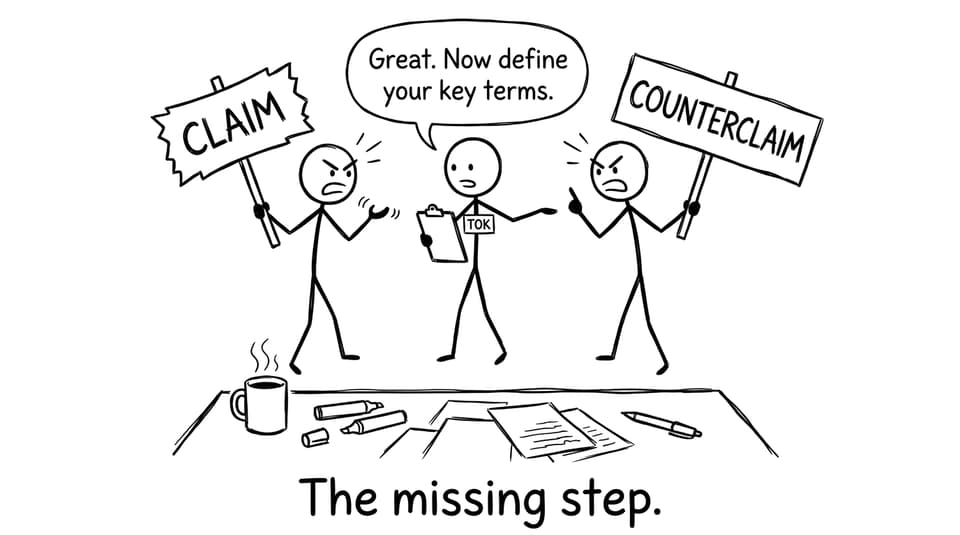
Define your key term inside your planning
If your TOK question uses “truth,” decide early whether you mean correspondence, coherence, pragmatic usefulness, or consensus. If you need help grounding this, What Counts as Knowledge? Exploring Different Definitions is a strong foundation.
Make sure your question can produce examples
A TOK question is not just philosophical. It should be testable through real-life situations.
If you want a structured way to connect knowledge questions to real contexts, use How to Identify Links Between Knowledge Questions and the World.
How RevisionDojo helps you practise TOK like a skill
Students often treat TOK as a personality trait. But TOK is closer to a craft: repeated drafts, better questions, clearer claims.
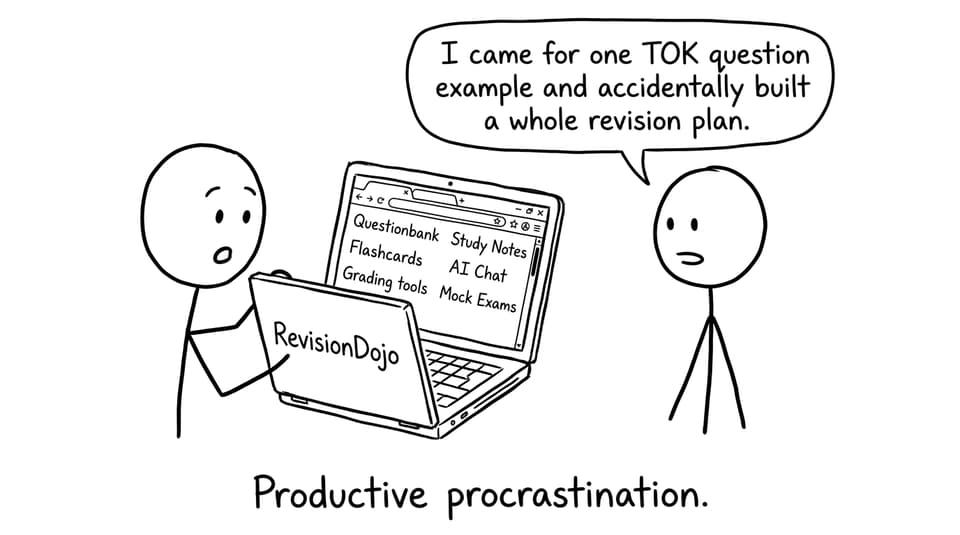
RevisionDojo is built for that kind of improvement:
-
Use the Questionbank to practise TOK-style prompts and pressure-test your reasoning.
-
Build confidence with Study Notes and targeted Flashcards for key terms (evidence, certainty, justification).
-
Use AI Chat to brainstorm alternative framings of the same TOK knowledge question, then choose the best one.
-
Submit practice writing to the Grading tools and get rubric-aware feedback.
-
Create realistic exam conditions with Mock Exams and Predicted Papers.
-
Learn from the Coursework Library of TOK exemplars: IB TOK examples.
-
If you want human feedback, RevisionDojo Tutors can help you tighten a TOK knowledge question until it actually drives analysis.
And if you want a broader TOK overview before you dive back into writing, TOK Thinking and Skills: How to Succeed in IB TOK is worth reading slowly.
Closing: your next TOK question should feel like a door
A good TOK knowledge question doesn’t just sit at the top of a page. It opens into a room where you can move around: evidence on one wall, bias on another, certainty and interpretation arguing in the corner.
Your goal is not to sound philosophical. Your goal is to make the reader trust your thinking.
If you want to practise TOK knowledge questions with feedback that actually improves your work, explore RevisionDojo’s IB Theory of Knowledge (TOK) hub, then use the Questionbank, AI Chat, and Grading tools to turn one strong TOK question into a high-scoring argument.