


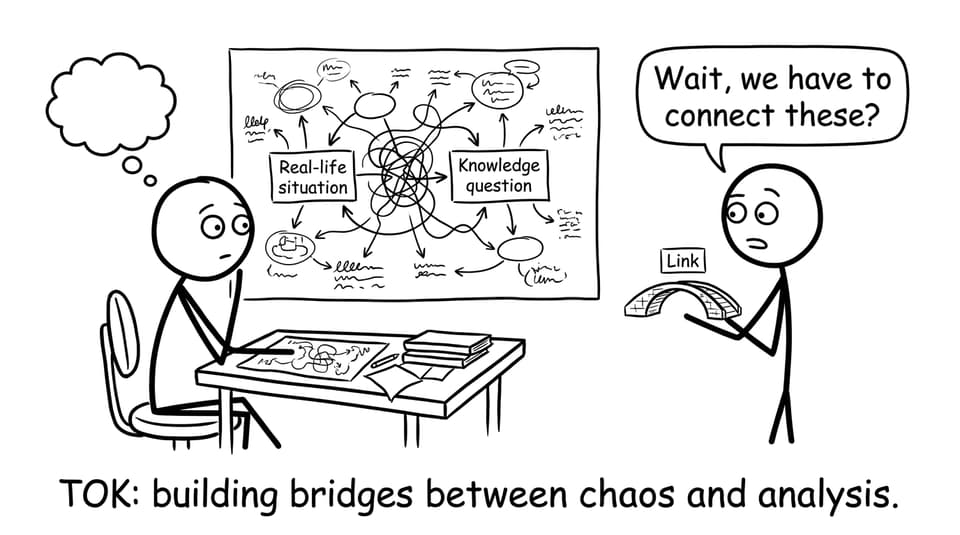
TOK can feel like standing in front of two maps that refuse to line up.
One map is your real life: a headline about vaccines, a teacher’s comment on bias, an AI image winning a prize, a friend insisting “it’s obvious.”
The other map is the TOK course: knowledge questions, Areas of Knowledge, Ways of Knowing, claims and counterclaims, implications.
Your job in TOK is not to pick one map. It’s to overlay them until the world becomes analysable.
That overlay is what examiners reward. And it’s also what most students struggle with: identifying the links between a knowledge question and the world in a way that is specific, evaluative, and clearly TOK.
A quick TOK checklist for spotting real links
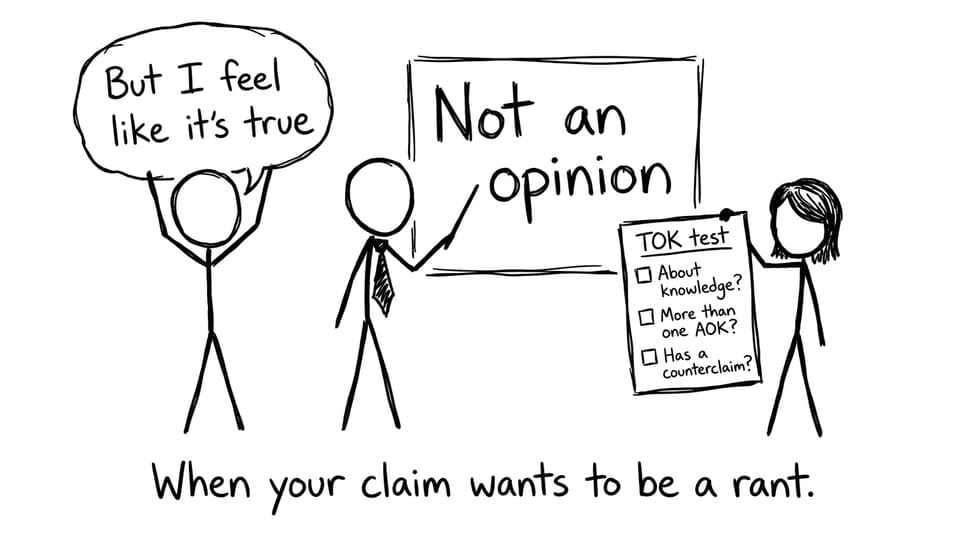
Use this fast filter when you meet a real-life situation and want to turn it into TOK analysis:
-
Can I phrase the issue as a knowledge question about how we know, not what is true?
-
Can I name at least one AOK where this knowledge is produced or judged?
-
Can I name at least one WOK shaping belief (language, reason, emotion, perception, imagination, faith, memory, intuition)?
-
Can I write a claim and a serious counterclaim without sounding cynical?
-
Can I explain what would change my mind (methods, evidence, standards, context)?
If you can do those five things, you have a real TOK link, not a loose association.
What makes a knowledge question “about the world” in TOK?
A knowledge question in TOK is not “big” because it sounds philosophical. It’s strong because it has a clear target: the methods, assumptions, and limits behind knowledge.
When students miss the link, it’s usually because they treat the world as decoration. They add a headline, then return to abstract talk. Examiners can feel that.
Instead, think of a real-life situation as your pressure test. A knowledge question becomes meaningful when it explains why smart people disagree, why evidence doesn’t settle things quickly, or why certainty arrives in one AOK but collapses in another.
If you need a broader framework for how TOK thinking works across tasks, RevisionDojo’s guide on TOK thinking and skills is a useful anchor.
The “bridge sentence” method (the simplest way to show links)
When you write TOK, you often need one sentence that does the heavy lifting. I call it the bridge sentence.
Template:
This real-life situation raises the knowledge question of ________, because in ________ (AOK), knowledge is accepted through ________ (method/standard), yet ________ (WOK/context) can distort or reshape what counts as justified.
That sentence forces you to do what TOK demands: connect the world to knowledge production.
If you’re building this into an essay structure, pair it with a clear plan like the one in Structuring for success in IB TOK essays.
Linking knowledge questions to AOKs without name-dropping
AOKs are not labels. In TOK, an AOK is a set of standards: what counts as evidence, which methods are trusted, and what “progress” even means.
Try this approach:
Ask what the AOK rewards
-
In natural sciences, the reward is often predictive power, replication, measurement, and modelling.
-
In history, the reward is coherence with sources, provenance, interpretation, and an awareness of perspective.
-
In the arts, the reward can include meaning, intention, technique, and audience response.
When you link a knowledge question to an AOK, your paragraph should mention at least one of those standards. Otherwise, your TOK link is thin.
For more targeted TOK examples, you can explore the IB Theory of Knowledge resources hub.
Linking knowledge questions to WOKs as causes (not decorations)
WOKs become powerful when you treat them like forces that change outcomes.
Instead of writing “WOK: emotion,” write:
-
Emotion changes risk perception, which changes how evidence is weighed.
-
Language compresses complexity into slogans, which changes what people remember.
-
Perception is selective, which changes what is noticed and later treated as “data.”
In other words: in TOK, WOKs should function like verbs.
If you’re preparing for assessed work, RevisionDojo’s TOK essay strategies guide can help you turn those forces into claim-counterclaim structure.
Two practical examples of TOK links you can reuse
Media framing and conflict reporting
Real-life situation: Two major outlets describe the same event with different language: “militants” vs “freedom fighters,” “incident” vs “attack.”
TOK knowledge question: To what extent does language shape what is accepted as objective knowledge in the human sciences?
Linking move (what to write next):
-
AOK: Human sciences (methods include surveys, statistics, and interpretive frameworks).
-
WOK: Language (framing), reason (inference from data).
-
Claim: Language guides interpretation, so neutrality is partly an illusion.
-
Counterclaim: Shared methods and transparency can reduce bias, even if language is imperfect.
AI-generated artwork and creativity
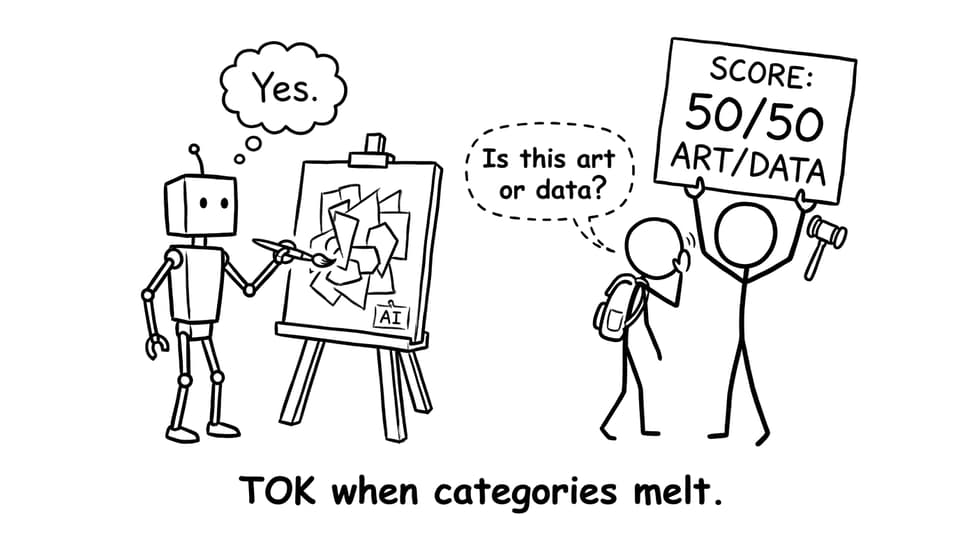
Real-life situation: An AI-generated piece wins a public competition.
TOK knowledge question: Can knowledge in the arts exist without human intention?
Linking move (what to write next):
-
AOK: The arts (standards include meaning, technique, and audience interpretation).
-
WOK: Imagination (creation), emotion (response), language (labels like “original”).
-
Claim: If artistic knowledge is partly in audience meaning-making, intention may not be required.
-
Counterclaim: Without human intention, we lose a key basis for evaluation and interpretation.
What examiners look for when you claim a “link” in TOK
Examiners reward clarity and restraint.
A strong TOK link shows:
-
The real-life situation is specific, not generic.
-
The knowledge question is answerable through analysis, not a yes/no debate.
-
AOKs and WOKs are used as analytical tools.
-
The writing includes evaluation: limits, assumptions, implications.
-
There is balance: claims and counterclaims that both sound intelligent.
If you want a rubric-aware checkpoint for drafts, RevisionDojo’s IB Coursework Grader and the dedicated TOK exhibition rubric grader can quickly reveal whether your “link” is actually explicit.
Closing: Make TOK links visible, then make them evaluative
The best TOK writing doesn’t sound like a debate club or a philosophy lecture. It sounds like someone carefully noticing how knowledge actually behaves in the world: how it’s built, trusted, challenged, and sometimes misused.
When you identify links between a knowledge question and the world, make those links visible (AOK standards, WOK forces, claim/counterclaim). Then make them evaluative (limits, implications, conditions).
If you want a single place to practice that loop with support, RevisionDojo brings it together: concise TOK Study Notes, Flashcards for key terms, AI Chat for tightening your knowledge question, Grading tools for rubric-aligned feedback, and a Coursework Library showing what strong TOK looks like. That’s how TOK stops being vague and starts becoming a skill you can reliably repeat under exam pressure.