
A small form that can decide a big result
The most stressful part of the EE is rarely the research question.
It’s the moment you realize the thing you treated like “admin” is actually assessment.
You finally submit your draft, exhale, and then your supervisor says something like: “Now we need to finish the reflection form.” You nod like you’ve been reflecting deeply all year, while your brain quietly asks: Wait, which which form is it now? The old RPPF or the new RPF?
That confusion is common because the EE reflection paperwork changed in a way that looks cosmetic from far away but feels very real when you’re trying to secure marks for engagement.
This article answers Q18 directly: What is the difference between the old RPPF and the new RPF? And more importantly, how to use the new system to protect your EE grade.
Quick checklist: old RPPF vs new RPF (in one glance)
If you only remember one section, make it this one.
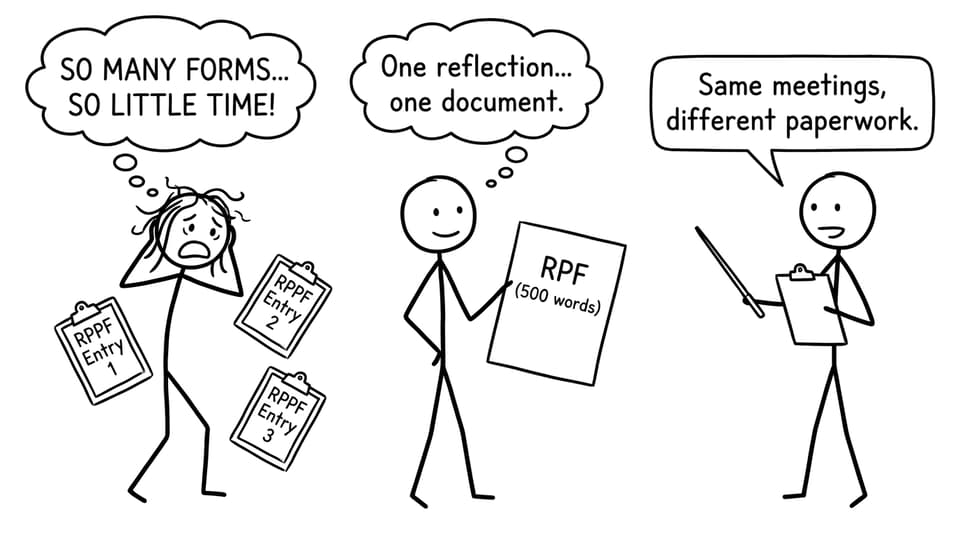
- Old RPPF (Reflections on Planning and Progress Form): required three separate reflective entries written across the process.
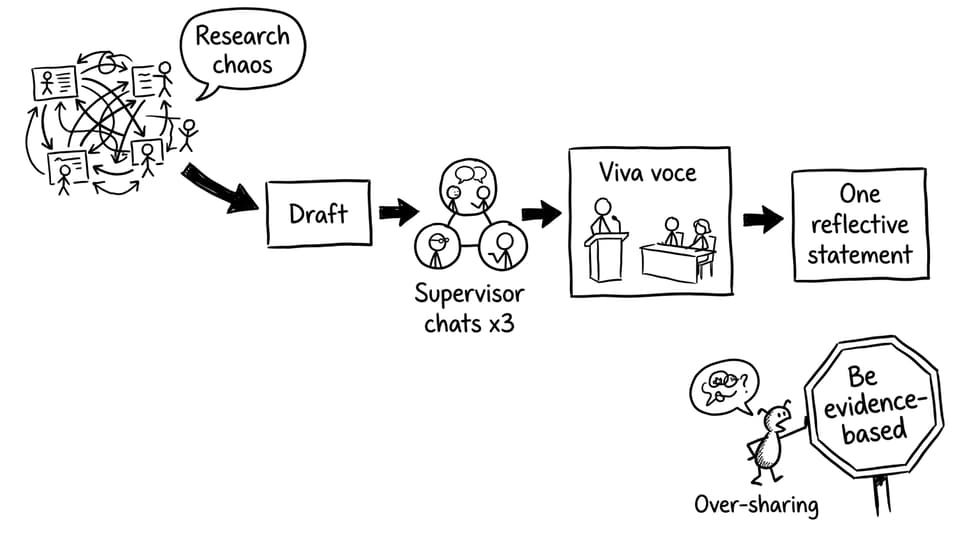
- New RPF (Reflections on Planning Form / Reflective Project Form, depending on your school’s naming): reflection is consolidated into one 500-word reflective statement, written at the end, after the viva voce.
- Still three sessions: the RPF still records attendance at all three mandatory reflection sessions.
- What’s assessed changed: the assessed text is one unified statement, not three discrete entries.
This is why students feel disoriented: the meetings remain, but the writing moves to the end.
What the old RPPF asked you to do (and why it felt hard)
Under the old RPPF, the rhythm of the EE reflection was like checkpoints on a long hike.
You had to stop three times and write three separate entries. In theory, that encouraged honest “in-the-moment” thinking: what you planned, what changed, what you learned.
In practice, it often produced three predictable problems:
- Forced reflection: you reflect because you must, not because you have clarity.
- Fragmentation: entry 1 says one thing, entry 2 contradicts it, entry 3 tries to patch it up.
- Timing mismatch: your best insights usually arrive late, after after you’ve written, revised, defended your decisions, and heard your supervisor’s final questions.
The old RPPF wasn’t impossible. But it rewarded students who were organized early, and it punished the very normal EE reality: you don’t truly understand your topic until you’ve wrestled with it.
For broader EE structure and process guidance, it helps to anchor yourself in a reliable guide such as IB Extended Essay Guides or the tag hub All IB Extended Essay Posts.
What the new RPF changes (the part most people miss)
The new RPF doesn’t remove reflection from the EE. It changes when you turn reflection into assessed writing.
Here’s the key detail you provided (and that many students misunderstand):
- The new RPF consolidates reflection into a single 500-word reflective statement written at the end, after the viva voce.
- The RPF still records attendance at all three reflection sessions.
- The assessed text is one unified statement rather than three separate entries.
That last bullet is the strategic opportunity.
A single statement means you can write reflection with the benefit of hindsight. Not fake hindsightreal clarity. You can explain the logic of your journey: what you tried, what failed, why you changed course, and what that taught you about research.
And because your EE engagement is assessed, clarity is not a luxury. It’s marks.
To understand how reflection connects to scoring, keep What Are the Assessment Criteria for the IB Extended Essay? open while you draft your RPF.
What stays the same: the three reflection sessions and the viva voce
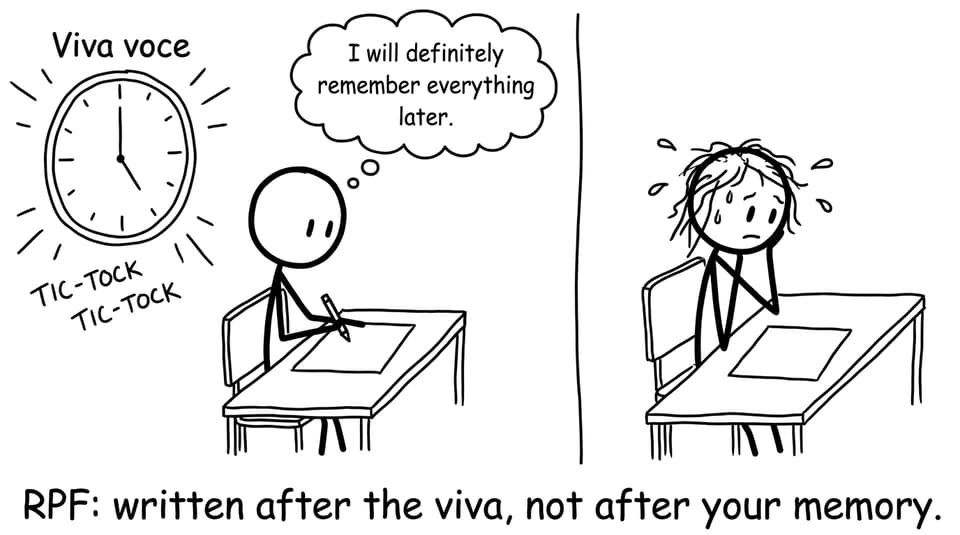
Even though the RPF’s assessed writing happens at the end, the process is still built around:
- Three mandatory reflection sessions (your supervisor still needs to confirm these)
- The viva voce (the final short interview after submission)
So if you were hoping the new RPF means “less reflection,” it doesn’t.
It means your reflection is now judged as a single coherent narrative of engagement.
If you’re unsure what the viva voce is supposed to feel like, use How to Prepare for the IB Extended Essay Viva Voce to plan what evidence you want fresh in your mind.
The most important practical difference: coherence beats chronology
The old RPPF rewarded chronology: Here’s what I thought then; here’s what I thought later.
The new RPF rewards coherence: Here’s the story of how my thinking evolved, and here’s why those decisions were reasonable.
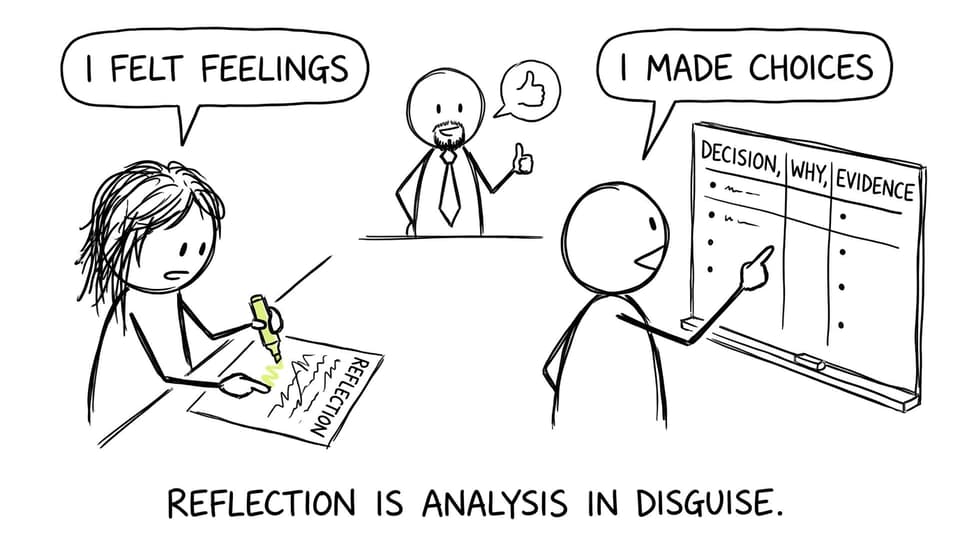
That matters for your EE because engagement is not “I was passionate.” Engagement is “I made intentional research choices.”
A useful mental model is:
- Chronology = diary
- Coherence = case study
Your RPF should read like a case study of your own research process.
A simple RPF structure that works in any EE subject
Within 500 words, you don’t have space to wander. Aim for 4 short blocks:
- Block 1 (context + initial aim): what you investigated and what you first assumed.
- Block 2 (a pivot): what changed your thinking (source limitations, method issues, scope, data access).
- Block 3 (a decision): what you did about it, and why that was a better research move.
- Block 4 (learning): what you learned about the subject and about yourself as a researcher.
If you need help keeping the whole EE structured, pair this with How to Create an Effective EE Outline for a Logical Flow.
What to write about in the RPF (and what to avoid)
Most students lose EE reflection marks by writing reflections that are emotionally honest but academically thin.
Reflection is not therapy. It’s metacognition with evidence.
Strong RPF content usually includes
- A research question change (or a justification for why you didn’t change it)
- A method choice you can defend
- A moment you evaluated sources or data quality
- A limitation you noticed early enough to respond to it
- A clear link between your actions and improved research quality
A great prompt bank is How to Reflect on Challenges in Your IB IA or EE. The same “challenge then decision then outcome” logic fits the RPF perfectly.
RPF pitfalls that quietly lower engagement marks
- Plot summary of your EE topic (reflection is about process, not content)
- Vague claims (“I learned a lot,” “It was hard,” “I managed my time better”)
- Supervisor dependency (“My supervisor told me to…”) without describing your reasoning
- Drama without decisions (a crisis story that never shows what you did differently)
How to use RevisionDojo to make your EE reflection easier (without faking it)
The new RPF is written at the end, but good reflection is gathered throughout.
This is where RevisionDojo becomes a practical advantage for your EE because it helps you capture decisions while they’re happening, then write one clean statement later.
Here’s a realistic workflow:
- Use Study Notes to clarify background concepts so your reflection can describe real academic learning, not just struggle.
- Use the Questionbank to test whether you truly understand the theories or content you’re applying in your EE (confident understanding shows up in confident reflection).
- Use Flashcards for key definitions and thinkers you reference in your essay and viva voce.
- Use AI Chat (Jojo AI) to pressure-test your reasoning: “If my method changed, what’s the strongest justification?”
- Use the Grading tools for rubric-aligned feedback so your reflection can reference what improved between drafts.
- Use Mock Exams and Predicted Papers to keep your exam prep moving while you finish the EE, because the fastest way to hate reflection is to do it while panicking about six subjects.
- Use the Coursework Library to benchmark tone: reflections that score well tend to sound calm, specific, and analytical.
- If you’re stuck, use Tutors to talk through the viva voce and extract your best “engagement moments” before you write the RPF.
If you want a supervisor-facing perspective (useful for understanding what they’re looking for), see Streamlining IB Extended Essay Supervision with RevisionDojo and 10 Key Responsibilities of the Extended Essay Supervisor in IB.
Mini example: turning messy reality into a high-scoring RPF paragraph
Imagine this is what happened in your EE:
- You started with a broad question.
- Your sources were too general.
- You narrowed it.
- Your argument improved.
A low-quality reflection sounds like:
“At first my topic was too broad. I found it difficult but then I narrowed it and it got better. I learned a lot about research.”
A higher-quality RPF version sounds like:
“My initial research question assumed that a broad comparison would allow me to identify clear patterns, but my early reading produced sources that were descriptive rather than analytical. After my first reflection session, I tested a narrower sub-question against three academic articles and realized I could evaluate methods rather than summarize outcomes. This decision shifted my drafting from topic coverage to argument building, and it also changed how I used my supervisor feedback: I began asking whether each paragraph answered the research question instead of whether it ‘sounded detailed.’ By the viva voce, I could explain not only what I concluded, but why the revised scope produced more defensible analysis.”
Same story. Different intellectual weight. Better EE engagement.
The bottom line: the EE reflection became one story, not three snapshots
The old RPPF asked you to produce three separate reflective entries across time.
The new RPF asks you to produce one 500-word reflective statement at the end, after the viva voce, while still recording attendance at the three reflection sessions.
So the difference isn’t just paperwork. It’s strategy.
Your job is to tell one honest, evidence-based story about how your EE thinking matured, showing how how you made choices, corrected course, and learned to research like someone who could do it again.
If you want that story to be easier to write, build your process inside RevisionDojo: practice content with the Questionbank, clarify concepts with Study Notes and Flashcards, pressure-test decisions with AI Chat, benchmark quality with the Coursework Library, and tighten drafts with the Grading tools. Then walk into the viva voce with calm evidence, and walk out ready to write a strong RPF that protects your EE marks.