


When most IB students imagine the EE, they picture a lonely document: 4,000 words, a research question, citations, and the quiet dread of Word count.
But there’s another part of the EE that feels smaller and somehow more confusing: the reflection paperwork. Not the essay itself. The part where you explain what happened while you were becoming the kind of student who could write an EE in the first place.
That’s where the RPF comes in.
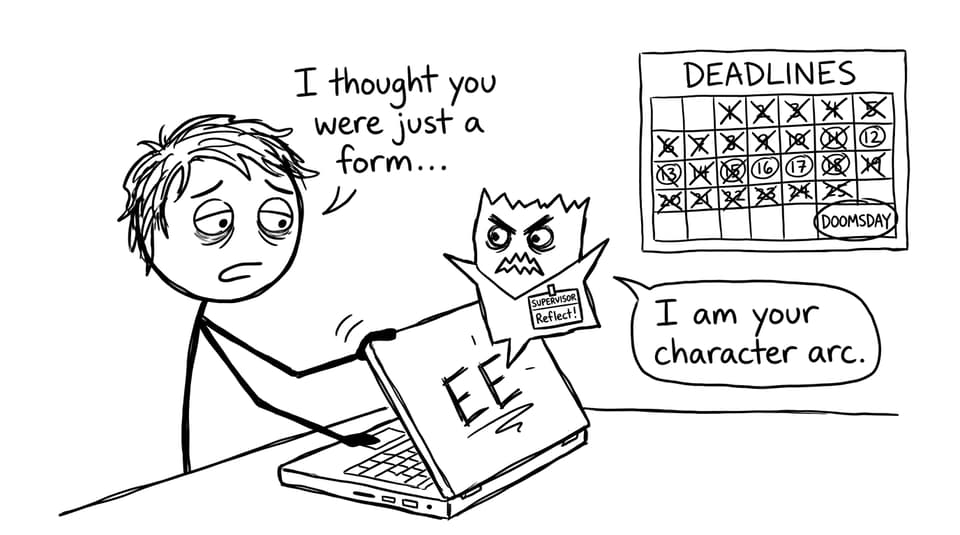
The Reflection and Progress Form looks like “just a form.” In reality, it’s the official record of how you planned, struggled, adapted, and learned during your EE process. It’s also where the IB finds evidence that your EE is genuinely yours, and that your thinking matured over time.
And if you treat it like an afterthought, you don’t just miss marks. You miss the easiest chance to show examiners what they rarely get to see: your judgment.
What is the RPF in the EE?
The RPF (Reflection and Progress Form) is the IB form used to document the required reflection points in the EE process. Think of it as a timeline of your intellectual decision-making.
You’ll complete it across your formal supervisor checkpoints. The wording and templates can vary by school and session, but the core idea is stable: the IB wants to see progress and reflection, not a perfectly smooth journey.
The RPF matters because it directly supports your EE engagement marks. Those marks reward evidence that you made intentional choices, responded to setbacks, refined your focus, and learned something real about research.
If you want to understand how this fits into the broader structure of the EE, start with RevisionDojo’s guide on how to structure an Extended Essay (EE).
Quick checklist: what a strong EE RPF entry includes
Use this before every reflection you write for the EE:
-
A specific decision you made (topic shift, method choice, source selection)
-
The reason you made it (not “because my supervisor said so”)
-
What changed in your thinking after feedback or research
-
A challenge that forced you to adapt
-
The next concrete step you will take
-
Evidence of ownership: “I chose… I noticed… I realized… I will…”
If you want a workflow that makes reflection easier, RevisionDojo’s reflection-first tools in school settings are explained in How RevisionDojo builds a culture of reflection in IB schools.
Why the IB cares about the RPF (and why you should too)
In the IB, reflection is not decoration. It’s quality control.
The EE is one of the few tasks where the IB asks you to act like a researcher instead of a student. Researchers don’t just produce results. They record how they got there, what they considered, what they rejected, and why.
The RPF helps the IB answer three quiet questions:
-
Did you do the work independently?
-
Did you think critically about your choices?
-
Did your process actually evolve?
If your EE is the final photograph, the RPF is the behind-the-scenes footage. And examiners trust the footage.
For a supervisor-centered perspective, see 10 key responsibilities of the Extended Essay supervisor, which clarifies what your supervisor can and cannot do in the EE process.
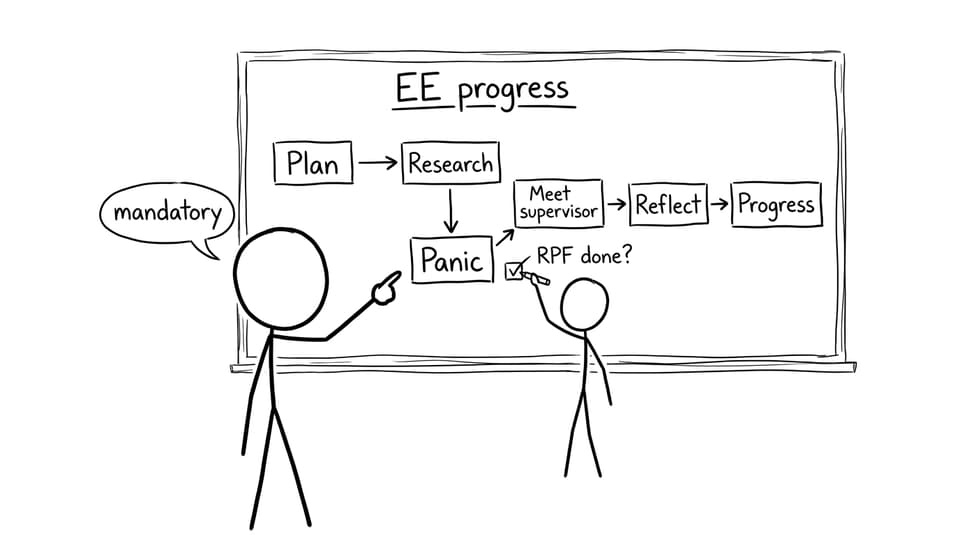
EE + RPF: what “progress” actually looks like
Progress in the EE does not mean “I wrote more words.” It means your research and thinking became more disciplined.
Here are realistic examples of what counts as progress in an EE RPF reflection:
Progress looks like narrowing
You started with an enormous topic. Then you realized what you could actually prove in 4,000 words. You refined the question to something researchable and specific.
If you’re still in the early narrowing phase, RevisionDojo’s How to survive the IB Extended Essay research process is one of the most practical roadmaps.
Progress looks like choosing methods consciously
In a science EE, you might realize your original experiment won’t produce reliable data. In a history EE, you might realize your sources are too biased for the claim you want to make. In a literature EE, you might realize your analysis is summarizing rather than interpreting.
Progress looks like learning to evaluate sources
At first, your bibliography is “anything that mentions my topic.” Later, your sources start to have jobs: background, theory, evidence, counterargument.
Progress looks like changing your mind without panicking
Many students fear changing anything after they start writing the EE. But intelligent research often requires adjustment. Your RPF is where you prove that the change was thoughtful, not chaotic.
What to write in each EE RPF reflection (simple framework)
The biggest mistake students make in the RPF is writing like it’s a diary or a summary.
A strong EE reflection is closer to a lab notebook for the mind.
Use this three-part structure for every RPF entry:
Situation: what happened?
Be concrete. Mention a meeting, a set of sources, a draft moment, or a data issue.
Meaning: so what did you learn?
Name the insight. What did you realize about your research question, your method, or your argument quality?
Action: now what will you do?
List 1-3 next steps. These should be specific enough that a supervisor could check them later.
This same reflection structure appears across IB core work. If you’re curious how reflective writing is coached more broadly, read Coaching students to write purposeful reflections in the DP.
Common EE RPF mistakes (and how to fix them)
“My supervisor told me to…”
Supervisors guide. You decide. Reframe it as:
- “After discussing X, I realized Y, so I decided to…”
If you’re preparing to submit a draft for feedback, pair your reflection with RevisionDojo’s How to improve your IB Extended Essay draft.
Writing only feelings, no thinking
Feelings are allowed, but they must lead to insight.
Bad: “I felt stressed and overwhelmed.”
Better: “I felt overwhelmed because my scope was too broad; narrowing my variables made the research manageable and improved my analysis.”
Listing tasks instead of decisions
Bad: “I read three articles and wrote my introduction.”
Better: “Reading three contrasting sources showed my original claim was too one-sided, so I rewrote my introduction to include a counter-claim I can evaluate.”
Waiting until the end to remember everything
This is the silent RPF killer. If you wait, you’ll invent reflections that sound polished but empty.
Instead, keep tiny weekly notes. RevisionDojo makes this easier when you treat the EE like a trackable project using its Study Notes, Flashcards, and planning workflow. For schools using the platform, Streamlining IB Extended Essay supervision with RevisionDojo shows how reflection logs become part of the routine.
How RevisionDojo helps you write a better EE RPF (without faking it)
The best reflections come from a real process. The easiest way to have a real process is to make it visible.
Here’s how RevisionDojo supports the EE and the RPF in a way that feels natural:
Use Study Notes and Flashcards to reduce “research fog”
Many EE reflections get shallow because students don’t understand their own topic well enough to reflect on it. RevisionDojo’s Study Notes and Flashcards help you build subject clarity so your RPF entries can talk about meaningful decisions, not just confusion.
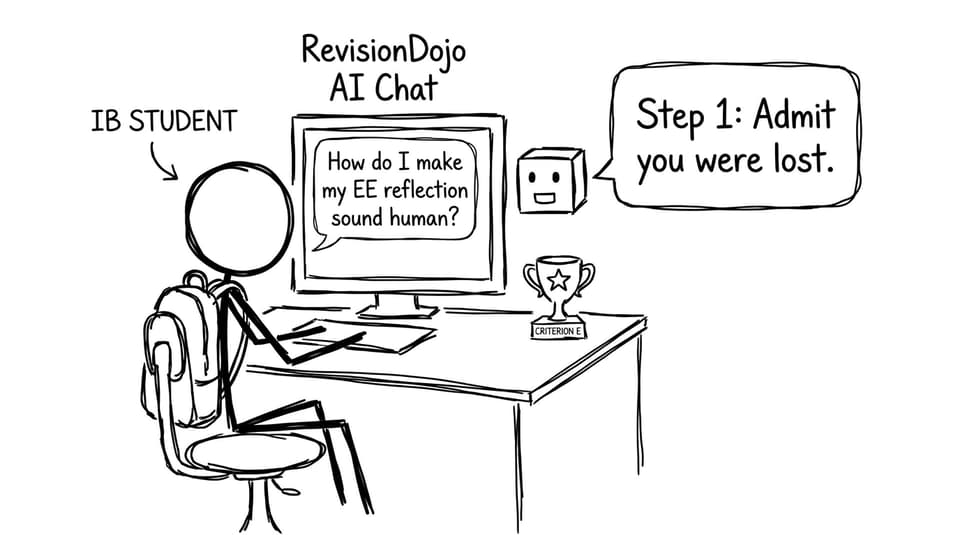
Use AI Chat to turn messy thinking into clear reflection language
You still must write your own reflections, but RevisionDojo’s AI Chat can help you:
-
generate reflection prompts
-
translate vague ideas into precise phrasing
-
spot where you’re summarizing instead of reflecting
Use Grading tools and rubrics to align reflection with marks
If your school has access to RevisionDojo’s grading tools and rubrics, you can self-check whether your engagement evidence is actually visible. For example, you can explore how criterion-based thinking works using an embedded rubric grader like the IB Business Management EE Grader.
Use Mock Exams and Predicted Papers to protect your time
The EE doesn’t exist in a vacuum. When exam season tightens, reflection becomes rushed. RevisionDojo’s Questionbank, Mock Exams, and Predicted Papers help you revise efficiently, so your EE process stays calm enough to reflect honestly.
Use the Coursework Library and Tutors when you’re stuck
Sometimes the problem isn’t effort, it’s direction. RevisionDojo’s Coursework Library and Tutors can help you get unstuck early, which creates real decision points you can later reflect on in the RPF.
Closing: treat the RPF like the spine of your EE story
The EE is not graded only on what you found. It’s graded on what you built: a focused question, a disciplined method, and a line of reasoning that survived contact with reality.
The RPF is where you prove that you were there for that journey.
So write reflections that sound like you. Name the moment you changed your mind. Explain what forced that change. Record what you’ll do next. Then use RevisionDojo to keep the rest of your IB life stable: Questionbank for targeted practice, Study Notes and Flashcards for clarity, AI Chat for reflection prompts, Grading tools for criterion alignment, and Mock Exams plus Predicted Papers to protect your time.
Your EE is a document. Your RPF is the evidence that you earned it.