
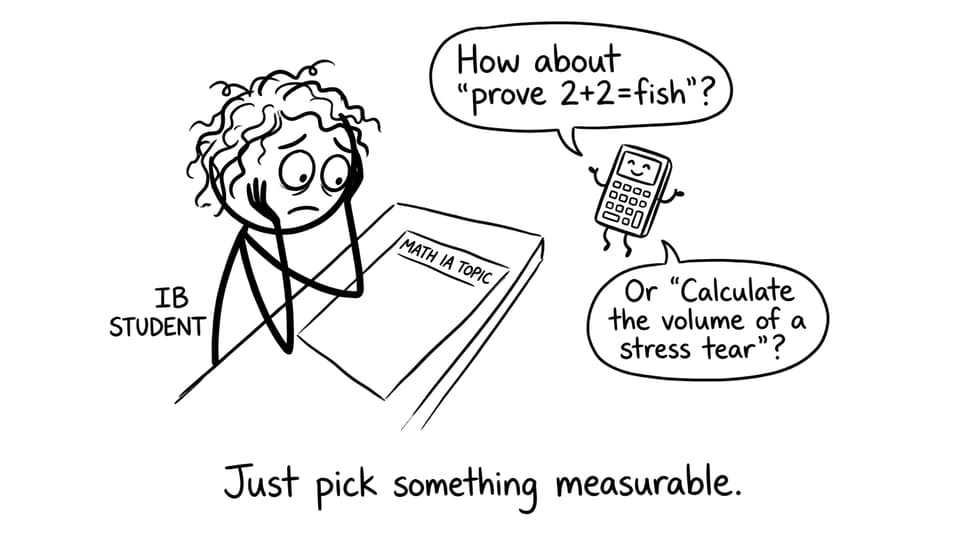
When you are stuck choosing an IA topic, it rarely feels like a “math” problem. It feels like standing in front of an open fridge at midnight: plenty of options, none that look right, and the clock is judging you.
The good news is that a strong IB Math IA is not about finding the most impressive idea. It is about choosing something small enough to finish and rich enough to explore. Manageable topics win because they create space for clarity, reflection, and tidy mathematics. And those are exactly the things examiners reward.
A quick checklist for a manageable IB Math IA topic
Before you commit, run your idea through this quick filter. If you can answer “yes” to most of these, you have a realistic IB Math IA.
-
You can describe your investigation in one sentence.
-
You can collect or access data in under 60 minutes.
-
The maths includes at least one technique you can explain confidently (regression, calculus, probability, geometry, sequences).
-
Your topic allows evaluation: assumptions, limitations, and improvements.
-
You can write a focused research question (not a general theme).
If you want the structure to feel less mysterious, follow a proven IA layout like in How to Structure Your IB Math IA Logically, then refine your approach using How to Structure the IB Math IA for Maximum Clarity.
Simple and manageable IB Math IA topics (with research question angles)
Below are classic, scoring-friendly directions. The key is not the headline topic. The key is making a narrow question that fits your course and your time.
Golden ratio: measuring beauty without over-claiming
This is one of the most approachable IB Math IA topics because it is measurable. You can collect your own data through photos, measurements, or proportions in a single afternoon.
Manageable angles:
-
Compare ratios in leaves, shells, or flowers and test how close they are to (\varphi \approx 1.618).
-
Investigate architectural facades (your school building counts) and quantify “fit.”
-
Use error analysis: how much does measurement uncertainty change your conclusion?
Tip: keep the conclusion humble. You are investigating approximation and variation, not proving nature follows a rule.

Fibonacci sequence in nature: counting patterns you can defend
The Fibonacci sequence is easy to explain, and that is why it works. A manageable IB Math IA here focuses on one organism or one setting, and then asks a precise question.
Manageable angles:
-
Do sunflower seed spirals match consecutive Fibonacci numbers across different sunflowers?
-
Are leaf spirals on a specific plant consistent with Fibonacci phyllotaxis?
-
Compare two species and discuss why patterns vary.
The best evaluations here talk about sampling bias, measurement noise, and biological variation.
Mathematics of music: frequencies, ratios, and real audio data
Music is a great topic when you want personal engagement without complicated modelling. It connects naturally to ratios, logarithms, and wave frequency analysis.
Manageable angles:
-
Investigate equal temperament vs “pure” tuning by comparing frequency ratios.
-
Measure harmonic frequencies from a recorded instrument note and compare to theory.
-
Use logarithms to connect frequency changes to pitch perception.
If you need a framework for communicating your work clearly, use 10 Essential Tips to Write a Strong IB Math IA Commentary as your quality checklist.
Probability in everyday experiments: small trials, strong reflection
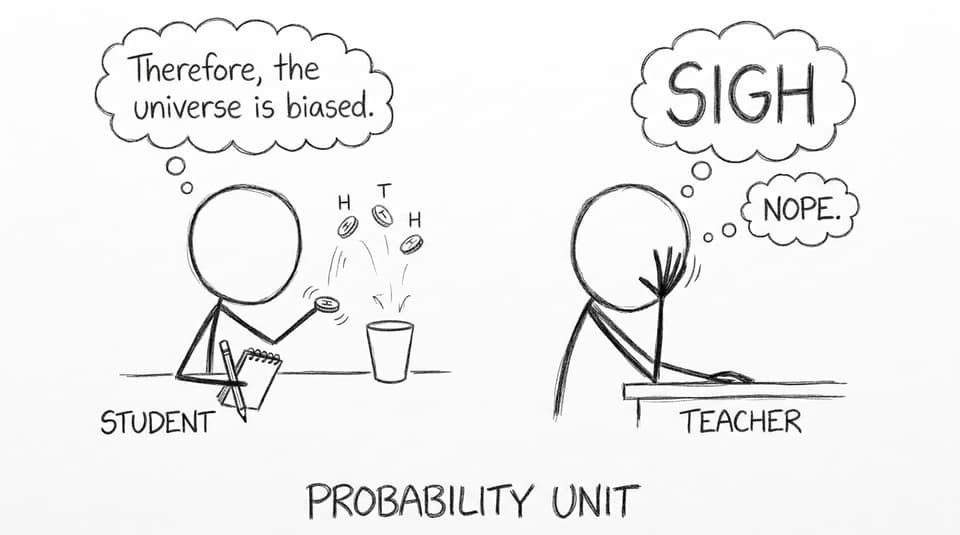
Probability topics stay manageable because your experiment can be simple, but your discussion can still be deep. That balance is perfect for IB Math.
Manageable angles:
-
Compare theoretical vs experimental probability for a biased coin (or a spinner you build).
-
Use a card-draw simulation and discuss convergence using increasing sample sizes.
-
Model streaks (runs) and discuss why humans see patterns in randomness.
Statistics in sports: the dataset is already waiting for you
Sports statistics are everywhere, which makes this a low-friction IB Math IA. Your job is to avoid turning it into a spreadsheet tour. Pick one relationship and investigate it.
Manageable angles:
-
Does a player’s shot volume predict scoring efficiency (linear or nonlinear regression)?
-
Compare home vs away performance using confidence intervals.
-
Model improvement over time using moving averages or exponential smoothing.
To make your data work cleaner, follow How to Use RevisionDojo to Prepare for IB Math IA Data Analysis.
Symmetry in art and nature: geometry you can actually show
Symmetry is visually intuitive, and that helps your mathematical communication. In IB Math, that clarity is a silent advantage.
Manageable angles:
-
Classify symmetry types in tiled patterns and connect to transformations.
-
Measure bilateral symmetry in leaves (left vs right side) and quantify deviation.
-
Use rotations and reflections to recreate a repeating motif.
If you want a fast refresh of geometry tools, RevisionDojo’s IB Math AA Geometry and Trigonometry Notes are a solid anchor.
Pascal’s triangle: patterns that turn into real mathematics
Pascal’s triangle is accessible, but it can still scale into strong IB Math if you focus on a particular pattern and explore why it appears.
Manageable angles:
-
Connect diagonals to Fibonacci numbers and justify it.
-
Explore modulo patterns (like mod 2) and discuss fractal-like structure.
-
Link rows to binomial expansion with examples.
For students who need binomial practice support while writing, use Binomial Theorem Questionbank practice.
Basic cryptography: ciphers, modular arithmetic, and clarity
Cryptography is fun because it feels like solving a mystery, but the mathematics can stay very controlled.
Manageable angles:
-
Analyze Caesar and substitution ciphers with frequency analysis.
-
Use modular arithmetic to create and break a simple shift cipher.
-
Discuss security limits: why “simple” encryption fails.
Population growth models: linear, exponential, logistic (choose one)
Modelling topics are common in IB Math for a reason: they naturally create evaluation. The trick is to keep the scope narrow.
Manageable angles:
-
Fit an exponential model to a short time period, then explain where it breaks.
-
Compare exponential vs logistic fits and discuss realism.
-
Use a real dataset (city population, app growth, bacteria count) and interpret parameters.
If you want more inspiration without making your scope explode, skim The Best IB Math IA Topics for 2025 and then deliberately shrink any idea you like.
How to finish your IB Math IA without the last-minute spiral
A manageable topic is only half the win. The other half is turning it into a document that reads like a guided tour.
Use a simple workflow
-
Day 1: Choose topic + draft a one-sentence research question.
-
Day 2: Collect or source data. Make one clean table.
-
Day 3: Do the maths and create graphs.
-
Day 4: Write reflection and evaluation while you still remember what felt hard.
-
Day 5: Edit for clarity and presentation.
Presentation matters more than students think. Use How to Format and Present Your IB Math IA Professionally as your final pass.
Let RevisionDojo do the heavy lifting (without taking over your voice)
A strong IB Math IA is still your work, but the process gets easier when your tools are organized.
-
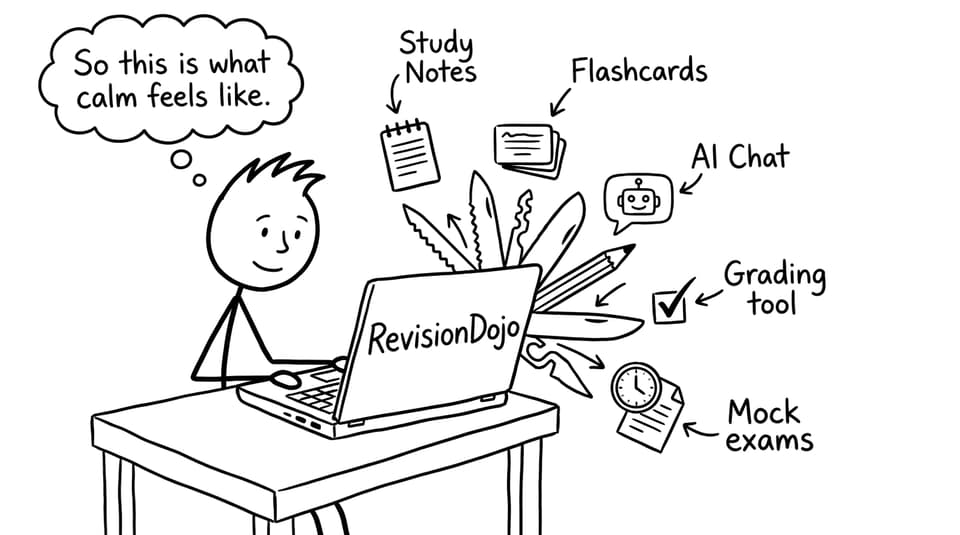
Use Study Notes to refresh the exact technique you need.
-
Use Flashcards to keep key formulas and interpretations active.
-
Use AI Chat to sanity-check whether your research question is focused enough.
-
Use the Grading tools to understand criteria and spot missing reflection.
-
Use Mock Exams and Predicted Papers to keep exam prep moving while your IA runs in the background.
-
Use the Coursework Library and Tutors when you need examples and feedback, not guesses.
For an examiner-aligned view of criteria, start with the IB Math AI IA Grader and then deepen your understanding via the IB Mathematics Applications & Interpretation (AI) IA Guide.
Conclusion: choose small, then make it excellent
A calm truth about IB Math is that the best IA topics are rarely the ones that sound impressive in a group chat. They are the ones you can measure, model, explain, and evaluate without begging time for mercy.
Pick one simple direction from this list, shrink it into a focused research question, and start collecting data this week. Then use RevisionDojo to keep your work structured: the Questionbank for skill gaps, Study Notes and Flashcards for recall, AI Chat for clarity checks, Grading tools for rubric alignment, and Tutors when you want real feedback.
Your goal is not to create the most complicated document in your class. Your goal is to finish a clear, thoughtful IB Math exploration and walk into exams with momentum.