
IB Visual Arts has a strange kind of gravity.
It pulls in students who can’t stop noticing things: the quiet geometry of a hallway, the way light bruises the edge of a desk, the story hiding inside a cheap plastic chair. And then, almost immediately, it introduces a fear that other subjects rarely deliver so personally: what if the thing I make says something unflattering about me?
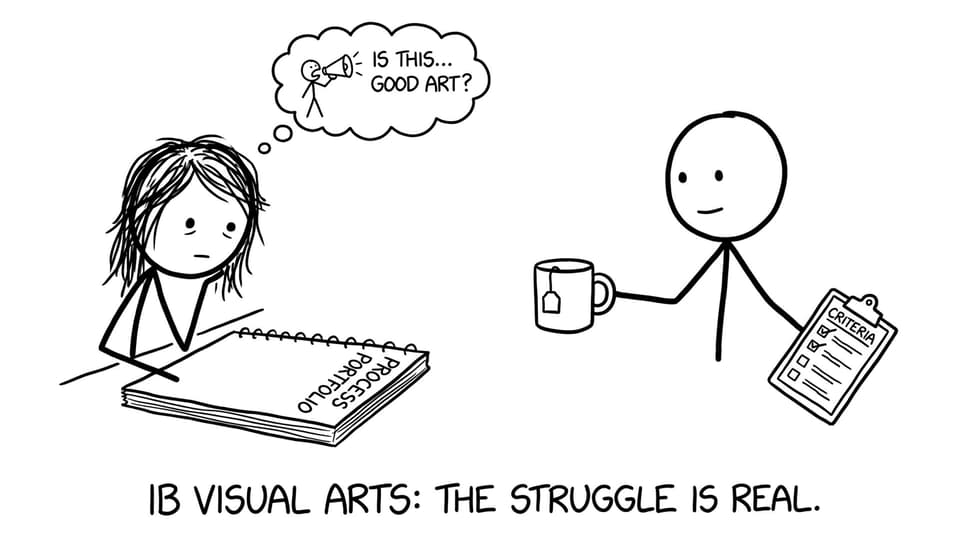
That fear is why IB Visual Arts gets called “risky.” Not because the course is unfair, but because it’s honest. It doesn’t grade how much you care. It grades how clearly you think, how deliberately you choose, and how well you can show your journey from curiosity to resolved work.
This is Part 1 of a short series: a calm decoding of what IB Visual Arts is actually asking you to do, and why “I could do that” is never the end of the conversation.
A quick checklist to steady your IB Visual Arts mindset
Use this as your anchor before you touch a brush or open your portfolio file:
-
Know the three assessed components of IB Visual Arts (Comparative Study, Process Portfolio, Exhibition)
-
Learn the criteria language so your choices become intentional
-
Document decisions, not just outcomes
-
Practice writing about art with clarity (formal analysis + context + intention)
-
Build a simple weekly rhythm: make, reflect, refine
If you want a clean overview of the course components, start with What is IB Visual Arts?. Then come back here.
Why modern art triggers the “I could do that” reflex
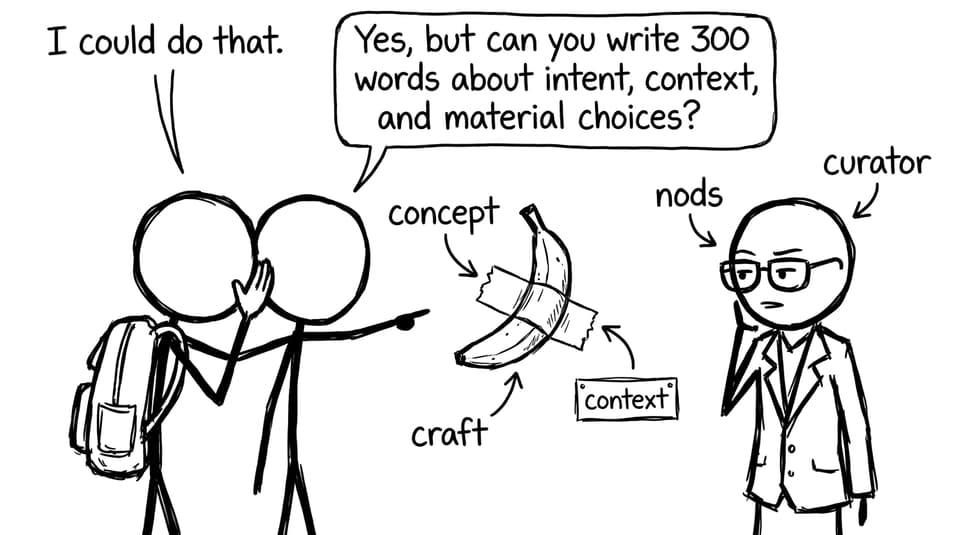
A banana taped to a wall. A nearly blank white canvas. A huge field of red that looks like it took ten minutes.
The first reaction is predictable: I could do that.
And sometimes you literally could. The physical action might be simple. But IB Visual Arts isn’t asking whether you can tape a banana to something. It’s asking whether you can justify choices in a way that holds up under criteria: intention, context, process, and communication.
Modern and contemporary art can feel like a prank when you don’t see the scaffolding underneath. But the scaffolding is often the point: concept, cultural reference, material meaning, audience interaction, and the artist’s position in a wider conversation.
In other words, what looks like “easy” is often just “quiet.”
And quiet art is still art, especially when you can explain what it’s doing.
The real definition of “good” in IB Visual Arts
Many students silently assume IB Visual Arts is scored like this:
-
Pretty work = high marks
-
Ugly work = low marks
That’s not how the assessment is built.
A more accurate model is:
- Clear intention + serious experimentation + smart reflection + coherent selection = high marks
Technical skill matters, yes. But technical skill without thinking is like a fluent sentence that says nothing.
If you’re unsure what examiners reward, read IB Visual Arts Assessment Criteria Explained Simply and keep it open while you plan your next screens.
Where the “uncertain grades” feeling actually comes from
The uncertainty usually isn’t randomness. It’s invisibility.
In IB Visual Arts, a lot of your marks live in things students forget to show:
-
why you chose a material
-
what you changed after a failed attempt
-
what you learned from an artist investigation
-
how one experiment led to a resolved piece
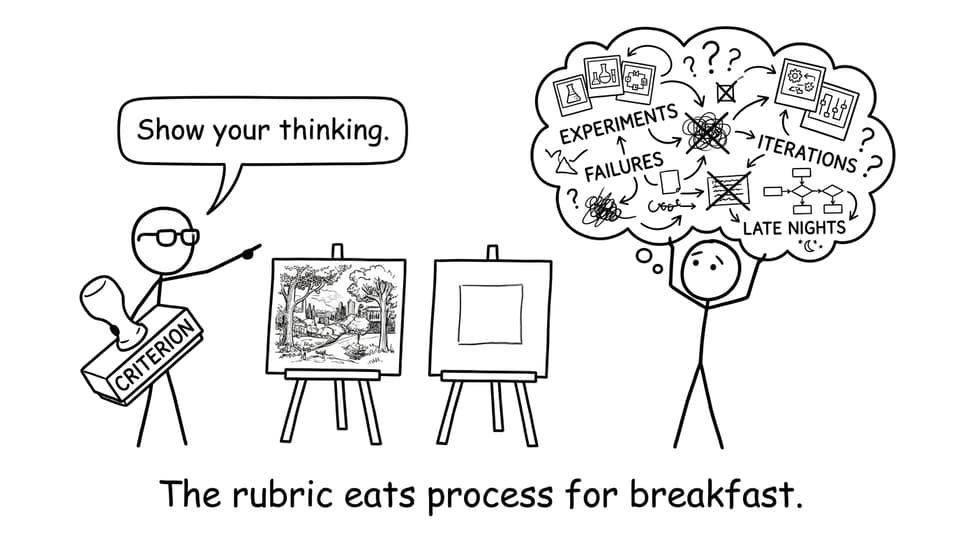
When those steps are missing, your work can look like it appeared fully formed. Examiners can’t award marks for invisible thinking.
This is why the Process Portfolio can feel like the course’s heartbeat. It turns private trial-and-error into evidence.
If your Process Portfolio currently feels like a scrapbook of random images, pause and use How to Structure Your IB Visual Arts Process Portfolio as a reset.
IB Visual Arts Part 1 focus: build a portfolio that shows a mind at work
Think of your Process Portfolio as a detective novel where you are both the mystery and the investigator.
Make experimentation obvious (and keep your “bad” work)
The fastest way to raise marks in IB Visual Arts is to stop hiding the mess.
Show:
-
the version where the composition failed
-
the color test that turned muddy
-
the material that didn’t behave the way you expected
Then annotate like a scientist who’s also an artist: what happened, why it matters, what you’ll do next.
For practical guidance, use How to Show Experimentation in Your IB Visual Arts Process Portfolio.
Choose a theme that creates momentum, not a prison
Themes are misunderstood. A good theme is not a slogan you force onto everything. It’s a question you can’t stop poking.
If you’re stuck, start with theme ideas that naturally generate variations: identity, memory, environment, technology, belonging. Then let the work complicate the theme.
Here’s a strong starting point: Best IB Visual Arts Themes for Process Portfolios.
Learn to speak “rubric” without losing your voice
The rubric is not your enemy. It’s a translation device.
When you learn it, you can defend your choices. You stop guessing what counts. You start making decisions that can be assessed.
To get specific about what earns marks, use Understanding the Marking Criteria for IB Visual Arts.
How RevisionDojo supports IB Visual Arts students (without killing the creativity)
In creative subjects, the danger is always the same: you either drown in freedom or suffocate under structure.
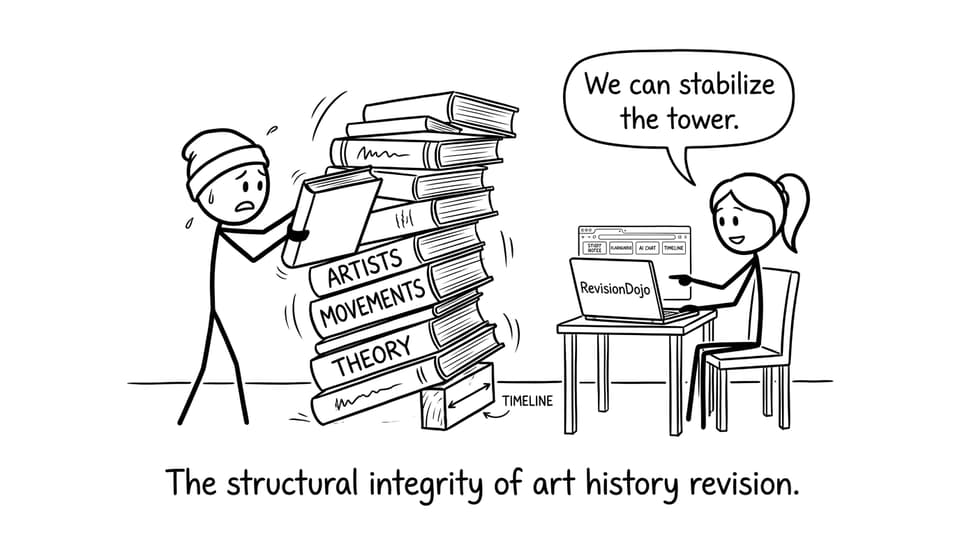
RevisionDojo is built to give you structure that stays out of your way:
-
Use the Coursework Library for real benchmarks and clarity: IB Visual Arts Examples
-
Use Grading tools when you need fast rubric alignment: IB Visual Arts Process Portfolio Grader and IB Visual Arts Comparative Study (HL) Grader
-
Use AI Chat to interrogate your own thinking (“Is my intention clear?” “What’s a stronger comparison point?”)
-
Use Flashcards for artist research, vocabulary, and movement characteristics so writing becomes easier under pressure
-
Use Study Notes, Questionbank, Predicted Papers, and Mock Exams to keep the rest of your IB subjects stable while art takes its time
-
Use Tutors when you want live feedback before you commit to a direction
And when you want a broader exam-prep system that reduces stress across subjects, RevisionDojo App: The Smarter Way to Prep for IB Exams lays out a sustainable weekly loop.
Closing: the risk in IB Visual Arts is the point
The quiet secret of IB Visual Arts is that it’s not grading whether you are “an artist.” It’s grading whether you can become one on purpose.
That’s why the course feels risky: it asks you to put your thinking where someone else can see it. But that’s also why the risk pays off. You learn how to experiment without panic, how to explain choices without apology, and how to build a body of work that has a spine.
If you’re ready to make the process clearer and the grading less mysterious, explore RevisionDojo’s IB Visual Arts resources, use the Coursework Library for benchmarks, and run your drafts through the Grading tools before you submit. Your creativity stays yours; RevisionDojo simply helps you prove it.