



Finishing your final IB examination can feel strangely incomplete. For months, every day had a target. Then you leave the exam room and discover that the work is over, but your mind is still trying to work.
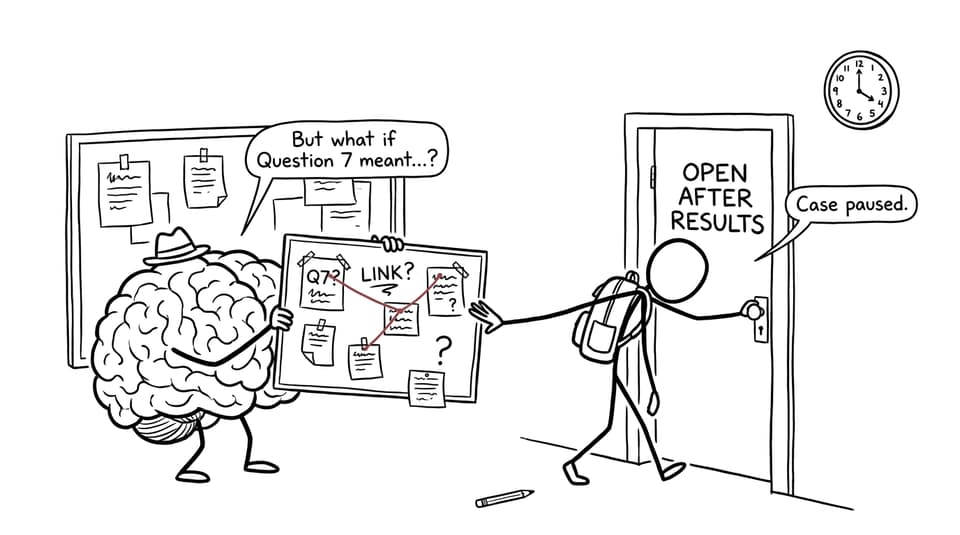
The goal of a debrief last exam overanalyzing reset is not to suppress every thought about the paper. It is to reflect briefly, record anything genuinely useful, and then stop. Give yourself 15 minutes, focus on your process rather than reconstructing answers, and close the review before uncertainty becomes self-judgment.
That distinction matters during the November session. The official 2026 examination window runs from 23 October-13 November, although your final paper depends on your subjects and level. Whether your school calls this IB NovExam, the November session, or part of the fall term, the moment after your last paper deserves a plan.
Your post-exam debrief checklist
After leaving the examination area and following your school’s rules about discussing content:
- Eat, hydrate, and physically settle.
- Set a timer for 15 minutes.
- Record three process observations, not reconstructed answers.
- Identify one lesson for university or a future assessment.
- Write down any remaining administrative tasks.
- Decide when you will prepare for results day.
- Close your notes and do something unrelated to the IB.
The timer matters. A reflection without an ending can quietly become an investigation.
Reflection and rumination are different activities
Useful reflection moves forward. Rumination circles the same uncertainty while creating the feeling that more thinking must eventually produce certainty.
A productive observation sounds like this: “I spent too long planning the first response, so I had less checking time.” It is specific, emotionally neutral, and useful later.
Rumination sounds different: “If I had written another introduction, perhaps the examiner would interpret everything differently and change my grade.” There is no reliable action available, so the mind keeps extending the chain.
Research on post-exam rumination associates repetitive brooding after stressful examinations with continuing negative emotion. This does not make every memory harmful. The quality of the thinking matters: reflection generates a lesson, while rumination generates another round of uncertainty.
Ask yourself:
Is this thought producing information I can use, or am I trying to calculate an unknowable result?
If it is the second, stop the debrief.
Debrief your last exam without reconstructing it
You do not need to remember every question. Attempting to rebuild the paper from fragments often creates false confidence or unnecessary panic. Memory immediately after a stressful event is not a marking service.
Use four short prompts instead.
What did I manage well?
Record one or two things you controlled. Perhaps you followed your timing plan, recovered after getting stuck, interpreted command terms carefully, or kept writing despite fatigue. This is evidence about behaviours worth carrying into your next academic stage.
What challenged my process?
Focus on the mechanism rather than the predicted consequence. Write “I rushed calculations in the final 15 minutes,” not “I probably lost enough marks to miss a 6.” The first is an observation. The second relies on unavailable information, including marking and eventual grade boundaries.
What would I repeat or change next time?
Choose one lesson only. For example:
- Start writing after five minutes of planning.
- Check units immediately after each calculation.
- Read every option before choosing an essay prompt.
- Protect sleep during consecutive examination days.
You are extracting a principle, not continuing revision for an examination that has ended.
Is there anything I must still do?
Check for real obligations: CAS completion, school forms, university communication, document backups, or coordinator instructions. The guide to productive things to do after IB exams can help separate useful closure from invented academic work.
Set boundaries around answer-checking
The group chat promises certainty and often delivers comparison. One person remembers a question differently. Another sounds completely confident. Someone finds an explanation without knowing whether it matches the exact wording. Soon, everyone is grading themselves with incomplete evidence.
You are allowed to say:
- “I’m not comparing answers today.”
- “I’ve finished my debrief, so I’m leaving the paper there.”
- “Let’s talk about something that is not an exam.”
Mute the chat temporarily if necessary. Avoid searching isolated questions. Do not use RevisionDojo’s AI Chat to recreate the examination or estimate your mark from fragments. AI Chat is valuable when a future learning decision exists. After your final paper, speculative marking usually feeds the loop you are trying to close.
Choose an activity that changes the setting. Eat together, walk somewhere, watch a film, or go home and sleep. Remaining outside the exam hall makes another examination conversation more likely.
Create a deliberate transition out of NovExam mode
The September-November period can train students to treat rest as suspicious. Every free hour seems as though it should contain Flashcards, a Questionbank set, or another timed simulation. That habit does not disappear when the final invigilator says stop.
Mark the transition physically:
- Clear examination materials from your desk.
- Back up notes and coursework files.
- Put your calculator, stationery, and timetable away.
- Change clothes, shower, or take a walk.
- Eat a proper meal before making plans.
Choose a low-pressure activity for the evening. Recovery can feel underwhelming because adrenaline has no ceremony. You do not need the perfect celebration or to feel happy immediately.
RevisionDojo’s guidance on managing IB exam stress, handling the final stages of exam fatigue, and staying sane during exam season can help explain why your body may need time to slow down.
Prepare for results without predicting them
Schedule one practical task after your final examination: prepare the logistics for results day. Do it once, preferably several days later, rather than turning the waiting period into a grade forecast.
Confirm how your school will communicate access details. Store your candidate credentials safely. Decide where you want to view your results and who should be with you. RevisionDojo explains how to check IB examination scores online and how to prepare emotionally for results day.
Do not estimate marks question by question. Grade boundaries are established through the assessment process, so remembered answers cannot produce a dependable final grade. If you want context later, use the RevisionDojo IB grade calculator after you have real information, not guesses.
Know when to ask for support
Some post-exam replay is common. Seek support if worry repeatedly disrupts sleep, appetite, relationships, or ordinary activities. Speak to a parent, trusted teacher, school counsellor, healthcare professional, or another appropriate adult.
A simple opening is enough: “My examinations are finished, but I cannot stop replaying them, and it is affecting my day.” You do not need to prove that your stress is serious before asking for help.
Close the examination cycle cleanly
The final paper creates a rare uncertainty. The work is finished, but the outcome is unavailable. Overanalysis is tempting because it impersonates control.
A better response is smaller. Debrief for 15 minutes. Keep observations factual. Extract one transferable lesson. Complete genuine administrative tasks. Then stop.
RevisionDojo remains the ultimate IB resource when your next actionable step arrives. Its Study Notes, Flashcards, Questionbank, AI Chat, Grading tools, Predicted Papers, Mock Exams, Coursework Library, and Tutors can support future learning, results decisions, or a carefully planned retake if relevant. For now, the most intelligent use of a study platform may be knowing that you do not need to open it tonight.
The paper has ended. Let the ending be real.