

If you've ever stared at your final grade and felt a strange certainty that your IA was better than that, you're not alone.
Most IB students don't panic because they hate hard work. They panic because they can't see the whole system. Your IA goes into the machine, marks come out, and there's a quiet, unnerving gap in between.
So let's close that gap.
This guide answers the question directly: can your IA be remarked? Yes, your IA can be part of a remark process, but the way it works is different from what most students imagine. We'll walk through what's possible, what isn't, when it's worth it, and how to decide calmly when emotions are loud.
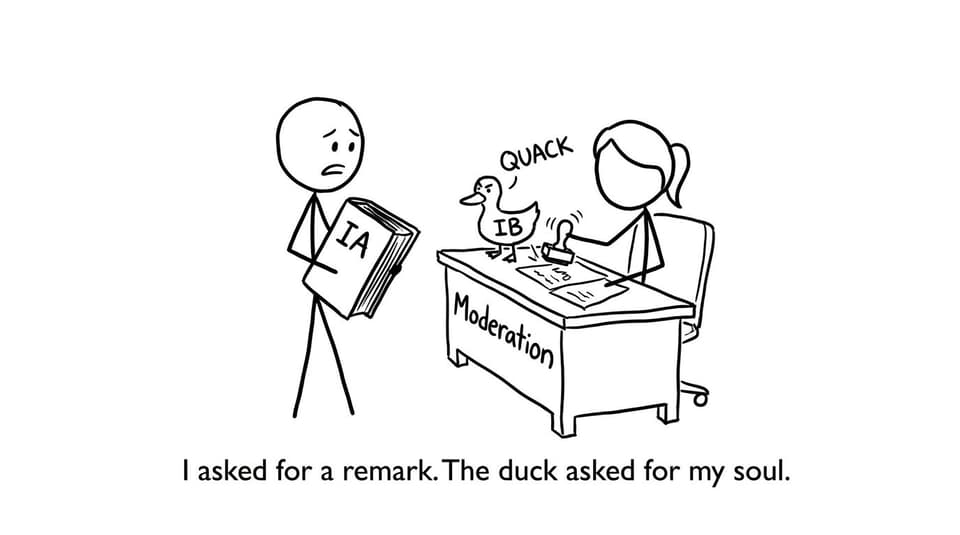
IA remarking in one page (quick checklist)
Use this as your fast decision tool before you read the deeper details.
- Yes, your IA can be affected by a remark (because IB can re-check components and recalculations, and moderated coursework can be reviewed through the inquiry route).
- No, you cannot simply "resubmit" a new IA after results.
- Your teacher does not re-mark your IA during a remark; the process is handled through IB services.
- Grades can go up, down, or stay the same.
- The best time to consider action is when you're near a boundary and the change would meaningfully affect your next step (university offer, scholarship, course requirement).
- You need a reason, not just a feeling: a pattern of inconsistency, boundary proximity, or clear procedural concern.
If you want to strengthen your coursework before results day, RevisionDojo's tools (especially the grader and exemplars) are the calmer route: AI IB Coursework Grader: Get Instant Feedback on Your Work and IB Coursework Exemplars Index (IA, EE, TOK).
What "remarking your IA" actually means
When students say "remark," they often imagine an examiner rereading the entire IA and giving it a fresh score like a re-do.
But the IB process is more structured.
Your IA is internally assessed by your teacher and then moderated by IB examiners. That moderation can adjust marks for your class (or keep them the same) based on how closely internal marking matches the IB standard.
So when you ask, "Can my IA be remarked?" you're really asking one of two things:
- Can the IB re-check the results and component totals? (This is often what a remark service covers: ensuring nothing was totaled or recorded incorrectly.)
- Can the IB re-review how moderation affected the coursework? (This tends to fall under inquiry services rather than a simple re-mark of your teacher-scored work.)
In practice, the most important truth is this: your IA matters, and it can influence your grade after results, but the pathway is not "upload a better draft." It's a formal process, with risk, cost, and uncertain outcomes.
If you're still learning how moderation works, it helps to read a grounded overview: IB Internal Assessment: A Complete Guide to Success in the Diploma Programme.
When an IA remark is most likely to help
Most remark requests don't change the final grade. Not because students are wrong to hope, but because marks tend to be approximately right.
The cases where an IA remark (or inquiry) is most worth considering usually look like this:
You're extremely close to a grade boundary
If you're one or two marks away at the subject level, small component shifts can matter. This is where "suddenly math matters," because a tiny movement in a weighted component can push the overall grade.
Your teacher flags a possible moderation mismatch
Sometimes teachers notice that the class was marked consistently, but the moderation result seems unusually harsh (or unusually generous). That doesn't guarantee an error, but it can justify asking questions.
There's a credible administrative concern
Wrong component entered, missing upload, incorrect level, incorrect category, or something procedural that can be checked.
The outcome would change something real
A remark is not a therapy session. It should be tied to a concrete goal: meeting a university condition, unlocking a subject prerequisite, or improving an overall point total for an offer.
If you're trying to understand what "strong coursework" looks like before you ever reach this stage, build your IA around criteria from the beginning using subject-specific guides like IB Internal Assessment Guides and targeted criterion breakdowns (example for Math AA): Criterion B: Mathematical Communication.
When an IA remark is usually not worth it
You're far from a boundary
If you need a large jump to change the final grade, an IA remark is usually a long shot. It's not impossible, but it's not a plan.
You can't name what might be wrong
"Because I worked hard" is emotionally valid, but it isn't evidence of an assessable error.
You're hoping for a rewrite opportunity
The IB isn't asking whether your IA could be better. They're checking whether the assessment outcome is correct and aligned to the system.
You're doing it out of pure panic
This is the most human reason, and the most expensive one.
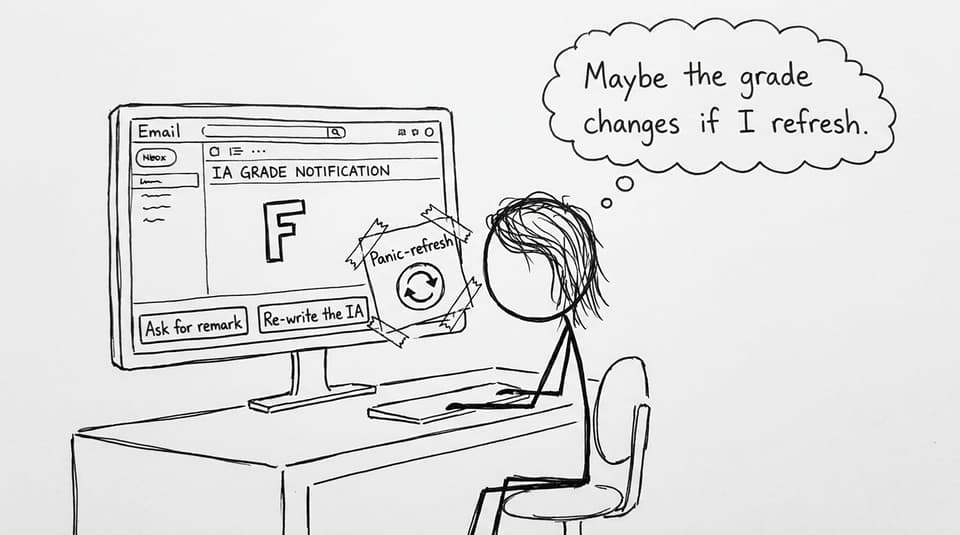
The calm decision process: "evidence, boundary, impact"
Here's a disciplined way to decide, using three questions.
Evidence: What makes you think the IA outcome is inaccurate?
Not "I feel robbed." Something more concrete:
- teacher expectation vs final result mismatch
- moderation shift that seems inconsistent with class performance
- suspicious component weighting or recorded marks
- a clear anomaly compared to other components
Boundary: How close are you to the next grade?
If you're close, small changes matter. If you're not, small changes won't help.
Impact: What changes if it goes up?
Be specific: university condition, scholarship threshold, subject requirement.
If you want to build this kind of evidence-based view before results, RevisionDojo makes the process less guessy:
- Use the Grading tools to see criterion-by-criterion weaknesses early.
- Use the Coursework Library to compare structure and depth against real exemplars.
- Use AI Chat to ask "why would an examiner not award this?" and get a rubric-anchored answer.
A good starting point is the platform explainer: How RevisionDojo Enhances IB Internal Assessment (IA) Feedback and Moderation.
What you can do before results to reduce remark regret
There's a quiet advantage most top students have: they treat the IA like a draft-driven project, not a single submission.
If you want fewer "I should've…" thoughts later, build a loop now.
Use criterion-first revision
Pick one weak criterion per week and improve it deliberately.
For example, if your science IA is strong on data but weak on evaluation, don't rewrite everything. Fix the evaluation section.
Helpful reads:
- How to Write a Compelling IA Evaluation Section
- How to Design Effective Experiments for a Science IA
- Tips for Organizing Graphs and Tables in Your IA
- How to Write a Strong IA Research Question
Use "external eyes" early
Your teacher is one set of eyes, and they're busy.
RevisionDojo's advantage is speed and iteration. With the IB IA/EE/TOK Grader workflow, you can upload, get rubric-aligned feedback, revise, and re-check before your next teacher meeting: IB IA/EE/TOK Grader: How RevisionDojo Delivers Rubric-Aligned Feedback.
Pair coursework work with exam prep
This sounds unrelated, but it's not.
When your coursework is stable, your brain has more room for exam training. RevisionDojo connects the ecosystem: Study Notes, Flashcards, Questionbank, Mock Exams, Predicted Papers, AI Chat, and Tutors.
If you need an exam routine that doesn't burn you out, use: How to Study for IB Mocks (Without Burning Out).
A simple script to ask your coordinator about IA remark options
Keep it short, factual, and calm. You're not negotiating; you're requesting clarity.
- "I'd like to understand which post-results services are available for my subject."
- "Can we check whether I'm near a boundary and whether a component review could change the grade?"
- "Is there any indication that moderation significantly affected the coursework for our cohort?"
That's it. You're trying to get signal, not create drama.
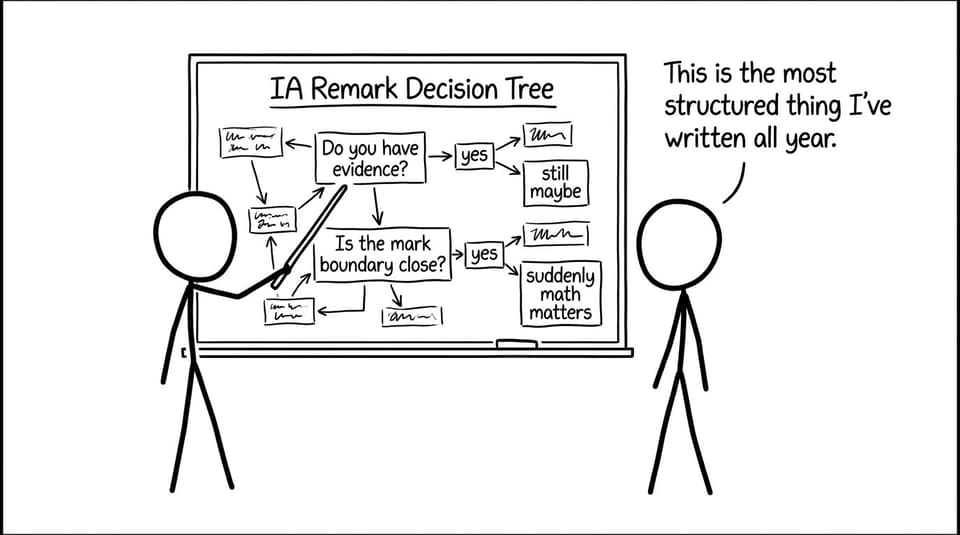
Closing: treat your IA like a system, not a verdict
An IA is strange because it feels personal, but it's judged impersonally.
That mismatch is where most stress lives.
Yes, your IA can be remarked in the sense that post-results services can review how components and outcomes were handled. But the deeper win is building an IA that doesn't need rescuing at the end.
If you want the most reliable path, make RevisionDojo your coursework + exam home base: draft with the Coursework Library, tighten with Grading tools, sanity-check with AI Chat, and keep the rest of your grades rising through Study Notes, Flashcards, the Questionbank, Mock Exams, Predicted Papers, and support from Tutors.
If you're deciding whether to pursue an IA remark, use the calm trio: evidence, boundary, impact. Then choose like a strategist, not like a tired student refreshing their inbox.