


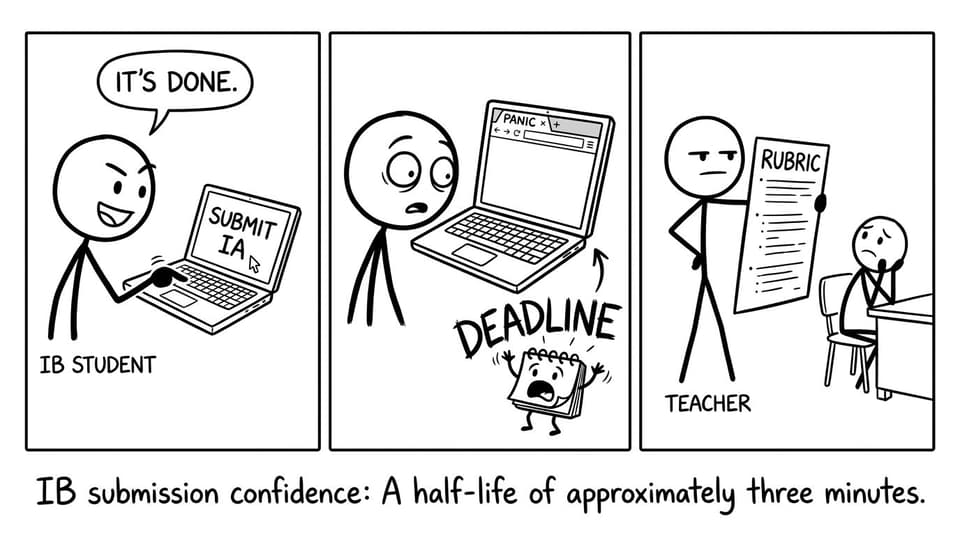
Every IB student has a moment where a single document starts to feel like a verdict.
You hit submit on your IA and, for a few seconds, the world is quiet. Then the mind does what it always does under pressure: it invents a worst-case scenario and asks it like a legal question.
Can you fail the IB because of an IA?
The honest answer is nuanced. An IA can hurt you. A weak IA can drag a subject grade down. A missing IA can create serious problems with course completion. And yes, in some edge cases, an IA can be part of the chain of events that leads to failing the Diploma.
But most of the time, the fear is bigger than the math.
This guide explains what your IA can and cannot do, how failing actually happens in the IB, and what to do if your IA is already submitted and you're worried. Along the way, we'll keep it practical, rubric-aligned, and calm.
The quick answer checklist (save this)
If you only read one section, read this.
- A low-scoring IA can lower your final subject grade, especially in subjects where the IA weighting is high.
- A missing IA is far more dangerous than a weak IA.
- One bad IA rarely makes you fail the entire Diploma on its own. It usually becomes a problem when it combines with weak exam performance, missed core requirements, or multiple low subject totals.
- The best response to IA anxiety is not rumination. It's evidence: rubric checking, targeted improvements, and exam-focused revision.
If you want a structured way to self-check rubric alignment, start with IB Internal Assessment Guides and then compare your draft to criterion language using a rubric tool like the IB Psychology IA Grader (or another subject-specific grader).
What your IA actually does to your grade
An IA is not a side quest. It is assessed work that contributes directly to your final subject result.
That said, the key word is contributes. In most IB subjects, the IA is one component among others (typically exams). So the real question becomes:
- How heavily is the IA weighted in this subject?
- How strong are the other components you can still control?
For example, RevisionDojo's rubric pages often state the weighting clearly. On the IB ESS (new) IA Grader, the IA weighting is described as a significant portion of the final grade (varying by level). That's the right way to think: not "my future is over," but "this component is worth X%, so I need to plan the rest accordingly."
A useful mental model:
- Your IA is your floor if exams go badly.
- Your exams are your ceiling if your IA is average.
When students fear the IA, they often treat it like a single point of failure. In reality, it's usually one dial among several.
Can a single IA make you fail the Diploma?
In most normal situations, a single weak IA does not automatically fail you.
The Diploma result is built from multiple subjects plus core requirements. So failing the Diploma typically comes from patterns:
- consistently low subject grades,
- an unexpected collapse in exam performance,
- missing required components,
- academic misconduct, or
- a combination of the above.
Where the IA becomes decisive is when you're already on a knife-edge.
Imagine you are hovering around passing in a subject. If your IA is very low, it can pull your final grade below the boundary. Then that subject grade can affect your total points. Then the total points can affect whether you meet the Diploma requirement.
So yes: one IA can be part of the story.
But it's rarely the whole story.
The calmer, more useful reframe is this: a weak IA raises the standard your exams must meet. That's not comforting, but it is actionable.
The situations where an IA becomes genuinely dangerous
Let's separate "bad feeling" from "real risk." Your IA becomes genuinely dangerous in four scenarios.
A missing IA or non-submission
A missing IA is different from a low-scoring IA.
Non-submission can create a situation where:
- the subject component is incomplete,
- the school may be unable to award a predicted standard internally,
- and you may end up with a result that cannot be moderated or awarded normally.
If you've missed an IA deadline, don't disappear. Communicate immediately, propose a realistic plan, and submit something that meets the minimum requirements.
If you need a broader system to stop deadlines from sneaking up, build an exam-and-coursework routine using How to Study for IB Exams: Step-by-Step Guide and pair it with regular coursework checkpoints.
Academic misconduct or AI misuse
The fastest way to turn an IA into a Diploma-level problem is academic misconduct.
Students don't usually intend to cheat. They panic. They copy a paragraph. They over-rely on a tool. They "fix wording" until the voice no longer sounds like them.
If you use support tools, use them transparently and responsibly. RevisionDojo's strength is that it helps you learn the rubric language and improve your own work, not replace it. When you're uncertain, ask your teacher what is permitted and keep drafts.
A very low IA plus weak exam readiness
This is the most common real-world risk pattern.
A low IA doesn't end you. It just means your exam performance must be more consistent. That's why students who want to "make up for the IA" should move quickly into exam training: topic-by-topic practice, timed work, and feedback loops.
RevisionDojo's ecosystem is built for that shift:
- Questionbank for targeted practice by topic and difficulty
- RevisionDojo App: The Smarter Way to Prep for IB Exams for a complete workflow
- How to Run Timed IB Mock Exams in RevisionDojo for stamina and timing under pressure
Multiple IAs slipping at once
One IA can be repaired. Several weak or late IA submissions create a fog of stress that makes exam preparation worse.
This is where systems matter more than motivation.
Small, repeatable habits win:
- one rubric check per week,
- one set of improvements per criterion,
- one timed practice session per week,
- one mistake-review loop.
Why good IAs feel "too simple" (and weak ones feel "hard")
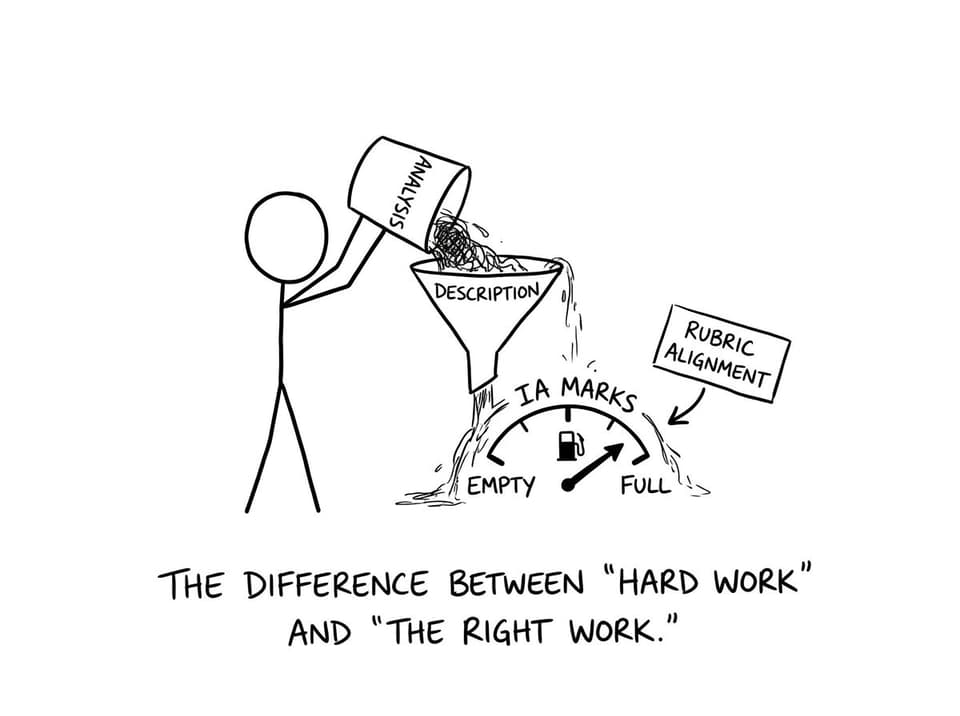
A surprising truth: students often lose IA marks not because they didn't work hard, but because they worked hard in the wrong direction.
The IA rewards alignment.
Alignment to:
- the criteria,
- the command terms implied by the rubric,
- the required structure,
- the evidence demanded.
A common failure mode is description dressed up as effort. You can write pages and still not hit the top markbands if you don't convert information into analysis.
This is why rubric-based feedback is so powerful. If you haven't already, read IB Internal Assessment Feedback: Detailed Comments and Suggestions. Then run a structured self-check using a rubric grader like the IB Business Management IA Grader or the IB Design Technology SL IA Grader.
The goal is not to chase perfection. The goal is to stop bleeding marks in predictable places.
If your IA is already submitted and you're panicking
After submission, the IA becomes a fixed number. Panic keeps treating it like a moving target.
So switch targets.
Here's the most useful post-submission plan:
Accept the uncertainty, then quantify it
Ask your teacher for a general indication if they can provide it. If not, assume a conservative range.
Then ask: what exam grade do I need to reach my goal?
You don't need perfect accuracy. You need a plan that makes you feel less helpless.
Move into exam-mode preparation early
This is the part students skip because it feels like admitting the IA wasn't "enough." But the diploma is a total score, and exams are the largest lever.
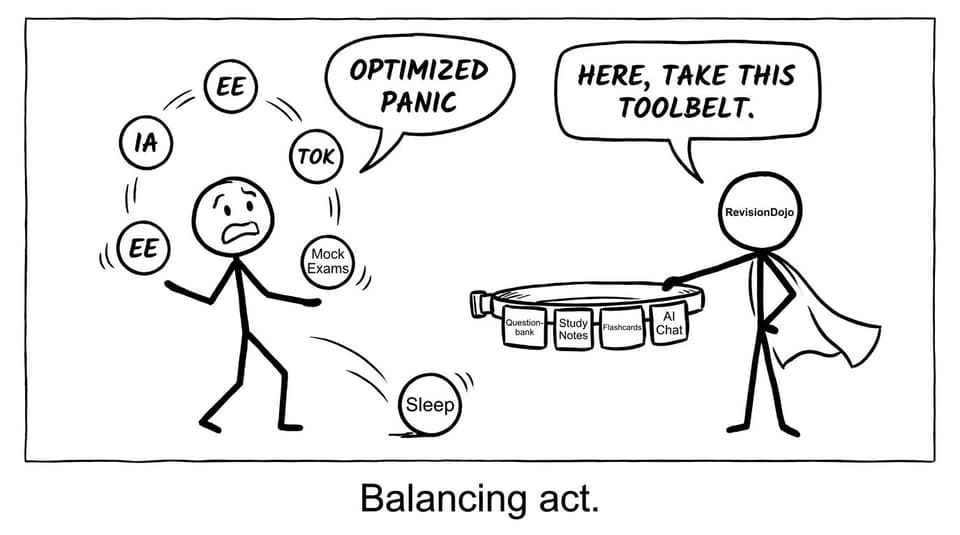
Use a simple loop:
- Study Notes for understanding
- Flashcards for daily recall
- Questionbank for application
- Mock Exams and predicted sets for timing
RevisionDojo is designed to make that loop fast:
- Use Study Notes and Flashcards from the free resource hub at Notes + Flashcards + Question Bank (Free)
- Ask clarifying questions using Jojo in AI Chat
- Build confidence with timed training using How to Run Timed IB Mock Exams in RevisionDojo
Convert IA anxiety into one constraint
A weak IA is not a prophecy. It's a constraint.
Constraints are useful because they tell you where to focus. If the IA might cost you points, the solution is not "study everything." The solution is "study what gets marks fastest."
That usually means:
- command terms,
- common question types,
- high-frequency topics,
- clean exam technique.
If your IA is not submitted yet: the fastest way to raise marks
If your IA is still in draft, you have leverage.
The fastest improvements tend to come from the same places across subjects:
Tighten the research question
Most IA drafts are too broad. Examiners reward precision because it makes analysis possible.
You don't need a dramatic topic. You need a question that produces interpretable evidence.
Upgrade analysis (not word count)
Add:
- comparison,
- evaluation,
- limitations,
- justified improvements,
- links to theory.
Cut:
- repeated background,
- obvious statements,
- unsupported claims.
Use exemplars strategically
Exemplars are not templates to copy. They're calibration tools. Compare your work to the standard: structure, depth, data handling, and reflection.
You can browse subject-specific exemplars like Chemistry IA Exemplars or see how different task styles look in IA Examples for IB Math AI.
Get rubric-aligned feedback, not general comments
General feedback sounds like: "make it clearer."
Rubric feedback sounds like: "your evaluation needs two specific limitations linked to method and one justified improvement tied to reliability."
If you want a deeper look at how to build a feedback loop, read How RevisionDojo Enhances IB Internal Assessment (IA) Feedback and Moderation.
Closing: the IA is a chapter, not the book
If you're asking whether an IA can make you fail, you're not being dramatic. You're being realistic about stakes.
But realism cuts both ways.
A weak IA is rarely a single point of failure. It's usually a signal: tighten your rubric alignment, protect your exam performance, and build a system that keeps coursework from turning into chaos.
That's exactly what RevisionDojo is built for: IA guides and exemplars when you're writing, rubric-aligned Grading tools when you're revising, and the full exam engine when it's time to perform: Questionbank, Study Notes, Flashcards, AI Chat, Mock Exams, Predicted Papers, a Coursework Library, and Tutors when you need a human second set of eyes.
If your IA is worrying you today, pick one next step that creates evidence: run a rubric check, do a targeted Questionbank set, or schedule one timed mock. Then repeat tomorrow. That's how IB outcomes change.