
You’re halfway through your IA, your brain is fried, and a meme perfectly captures the problem you’re analyzing. It feels like relief: one image, instant clarity, shared understanding.
But the IA isn’t your group chat. It’s assessed coursework. And the difference between “engaging” and “unprofessional” is often one caption, one missing citation, or one meme that makes sense only if you’re online at the same corners of the internet.
So, can you include memes in your IA? Yes, sometimes. The smarter question is: can you include a meme in a way that earns marks rather than suspicion?
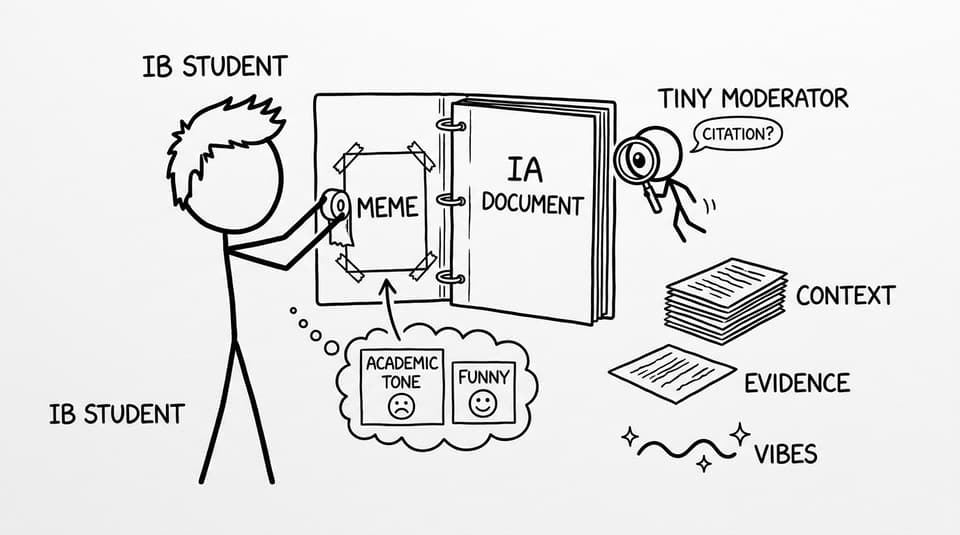
The short answer: yes, but treat a meme like evidence
A meme can belong in an IA if it functions like a source or a visual artifact, not like decoration.
Use this quick checklist before you add one:
-
Does the meme directly support your argument in the IA?
-
Can you explain its relevance in one or two academic sentences?
-
Can you cite where it came from (creator, platform, date, URL)?
-
Is the tone appropriate for a teacher and external moderator?
-
Would your IA still make sense if the reader didn’t “get” the meme?
If you answered “no” to any of those, keep the meme out of the main body. Put it in your planning notes instead.
When memes can strengthen an IA
Memes work best when your IA is analyzing communication, perception, or real-world behavior. In other words: when the meme is the data.
Memes as primary source material in an IA
If your IA involves media analysis (Language A, Language B, Digital Society, some Individuals and Societies approaches), a meme can be legitimate evidence because it’s a cultural text.
In that case, your IA isn’t saying “this is funny.” It’s saying:
-
this meme uses rhetoric
-
this meme reflects an attitude or bias
-
this meme spreads an idea efficiently
-
this meme shows how meaning changes with context
The key is that you’re analyzing it the way you would analyze an ad, headline, or infographic.
Memes as a visual example (rare, but possible)
In some IAs, you might use a meme as a visual example of a misconception or a simplified representation that you then critique.
But keep it minimal. The meme must not replace explanation, data, or evaluation.
If you want a rubric-centered way to pressure-test choices like this, it helps to read what examiners actually reward in an IA: What IB Examiners Look for in a Strong IA.
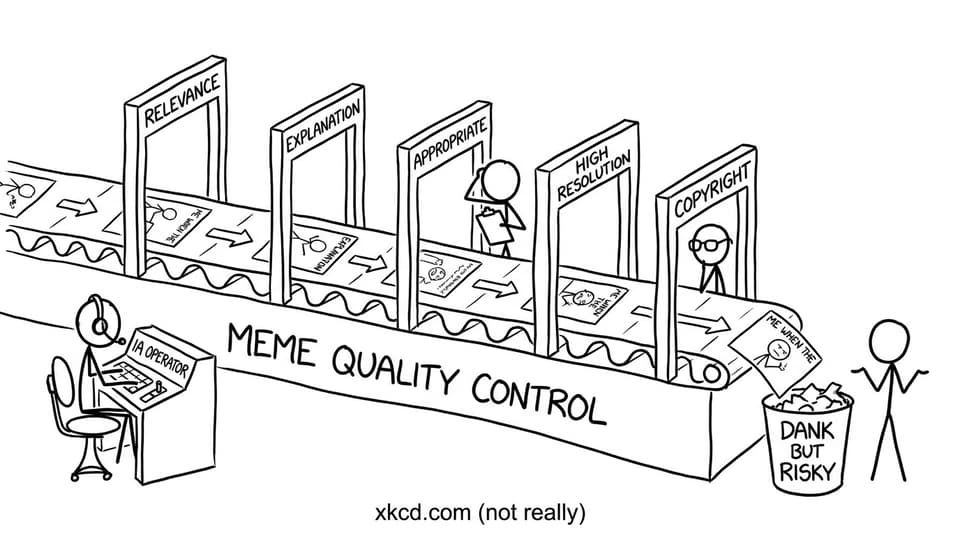
What can go wrong (and how to avoid it)
A meme can quietly damage an IA in three common ways.
Tone drift: your IA starts sounding casual
Your analysis might be strong, but one meme can signal “I’m not taking this seriously,” especially if it’s placed like a punchline.
Fix: introduce it like a source. Use neutral language: “Figure 2 illustrates a common online framing of…” Then move straight into analysis.
Misinterpretation: the reader doesn’t share your internet context
Moderators are intelligent, but they’re not required to understand your niche references. If the meme needs insider knowledge, it becomes confusing.
Fix: explain the relevant context briefly. Make the IA understandable without shared cultural background.
Academic integrity: unclear ownership or missing citation
Memes are often reposted and remixed. That doesn’t remove your responsibility to cite where you found it.
Fix: cite the version you used (platform, account, date accessed). If authorship is unknown, cite it as an online image with as much detail as possible. When in doubt, ask your teacher.
For more coursework decision-making that won’t backfire later, you can browse focused IA support at IB IA Guides.
How to include a meme in an IA the “safe” way
Here’s a practical method that keeps your IA clean.
Place it strategically
Put the meme near the paragraph where you analyze it, not in the introduction as a hook. In an IA, hooks are earned through clarity, not comedy.
Caption it like an academic figure
Use a figure label, a short description, and a citation. Treat it the same way you’d treat a graph or photograph.
Explain what it shows and why it matters
One or two sentences is enough. Your IA should never rely on “you know what I mean.”
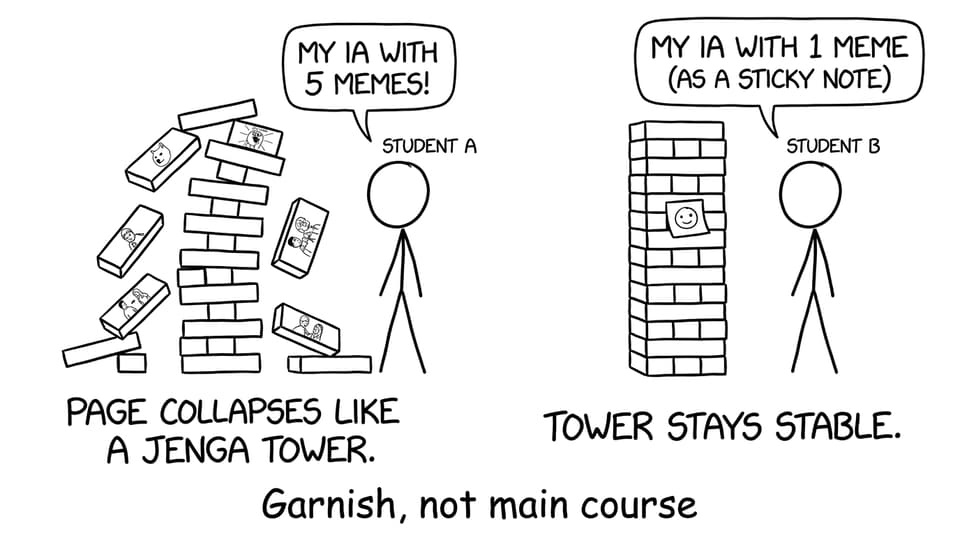
Keep it rare
Think of a meme as garnish. One good meme can work. Five memes turns your IA into a mood board.
Use RevisionDojo to keep your IA academic (even if it’s creative)
The most underrated skill in an IA is not creativity. It’s judgment: knowing what earns marks.
RevisionDojo is built for that kind of judgment call:
-
Use the All IA posts hub to compare strategies across subjects.
-
Check your structure against examiner expectations in What IB Examiners Look for in a Strong IA.
-
If you’re unsure how your draft reads to a marker, use IB Internal Assessment Feedback and RevisionDojo’s Grading tools to map changes to criteria.
-
When you’re stuck on phrasing or tone, RevisionDojo’s AI Chat can help you rewrite a paragraph so it stays formal while still sounding human.
-
If coursework is stealing exam time, use the RevisionDojo loop: Study Notes, Flashcards, and the Questionbank, plus Mock Exams and Predicted Papers to keep timing sharp. A good reset is How to Study for IB Mocks (Without Burning Out).
-
If you need real models, the Coursework Library is the fastest way to see what “appropriate” looks like in practice.
-
And if you want a human second opinion, Tutors are there for high-stakes choices (like whether your meme helps or hurts).
Conclusion: the IA isn’t allergic to humor, it’s allergic to randomness
Including memes in an IA isn’t automatically wrong. But it must be relevant, explained, and cited. If a meme sharpens your point and you treat it like evidence, it can add clarity and even originality. If it’s there because you were tired and wanted your document to feel more fun, it usually costs more than it gives.
If you want to make smart, criteria-aligned calls while still keeping your IA human, use RevisionDojo as your coursework compass: the Coursework Library for models, Grading tools for rubric alignment, AI Chat for clean academic tone, and the Questionbank, Study Notes, Flashcards, Mock Exams, and Predicted Papers to protect your exam preparation while your IA comes together.