


A student can complete every CAS requirement and still miss the point.
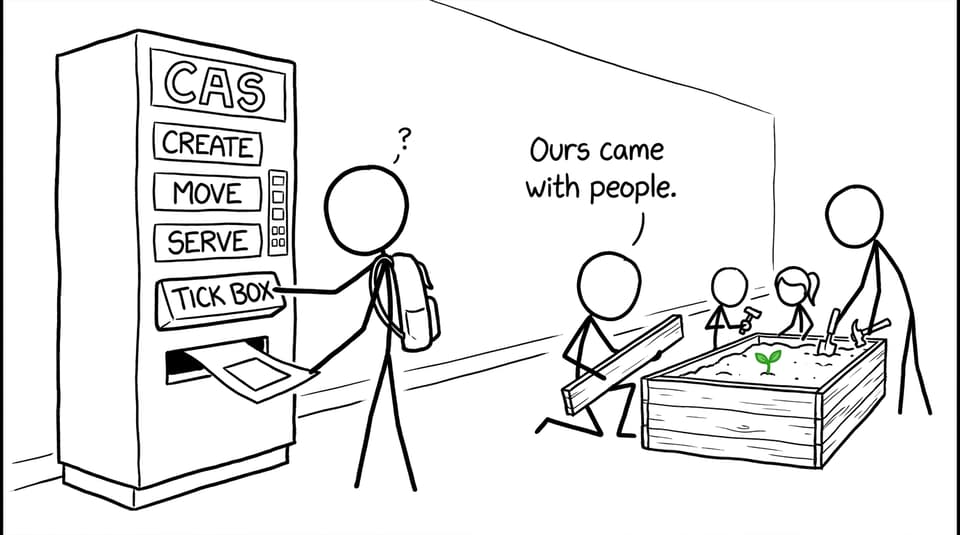
The portfolio may contain evidence. The reflections may mention the learning outcomes. The project may meet the required duration. Yet if CAS is treated as paperwork beside the real life of the school, students quickly learn to approach it as another box to tick.
Building a CAS culture means creating something different. Creativity, activity and service become visible expressions of what the school values, not obligations owned by one coordinator. Students have meaningful choices, teachers understand the purpose, community partners have a voice, and reflection influences what happens next.
The practical answer is not more events. It is connecting existing people, needs and opportunities through a shared CAS language.
A school-wide CAS culture checklist
Start by asking whether your programme has these conditions:
- Students help identify needs and design responses.
- Teachers can explain CAS without immediately referring to a form.
- Creativity and activity receive attention alongside service.
- Community partnerships are reciprocal rather than transactional.
- Reflection happens during experiences, not only afterward.
- Timetabled space protects CAS from becoming invisible.
- Recognition focuses on learning, collaboration and persistence.
- Administrative systems support meaningful work without dominating it.
This is not another compliance checklist. It is a quick test of whether CAS lives across the school or mainly inside the coordinator's office.
Begin with a shared definition of meaningful CAS
Culture starts with language. If adults describe CAS as volunteering hours, students will optimize for hours. If they describe it as a portfolio requirement, students will optimize for uploads.
The IB identifies CAS as an essential element of the Diploma Programme. It is not formally assessed, but students must provide evidence of achieving seven learning outcomes. Students also undertake at least one collaborative CAS project, defined in official guidance as a sequence of experiences lasting at least one month.
These requirements provide structure, but they are not the purpose. RevisionDojo's guide to what CAS means in the IB can help staff and families understand the distinction.
Create a short school statement that everyone can remember. For example:
CAS is how students turn interests, challenges and community needs into purposeful action, then reflect on what changes.
Use it consistently in assemblies, advisory sessions, parent meetings, staff induction and student handbooks. Shared language gives a culture somewhere to begin.
Give students ownership within clear boundaries
Student agency does not mean leaving students alone with a blank proposal form. It means providing enough structure for responsible decisions while preserving ownership of those decisions.
Invite students to map three things: what they care about, what skills and relationships already exist, and what needs have been identified by people directly affected. This produces better ideas than distributing a convenient activity list.
A student interested in photography might support a local environmental group, but only after asking what visual resources would be useful. A student who enjoys sport might help design inclusive movement sessions with younger pupils rather than assuming what participants need.
Short proposal conferences can test purpose, feasibility, safeguarding and reciprocity. RevisionDojo's explanation of CAS projects versus CAS experiences gives students a useful foundation. The coordinator then becomes less like an activity broker and more like an editor, helping students make their ideas ethical and achievable.
Build school-wide CAS engagement through adults
CAS weakens when teachers see it as somebody else's programme. It strengthens when adults recognize that small contributions matter.
A science teacher might advise on measuring environmental change. A language teacher could help students communicate responsibly with partners. A coach might support goal-setting around activity, while a librarian could connect teams with research and meeting space.
Ask each department to identify one contact person, one useful skill and one possible connection each year. This distributes support without turning every teacher into an administrator. Senior leaders reinforce the same message when they protect CAS time, attend student presentations and ask about learning rather than totals. RevisionDojo's guide to collaborative IB department cultures offers further ideas for aligning staff.
Protect time without over-programming CAS
What schools place on the timetable acquires legitimacy. What they leave entirely to spare time can become hurried, inequitable or invisible.
Consider a recurring advisory period, project studio or monthly workshop. Use it for tasks students struggle to complete alone, such as contacting partners, reviewing risks, resolving team problems and discussing ethical questions.
A simple session can include a brief check-in, sustained project work and a short next-step commitment. Avoid filling protected time with coordinator presentations. The purpose is to create room for student action.
Map demanding CAS periods against the wider Diploma Programme calendar so launches do not collide unnecessarily with coursework or Mock Exams. RevisionDojo's advice on balancing CAS with real life can help students create sustainable routines.
Flexibility matters too. Transport, health, employment and caring responsibilities can limit options. A healthy culture does not confuse expensive travel or public visibility with significance. Local, consistent action may produce deeper learning than an elaborate one-off event.
Make community partnership reciprocal
Service becomes thin when students arrive with a solution before listening. It becomes meaningful when the relationship begins with inquiry.
Develop a manageable set of recurring partnerships rather than continually searching for isolated placements. Ask partners what help is genuinely useful, what preparation students need, how communication should work and how the relationship will be reviewed.
A simple review can ask whether the activity addressed a need identified with the community, whether participants had meaningful choices, and what burden the project placed on the partner. Students should also consider what ought to continue, change or stop.
These questions make ethical choices visible. They also teach a difficult lesson: good intentions are not the same as useful impact.
Replace performative reflection with useful conversation
Reflection becomes artificial when students repeatedly produce polished paragraphs about predictable outcomes. The result can be fluent description with little thought.
Instead, focus conversations on moments of tension. Ask what surprised the student, whose perspective was missing, what decision changed the project, or what they would now do differently. RevisionDojo's guide to what coordinators want in CAS reflections distinguishes recounting an event from demonstrating learning.
Where school policy permits, students might use audio, annotated photographs, project debriefs, short written entries or adviser conversations. The medium should reveal thinking rather than become another performance.
Most importantly, reflection should change action. If a team realizes its communication excluded participants, the next meeting should look different. That loop of noticing, interpreting and adjusting is where CAS becomes education.
Recognize growth without creating competition
Public recognition can strengthen culture, but rewarding only the most visible project may favor privilege, scale or confidence over learning.
Recognize sustained commitment, ethical reconsideration, quiet collaboration, recovery from failure and responsible listening. Invite students to present unfinished problems as well as successful outcomes. Younger year groups can attend, allowing them to understand CAS before encountering its formal requirements.
Families also need clear boundaries. RevisionDojo's parent guide to meaningful CAS projects explains how adults can support students without directing the experience.
Keep administration in the background
Documentation is necessary, but it should not become the most memorable part of CAS. Keep approval steps clear, use common templates and schedule portfolio reviews early enough to prevent final-stage reconstruction.
Publish one calendar showing interviews, project checkpoints and school deadlines. Train advisers to use consistent language for evidence and learning outcomes. Reviewing a small sample of portfolios together can also keep expectations aligned.
RevisionDojo supports the surrounding academic journey through its Questionbank, Study Notes, Flashcards, AI Chat, Grading tools, Predicted Papers, Mock Exams, Coursework Library and Tutors. The RevisionDojo guide for IB coordinators shows how shared resources can support coherent routines while educators retain professional judgment.
When academic preparation is organized, CAS has a better chance of remaining meaningful rather than competing chaotically with it.
Culture is what students see repeated
Building a CAS culture rarely depends on one spectacular initiative. It grows through ordinary signals repeated over time: a teacher asking a better question, a leader protecting time, a partner being heard, or a student changing direction after honest reflection.
The coordinator makes those signals coherent. RevisionDojo supports the wider IB journey, leaving schools more space to preserve what CAS uniquely offers: the chance for education to move beyond preparation and become participation.