
The fastest way to build friendships with people who understand the IB grind is not to search for an instant best friend. Create small, repeatable moments with people who share your classes, deadlines, questions, and need for an occasional laugh.
September offers introductions. October reveals routines. By November, the people you repeatedly sit beside, study with, message, and check on can begin to feel like a support system.
That matters because the Diploma Programme combines six subjects with TOK, the extended essay, and CAS. Yet friendship should not become another requirement to optimize. The goal is simpler: find people around whom you can admit that you are confused, tired, ambitious, or all three.
Your friendship-building checklist
- Speak to the same people more than once.
- Use shared IB experiences as conversation starters.
- Suggest one small, specific plan instead of a vague future hangout.
- Mix academic time with genuinely social time.
- Include quieter students rather than waiting to be included.
- Respect academic integrity and personal boundaries.
- Give new connections until November to develop.
If you are still organizing the academic side of school, the RevisionDojo guide for new DP1 students offers a calm starting structure.
Why the IB DP1 fall term can feel socially strange
A new cohort may look settled before it actually is. Some students arrive with old friends. Others appear confident because they speak quickly in class. Nearly everyone is still deciding where to sit, whom to message, and whether everyone else understands the workload better.
Subject combinations divide the cohort into overlapping groups, while HL and SL choices create different schedules and pressures. Someone may understand your Biology assignment but not your History deadline. Another person may share TOK with you but none of your subjects.
Do not interpret this fragmentation as social failure. IB friendships are often built through several points of contact rather than one dramatic meeting. A useful goal for September is recognition, not closeness. Learn names, say hello again, and ask how someone found the lesson. Familiarity is quiet, but it does much of friendship's early work.
Start with specific, low-pressure invitations
People often say, “We should study sometime.” It sounds friendly, but it leaves someone else to create the plan. Specific invitations are easier to accept:
- “Do you want to compare our Chemistry answers for 15 minutes after school?”
- “I am getting lunch before TOK. Want to come?”
- “Would you like to do one Maths Questionbank set together on Thursday?”
- “A few of us are staying in the library until 4:30. You are welcome to join.”
- “Are you interested in that CAS club too?”
These invitations have a time, purpose, and natural ending. Nobody is committing to a permanent group, and a slightly awkward first meeting does not carry much weight.
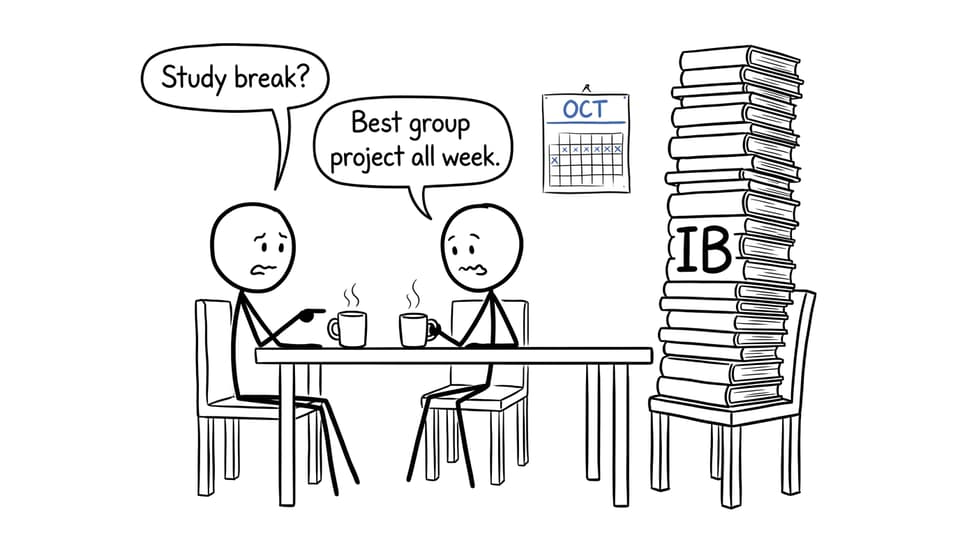
Shared difficulty can open a conversation, but avoid making panic your only social language. “That assignment was difficult” creates connection. Repeating “We are doomed” every afternoon can turn friendship into shared anxiety.
Use September, October, and November differently
Friendship develops through accumulated evidence. You gradually notice who includes you, who listens, and who remains kind when deadlines arrive.
| Period | Social goal | Practical action |
|---|---|---|
| September | Increase familiarity | Learn names and sit with different people |
| October | Create repetition | Start a weekly lunch, study block, or CAS activity |
| November | Deepen trust | Check in after assessments and make non-school plans |
In September, speak to classmates before lessons and attend introductory activities. In October, notice where conversation feels reciprocal, then suggest a repeatable ritual such as Wednesday lunch or a Friday library session. Small routines are more dependable than elaborate plans.
By November, protect time in which the IB is not the main topic. Eat together, take a walk, play a sport, or discuss music. Healthy IB friendships understand the grind without making it the entire relationship.
Turn studying together into actual connection
A productive session needs enough structure to prevent distraction and enough breathing room for conversation. RevisionDojo's guide to revising with an IB study group recommends keeping groups small, choosing one output, and working independently before comparing answers.
Try this 60-minute format:
- 5 minutes to choose one goal
- 25 minutes of quiet individual work
- 15 minutes to compare reasoning and explain mistakes
- 10 minutes for a genuine break
- 5 minutes to choose the next step
RevisionDojo gives everyone a shared academic reference point. You might clarify a concept with Study Notes, test recall with Flashcards, and attempt a focused Questionbank set. AI Chat can help resolve a precise point of confusion, while Grading tools can offer feedback on independently written responses.
Later, Predicted Papers and Mock Exams can support timed practice. The Coursework Library can clarify expectations, and Tutors can provide targeted human guidance when the group remains stuck. The aim is not to turn friendship into tutoring. It is to prevent resource confusion from consuming the time you hoped to spend learning together. The RevisionDojo IB resources hub keeps these tools together.
Keep support healthy and academically honest
Good IB friends help one another think. They do not become responsible for one another's work.
You can explain concepts, quiz each other, discuss feedback, or compare approaches when collaboration is permitted. You should not copy wording, share work that must be completed independently, or pressure a friend to rescue you before every deadline. Check your school's academic integrity policy whenever the boundary is unclear.
Emotional boundaries matter too. A friend can listen without being available at every hour. It is reasonable to say, “I cannot study tonight, but I can check in tomorrow.” If academic commitments consume every social plan, read this guide to balancing IB study and social life.
Find friends beyond your immediate classes
Your closest source of understanding may not share all six subjects. Look for overlapping experiences through CAS teams, sports, music, cultural groups, volunteering, mixed-year mentoring, or one shared HL class.
CAS can be particularly useful because repeated activity gives conversation somewhere to begin. Choose something sustainable rather than treating CAS purely as social access. RevisionDojo explains how to balance CAS, friends, and academics without overloading your schedule.
DP2 students can also provide perspective. Ask one focused question instead of requesting a complete survival guide. These tips for connecting with DP2 students can help the interaction feel natural rather than transactional.
Choose people who make the grind healthier
Understanding the IB does not automatically make someone supportive. Healthy friends can celebrate a strong result without turning it into a ranking. They can discuss disappointment without treating a grade as a verdict. They share useful information, respect a “no,” and accept that people have different goals.
Be cautious around relationships built on constant comparison, copied work, competitive secrecy, or guilt. Academic pressure does not excuse unkindness. Offer the qualities you want to receive: invite the person standing alone, share an official reminder, and listen when you ask how an assessment went.
Let consistency do what confidence cannot
You do not need a magnetic personality to make friends in DP1. You need repeated contact, modest courage, and patience. Invite someone to lunch, propose a short study set, join one sustainable activity, or message the person who seemed friendly after class.
Then let RevisionDojo carry more of the academic load. Its connected learning tools can help you build a stable routine rather than allowing schoolwork to occupy every conversation. For the wider journey, use the IB Diploma preparation guide. The IB grind becomes more manageable when it is understood. Friendship begins when that understanding is offered with kindness.