Choosing IB subjects can feel uncomfortably permanent. A student may still be discovering what engineering means, while the timetable asks them to make decisions that could shape university eligibility two years later.
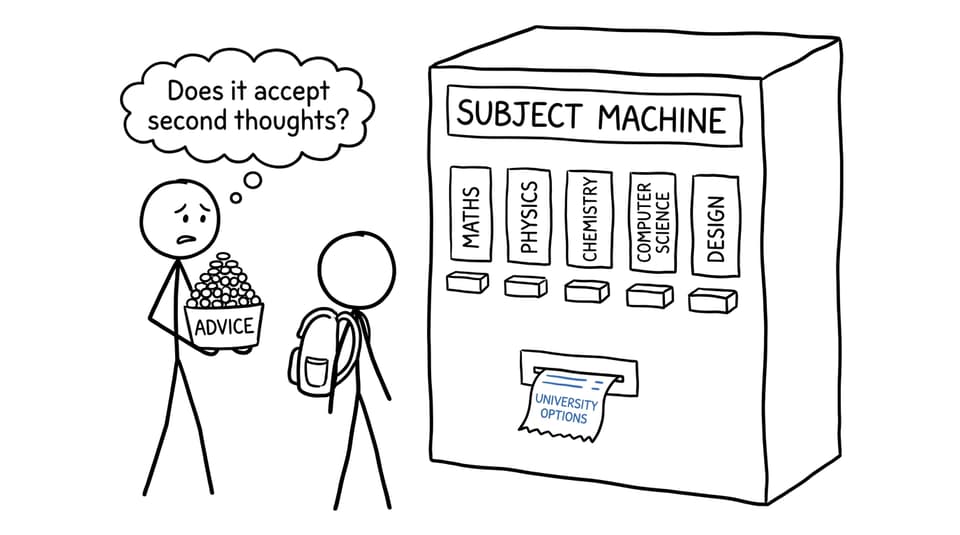
The reassuring answer is that there is a dependable starting point. For most students, the best IB subjects for engineering are Mathematics: Analysis and Approaches HL and Physics HL, followed by a third HL chosen for the intended engineering branch, academic strength, and university requirements. Chemistry, Computer Science, and Design Technology can all be valuable, but the best third subject is not identical for every student.
The objective is not to assemble the hardest-looking diploma. It is to preserve the right university options while building a combination in which strong grades remain realistic.
The short answer for parents
A strong general-purpose engineering combination is:
- Mathematics: Analysis and Approaches HL
- Physics HL
- Chemistry, Computer Science, Design Technology, or another strong subject at HL
- Languages, humanities, and any remaining science subjects at SL, arranged around diploma rules and the student's strengths
Before confirming the combination, check these four points:
- Does every prospective university accept the selected mathematics course and level?
- Is Physics required at HL for the relevant engineering degree?
- Would Chemistry, Computer Science, or another subject support the intended specialism?
- Can the student sustain the workload and achieve the required grades?
That final question matters. Subject eligibility opens the door, but grades still determine whether a student can walk through it.
Why Mathematics AA HL is usually the safest choice
Engineering degrees depend heavily on algebra, functions, trigonometry, vectors, calculus, and mathematical reasoning. Mathematics AA HL develops these areas in greater depth than the Standard Level course and generally provides the broadest preparation for mathematically intensive degrees.
More importantly, some universities explicitly require it. For 2027 entry, Cambridge Engineering asks IB applicants to take Mathematics: Analysis and Approaches at Higher Level alongside Physics HL. Its published minimum offer is 41-42 points with 776 at HL. Other universities may accept Mathematics AI HL, but policies differ by institution and sometimes by engineering department.
This is why AA HL is best understood as the conservative option: it preserves more possibilities. RevisionDojo's guide to why Mathematics AA HL suits engineering applicants explores that preparation in greater detail. Families comparing all four mathematics routes can also review the IB Mathematics AA versus AI guide.
That does not mean every engineering applicant must take AA HL regardless of circumstances. If a student is considering a university that accepts AI HL, the published course page should guide the decision. Requirements must be checked for the precise degree, entry year, and campus rather than inferred from the university's general admissions page.
Why Physics HL is the second anchor
Physics connects mathematics to motion, forces, energy, electricity, waves, fields, and materials. Those ideas sit close to the foundations of mechanical, electrical, electronic, civil, aerospace, and several other engineering disciplines.
At selective UK courses, Physics HL is often more than useful preparation. Oxford Engineering Science currently requires Mathematics and Physics at Higher Level, with a published 2027-entry requirement of 40 points, 776 at HL, and grade 7 in both subjects. Cambridge also requires both subjects at HL. Imperial's electrical and electronic engineering guidance similarly places Mathematics and Physics at the centre of its IB expectations.
Not every engineering programme follows the same model. Design engineering, software-oriented degrees, and some interdisciplinary programmes may have different prerequisites. Nevertheless, Physics HL usually provides the broadest flexibility when a student has not yet chosen a specialism.
Parents wondering why level matters can read how universities evaluate HL and SL subjects. The distinction is substantial: the IB recommends 240 teaching hours for HL subjects and 150 for SL subjects, with greater breadth and depth expected at HL.
Choosing the third HL subject
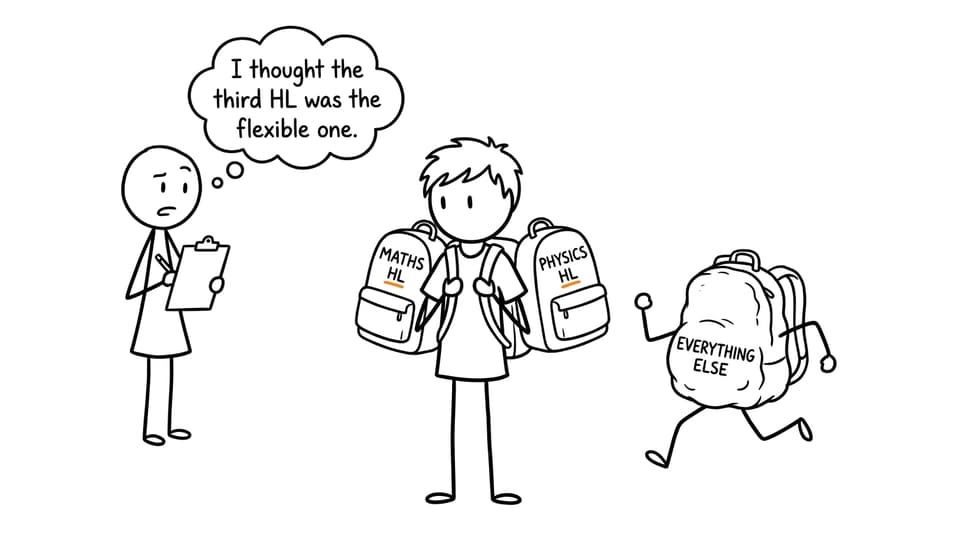
The third HL should add relevant preparation without turning the diploma into an endurance contest. There is no universally superior choice.
| Engineering direction | Strong third-HL option | Reason to consider it |
|---|---|---|
| Chemical or process engineering | Chemistry | Supports molecular, materials, reaction, and process-related study |
| Biomedical or biochemical engineering | Chemistry or Biology | Builds preparation for an interdisciplinary life-science route |
| Computer or software engineering | Computer Science | Develops programming and computational problem-solving experience |
| Electrical, electronic, or robotics pathways | Computer Science or Chemistry | Can complement systems, hardware, materials, or programming interests |
| Mechanical, civil, or product design | Design Technology or Chemistry | May support design thinking, materials knowledge, and practical investigation |
| Engineering route still undecided | Chemistry or the student's strongest suitable subject | Preserves breadth while protecting the overall diploma result |
These are planning suggestions, not admissions rules. Chemical engineering, for example, may require Chemistry at one university while another places greater emphasis on Mathematics and Physics. Biomedical engineering requirements vary even more because programmes can sit closer to engineering, medicine, biology, or materials science.
A strong essay-based third HL is not automatically a poor choice. If Mathematics AA HL and Physics HL already satisfy the prerequisites, choosing a subject in which the student can earn a high grade may be wiser than adding another demanding science merely for appearance.
Comparing useful subject combinations
For a student who wants maximum flexibility across traditional engineering fields, Mathematics AA HL, Physics HL, and Chemistry HL is a powerful combination. It supports a wide scientific base, although it also creates a demanding workload.
For computing, robotics, or digital systems, Mathematics AA HL, Physics HL, and Computer Science HL creates a coherent technical profile. Students considering this route may find the guide to pairing IB Computer Science with other subjects useful.
For design-led pathways, Mathematics AA HL, Physics HL, and Design Technology HL can connect analytical work with iterative design and project development. However, Design Technology rarely replaces a stated Chemistry or Physics prerequisite, so it must be checked against each intended course.
If workload is the central concern, a balanced route might keep Mathematics AA and Physics at HL while placing the third HL in a subject where the student has demonstrated consistent strength. The aim is not to make the diploma easier. It is to avoid spending so much energy surviving the third HL that performance falls in the two subjects universities actually require.
A practical university-requirements check
IB university requirements are specific and change over time. Before finalising subjects, create a small comparison sheet containing at least five realistic courses across reach, target, and safer choices.
For each course, record:
- Required total IB score
- Required HL grade pattern
- Mandatory subjects and levels
- Whether Mathematics AA HL is required, preferred, or interchangeable with AI HL
- Whether Physics or Chemistry must be taken at HL
- Admissions tests or other selection requirements
- The entry year to which the information applies
Use the official course page as the final authority. A general statement such as "the university accepts the IB Diploma" does not establish eligibility for its engineering faculty.
This process also prevents a common misunderstanding among IB diploma parents: a high total score does not normally compensate for a missing prerequisite. A student could have an excellent overall result and still be ineligible if the course demands Mathematics AA HL or Physics HL and the student took it at SL.
Balancing ambition with achievable grades
Subject choice is partly an admissions decision and partly a workload decision. Mathematics AA HL and Physics HL both reward regular problem-solving. Understanding the theory without practising unfamiliar questions is rarely enough.
Look at evidence rather than aspiration. Consider the student's current algebra fluency, comfort with multi-step science problems, ability to recover from mistakes, and weekly capacity alongside coursework and the IB core. If possible, review sample HL material and discuss the proposed combination with teachers and the IB coordinator.
The IB normally involves three HL and three SL subjects, although four HLs are permitted. Taking a fourth HL is not inherently more impressive if it lowers the grades that matter. RevisionDojo's explanation of mixing HL and SL sciences can help families think through that balance.
The best combination is therefore not the one with the most HL science labels. It is the most rigorous combination the student can sustain while meeting every prerequisite.
Turning the chosen combination into exam readiness
Once the subjects are fixed, the question changes. It is no longer "Did we choose correctly?" but "How do we convert these choices into strong results?"
For Mathematics AA HL, students can use the Mathematics AA Questionbank to identify weaknesses in calculus, algebra, functions, vectors, and other syllabus areas. Revision should move from Study Notes to a short set of related questions, followed by correction and a later reattempt. The guide to revising IB Mathematics with topic notes explains this active approach.
For Physics, RevisionDojo's IB Physics resource hub brings together Study Notes, Flashcards, lessons, and topic resources. The IB Physics Questionbank then lets students practise areas such as mechanics, energy, circuits, fields, waves, and HL-only content in focused sets.
RevisionDojo is designed to connect the full process. Students can clarify a difficult idea with AI Chat, retain definitions and relationships through Flashcards, apply them in the Questionbank, and use Grading tools to understand where marks were lost. Predicted Papers and Mock Exams develop timing and stamina, while the Coursework Library and Tutors provide deeper support when an investigation or concept becomes difficult.
Make the decision by working backwards
For most future engineers, the clearest default is Mathematics AA HL and Physics HL, with a third HL selected according to specialism, performance, and workload. Chemistry offers scientific breadth. Computer Science supports computational routes. Design Technology can complement design-led interests. A strong non-STEM subject may also be sensible once all essential prerequisites are safely covered.
Begin with official university course pages, not with assumptions about what "looks impressive." Build a shortlist, identify the common requirements, and then test whether the resulting diploma is realistic for the student who must study it.
Once the combination is chosen, RevisionDojo can turn that plan into a repeatable routine: learn one concept, practise it, review the feedback, and return to it under pressure. Subject selection opens the engineering pathway. Consistent preparation is what carries the student along it.