




If you’ve ever watched an engineer explain a bridge, a circuit, or a rocket trajectory, you’ll notice something quietly unsettling: they talk the way your IB math teacher wants you to think.
Not in the “memorize this formula” way.
In the “show me why this works” way.
That’s the real reason IB Mathematics: Analysis and Approaches (AA) Higher Level often feels like a door with a heavy handle. It isn’t trying to be friendly. It’s trying to be honest. And for engineering aspirants, that honesty turns into an advantage that compounds for years.
This article explains why IB Math AA HL is the best choice for engineering-bound students, how it lines up with what universities actually assume you can do, and how to prepare for exams without turning your life into an endless loop of panic and calculus.
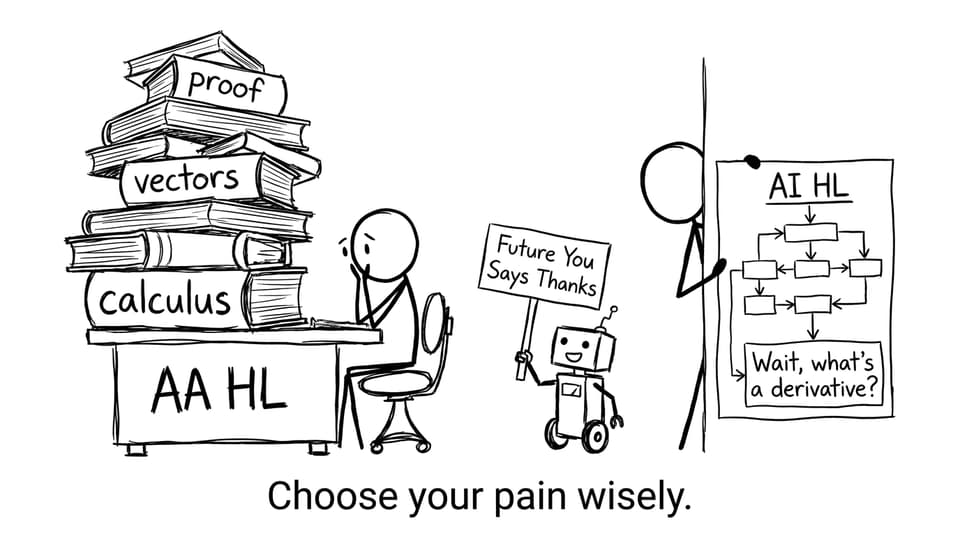
The quick checklist: is IB Math AA HL right for engineering?
Use this as your fast decision filter. IB Math AA HL is usually the best fit if most of these are true:
-
You’re applying to engineering, physics, mathematics, or computer science.
-
You don’t just want answers, you want the reasoning chain that earns method marks.
-
You can tolerate abstraction (and are willing to build stamina for it).
-
You want a course that keeps top university options open.
-
You’re ready to practice consistently rather than cramming.
If you want to compare pathways directly, keep this open while you read: Should I Take IB Math AA or AI? A Realistic Breakdown.
What IB Math AA HL actually trains you to do
People describe IB Math AA HL as “calculus-heavy” or “more theoretical,” which is true but incomplete. The deeper difference is that AA HL trains you to build and communicate structure.
Engineering is basically structure under constraints: forces, flows, tolerances, error margins, efficiency targets. AA HL is one of the few high-school-level courses that repeatedly asks you to:
-
Define assumptions
-
Create a model
-
Manipulate it cleanly
-
Interpret the result
-
Justify your steps
That’s why AA HL content leans hard into:
-
Functions as objects you can transform and analyze
-
Algebra as a language for generalization
-
Vectors as geometry with direction and meaning
-
Proof and justification as a habit, not a special unit
-
Calculus as the tool for change, optimization, and system behavior
If you want a syllabus-aligned map you can revise from, start here: IB Mathematics Analysis and Approaches Resources.
Why IB Math AA HL matches first-year engineering reality
A quiet shock hits many students in first-year engineering: lecturers move fast because they’re not teaching math from scratch. They’re building engineering on top of assumed math.
That assumption typically includes:
-
Comfort with differentiation and integration
-
Fluency in algebraic manipulation
-
Vector reasoning in 2D and 3D
-
Function behavior, graphs, and transformations
-
Series and approximation thinking
IB Math AA HL is designed around those assumptions. It’s not that other routes can’t lead to engineering. It’s that AA HL reduces the number of “catch-up” moments where you’re learning prerequisites while everyone else is applying them.
For targeted revision in the most engineer-relevant area, use RevisionDojo’s calculus hub: IB Math AA Calculus.
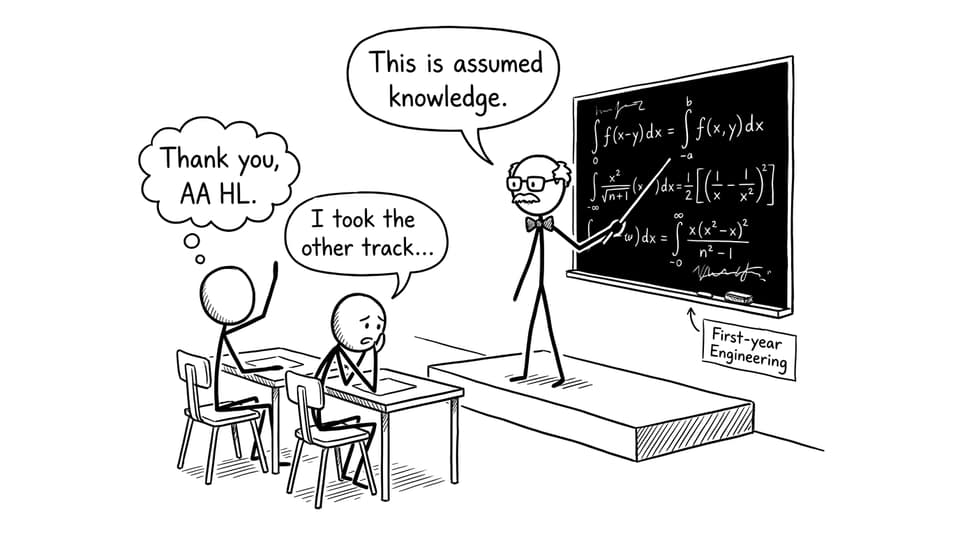
IB Math AA HL vs AI HL for engineering: the practical difference
This is where students often get stuck: both are “HL,” both are respected, both involve serious work. So what changes for engineering aspirants?
AA HL builds the engineering core: calculus, vectors, algebraic depth
Engineering maths is filled with change, accumulation, and geometry in motion. IB Math AA HL repeatedly trains those muscles.
A simple example: optimization. In engineering, optimization is rarely a tidy textbook rectangle. It’s a system with constraints. AA HL’s approach to calculus and reasoning prepares you for that messy reality.
AI HL tilts toward statistics, modeling tools, and technology reliance
IB Math AI HL can be brilliant for data-heavy pathways, business, some social sciences, and applied modeling contexts. But many engineering programs (especially competitive ones) prefer AA HL because it maps more directly to their early modules.
If you want the larger comparison from a student lens, read: Which IB Math Is Harder? A Detailed Comparison and How Difficult Is IB Math HL Compared to Other IB Subjects?.
The hidden reason AA HL helps engineering: it teaches transfer
The hardest part of IB Math AA HL is not any single topic. It’s the moment a question blends three familiar ideas into an unfamiliar shape.
That skill is called transfer: using known tools in new contexts.
Engineering is transfer, day after day.
-
A circuit becomes a system of differential equations.
-
A beam becomes vectors and moments.
-
A signal becomes a function you transform and approximate.
AA HL trains you to recognize the underlying structure instead of searching for a matching template. And that’s exactly what engineering exams demand later, too.
How to study IB Math AA HL like an engineering student (not like a panicked one)
AA HL rewards calm repetition. The course is cumulative, which means gaps don’t stay small. They grow.
Here’s a practical system used by high scorers.
Build concept clarity first, then grind questions
Start with clean explanations and worked examples. RevisionDojo’s AA resources are built for that two-step rhythm: learn, then apply.
-
Use Mathematics Analysis and Approaches (AA) Notes to rebuild shaky topics.
-
Keep the official formula reference close: IB Mathematics Analysis and Approaches Data Booklet.
Practice with exam-style pressure, but in controlled doses
Engineering doesn’t reward “I kind of get it.” It rewards precision under constraints. IB exams do the same.
Use targeted practice sets like:
On RevisionDojo, this is where the ecosystem matters. The Questionbank gives you exam-style items. Study Notes fix understanding. Flashcards keep formulas and methods active. AI Chat helps when one line of reasoning keeps breaking. The Grading tools show you what an examiner would accept. And when it’s time to simulate real conditions, Mock Exams and Predicted Papers help you train the exact kind of stamina AA HL requires.
If Paper 1 is your stress point, this guide is gold: How to Master IB Math AA Paper 1: Step-by-Step Strategy.

Turn mocks into feedback loops, not judgment days
Most students take a mock, get a score, feel something unpleasant, and move on.
Do this instead:
-
Sit a full mock under timed conditions.
-
Mark it carefully.
-
List your errors by type (concept, algebra slip, interpretation, time).
-
Drill the same error type until it stops appearing.
RevisionDojo is built for that loop. Start here: How to Use RevisionDojo to Prepare for IB Math Mock Exams and How to Use RevisionDojo's Mock Exam Builder to Simulate IB Conditions.
To keep your expectations realistic, use this reference while planning: IB Mathematics: Analysis and Approaches HL 2025 Grade Boundaries Guide.
Common misconceptions engineering aspirants have about IB Math AA HL
“AA HL is only for geniuses”
It’s for students who can be consistent. Talent helps, but consistency wins more often in IB Math AA HL because the course punishes gaps. The strongest students aren’t always the fastest. They’re usually the most systematic.
“AI HL is enough everywhere”
Some universities accept it, some recommend AA HL, some strongly prefer AA HL for engineering, and some effectively require AA HL by prerequisite language. Even when AI HL is accepted, AA HL often reduces first-year friction.
“Engineering math is practical, so AA HL is too abstract”
Engineering math is practical, but the practical part sits on abstract foundations. You optimize real systems using idealized models. You use abstract tools to make real predictions. AA HL makes that feel normal.
Closing: the best engineering decision you can make in IB math
Choosing IB Math AA HL is less about proving you can survive a hard class and more about choosing the kind of future where hard problems feel familiar.
AA HL won’t make engineering easy. But it will make engineering less surprising. That’s a powerful advantage.
If you’re committing to AA HL, build your support system early: start with the full IB Mathematics Analysis and Approaches Resources, then combine Study Notes, Flashcards, AI Chat, Questionbank, Grading tools, Predicted Papers, and Mock Exams into a weekly loop.
That’s what RevisionDojo is for: turning ambitious IB goals into repeatable daily actions you can actually sustain.