
Baha'i administration is the system through which Baha'is organize collective religious life without an ordained clergy. Its elected institutions, consultative practices, community gatherings, and concept of covenant connect belief with action. For IB World Religions SL, the key is not to memorize an organizational chart in isolation. You need to explain how administration answers religious questions about human nature, spiritual progress, authority, unity, and ethical community life.
This topic belongs to Part 1 and may be assessed through Paper 1 stimulus-response questions. The Baha'i Faith is not offered as an in-depth study option, so revision should emphasize accurate terminology, connections among the five themes, and concise application to an unfamiliar extract or image. The RevisionDojo IB World Religions resources can help you place those connections within the wider course.
Baha'i administration at a glance
| Area | What an IB student should know |
|---|---|
| Authority | Authority develops through the Covenant and authoritative texts rather than an ordained priesthood. |
| Local level | A nine-member Local Spiritual Assembly is elected annually where conditions allow. |
| National level | National Spiritual Assemblies coordinate communities within countries or territories. |
| International level | The nine-member Universal House of Justice is the international governing institution. |
| Decision-making | Consultation seeks truth and unity through detached, respectful discussion. |
| Community life | Prayer, education, service, the Nineteen Day Feast, and collective action connect belief with practice. |
| Paper 1 priority | Define the feature shown, support it with precise knowledge, and explain its religious meaning. |
A useful revision check is simple: can you identify the institution or practice, describe what happens, and explain why it matters theologically? If not, the fact is not yet ready for Paper 1.
Covenant and authority without clergy
Baha'i administrative order begins with the Covenant. In Baha'i understanding, the Covenant provides an authorized line of interpretation and leadership intended to preserve the religion's unity after the death of its founder.
Baha'u'llah appointed his son 'Abdu'l-Baha as the authorized interpreter of his teachings. In his Will and Testament, 'Abdu'l-Baha appointed his grandson Shoghi Effendi as Guardian. Shoghi Effendi interpreted the writings, translated major texts, and helped develop the administrative institutions envisioned in earlier sources.
The central primary texts include Baha'u'llah's Kitab-i-Aqdas, meaning the Most Holy Book, and the Will and Testament of 'Abdu'l-Baha. Shoghi Effendi's letters collected in The World Order of Baha'u'llah explain how these textual foundations relate to local, national, and international institutions. The Universal House of Justice was first elected in 1963 and legislates on matters not explicitly settled in the sacred writings. It does not replace the foundational texts or alter their authoritative meaning.
This arrangement explains why Baha'i communities have elected councils but no professional priesthood. Individuals can teach, facilitate worship, or serve institutions, yet they do not receive sacramental authority over other believers. For Paper 1, that contrast may be more significant than the institution's name.
The elected institutions
A Local Spiritual Assembly normally consists of nine adult members elected annually by eligible Baha'is in a locality. Elections have no nominations, political parties, campaigning, or canvassing. Voters consider relevant personal qualities and then vote privately.
National Spiritual Assemblies guide affairs at the national or territorial level, supporting communities and coordinating plans. The Universal House of Justice, based at the Baha'i World Centre in Haifa, provides international guidance. It is elected every five years by members of National Spiritual Assemblies.
These bodies exercise authority collectively. An assembly member does not become a priest or permanent religious ruler. Institutional authority can therefore be respected without turning officeholders into a privileged religious class.
An examiner may present an election scene and ask what it reveals. A strong answer moves from observation to meaning: the absence of campaigning discourages personal ambition, while secret voting protects individual conscience. Use the IB exam command terms guide to distinguish a request to describe the process from one asking you to explain its importance.
Consultation as a spiritual discipline
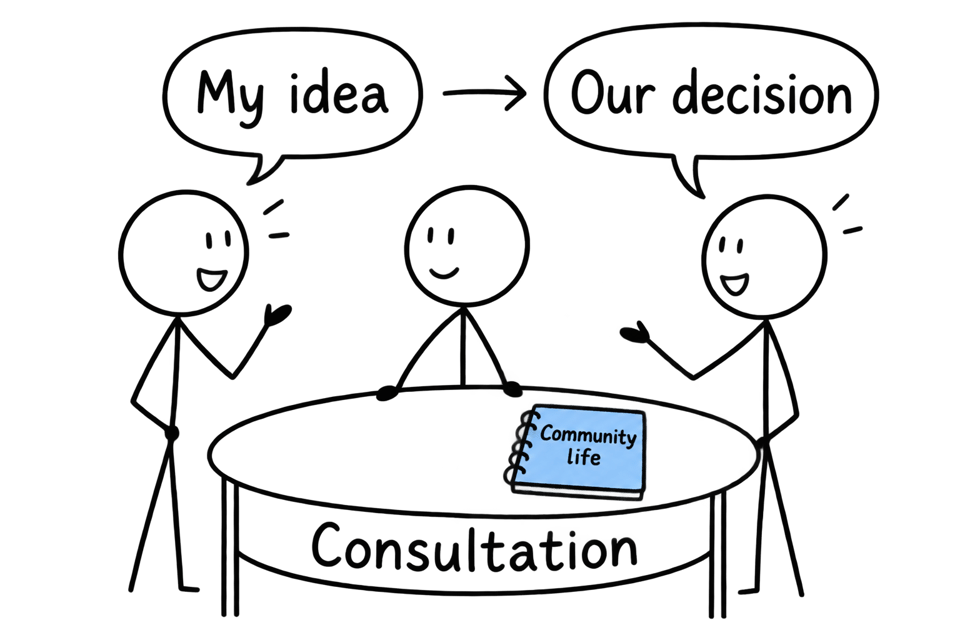
Consultation is more than exchanging opinions. Participants are encouraged to pray, speak honestly, listen carefully, avoid personal conflict, and detach themselves from ownership of an idea once it has been offered. The group can then examine the idea on its merits and seek a unified decision.
Theologically, consultation helps people overcome ego and search collectively for truth. Socially, it supports participation, conflict resolution, and trust. For believers, its social value may follow from its spiritual qualities.
Consultation does not assume immediate agreement or require differences to be hidden. It transforms disagreement into disciplined inquiry, followed by support for the collective decision. This connects doctrines and beliefs, religious experience, and ethics.
The Nineteen Day Feast and community life
The Nineteen Day Feast takes place once in each month of the Baha'i calendar. Baha'u'llah ordained this regular gathering in the Kitab-i-Aqdas. It normally has three connected parts:
- Devotional: prayers and readings from sacred writings
- Administrative: news, reports, recommendations, and consultation about community affairs
- Social: hospitality and fellowship
The Feast is not simply a meal, meeting, or worship service. It holds all three dimensions together. A believer encounters sacred text, participates in collective responsibility, and strengthens relationships with other community members.
Community life also includes devotional gatherings, children's classes, junior youth groups, study circles, service, and social action. Some activities may involve the wider public. Spiritual development is intended to contribute to society's material and moral well-being rather than remain private.
The term Mashriqu'l-Adhkar, meaning Dawning-place of the Mention of God, refers to a Baha'i house of worship and, in its fuller conception, associated institutions of service. It expresses the relationship between worship and practical contribution. Prayer turns attention toward God; service directs that orientation toward society.
Majority understanding and minority claims
Most Baha'is recognize the Universal House of Justice as the religion's international governing body and view loyalty to it through the Covenant. From this perspective, the Baha'i Faith is one worldwide religion rather than a collection of denominations.
Small groups have disputed the mainstream succession. The Orthodox Baha'i Faith developed among followers of Charles Mason Remey, who claimed the Guardianship after Shoghi Effendi's death in 1957. Followers associated with Mirza Muhammad 'Ali have also been described as Unitarian Baha'is.
External academic classifications may call these groups branches or schisms. Mainstream Baha'is regard their rejection of authorized succession as a breach of the Covenant. In an IB answer, identify whose perspective you are presenting rather than treating either label as neutral.
Connecting administration to fundamental questions
What is the human condition?
Human beings are understood as spiritual beings with rational souls and noble capacities, but also a tendency toward ego, prejudice, and conflict. Consultation cultivates truthfulness and detachment, while collective institutions limit concentrated personal authority.
Where are we going?
Individually, life involves spiritual growth and movement toward God. Collectively, humanity is understood as progressing toward greater unity and justice. Baha'i administration can therefore be interpreted as preparation for peaceful global civilization, not merely management of a religious community.
How do we get there?
The path includes prayer, study of revelation, moral discipline, consultation, education, service, and participation in community life. Institutions provide continuity, but transformation still requires individual choice. Neither private spirituality nor administration is considered sufficient alone.
These questions help you avoid a purely descriptive response. The RevisionDojo guide to World Religions misconceptions can help you check whether your notes explain religious meaning rather than reducing a tradition to disconnected customs.
Linking administration to the five themes
| IB theme | Relevant connection |
|---|---|
| Rituals | Elections, the Nineteen Day Feast, prayer, and devotional gatherings create repeated forms of participation. |
| Sacred texts | The Kitab-i-Aqdas, the Will and Testament of 'Abdu'l-Baha, and Shoghi Effendi's writings ground authority and practice. |
| Doctrines and beliefs | The Covenant, unity of humanity, progressive revelation, and spiritual development explain why institutions matter. |
| Religious experience | Prayer, consultation, fellowship, and service allow religion to be experienced individually and collectively. |
| Ethics and moral conduct | Non-partisanship, trustworthiness, justice, service, and freedom from prejudice shape institutional behavior. |
One example can cross several themes. The Feast is ritualized, includes sacred texts, expresses unity, creates communal religious experience, and encourages ethical consultation. Recognizing these overlaps is more useful than memorizing five isolated lists.
A focused Paper 1 revision method
Build flashcards with a term on one side and three prompts on the other: definition, textual basis, and religious significance. The RevisionDojo active recall guide shows how to turn notes into retrieval, while spaced repetition for IB revision helps schedule review.
Then practise with short stimuli. For an image of people voting, identify the likely institution, describe the election principles, and connect them to humility and collective authority. For an extract about unity, connect Covenant, consultation, and the absence of clergy. The World Religions mock exam preparation guide can support timed practice.
RevisionDojo brings the process together through Study Notes, Flashcards, its Questionbank, AI Chat, and Grading tools. Predicted Papers and Mock Exams support timed application, while the Coursework Library and Tutors help with the wider course. Together, these tools create a manageable cycle: learn, retrieve, apply, receive feedback, and refine.
From organization to religious meaning
Baha'i administration matters because it shows what happens when a religious ideal is given social form. Unity becomes consultation. Equality becomes election without campaigning. Worship becomes fellowship and service. Covenant becomes institutional continuity.
That is the insight to carry into Paper 1. Do not stop after naming a Local Spiritual Assembly or listing the sections of the Feast. Explain how the practice expresses a view of human beings, their spiritual destination, and the path toward it. With RevisionDojo as your central IB resource, those connections can become precise enough to recall under pressure and flexible enough to apply to an unfamiliar stimulus.