

A university requirement can turn one number into a family-wide source of anxiety. A predicted 38 may look excellent until someone notices that a preferred course asks for 40. Then the questions begin: Is the goal still realistic? Does one missing point close the door? Should the university list change?
The reassuring answer is that average IB scores at top universities generally sit in a competitive range of about 37 to 42 points, but there is no universal accepted average. UK universities usually publish course-specific offers, while highly selective US universities often assess IB results within a broader, holistic application. Higher Level grades, required subjects, admissions tests, written work, interviews and the academic context of the student can all matter alongside the total.
For parents, the useful question is therefore not simply, “Is this a good score?” It is: Does this score meet the requirements for this particular course, and is the rest of the application competitive?
The short answer for IB diploma parents
Use this checklist before comparing a student’s predicted score with university expectations:
- Check the exact degree, not just the university name.
- Separate the overall score from required Higher Level grades.
- Confirm whether core points are included in the stated total.
- Look for mandatory subjects, admissions tests or portfolios.
- Distinguish a minimum requirement from a competitive profile.
- Build a balanced list containing ambitious, realistic and more secure choices.
- Recheck the official course page for the intended entry year.
A score of 40 or above is academically strong for many highly selective institutions. Scores around 37 to 39 can satisfy numerous demanding UK offers, depending on the course and HL profile. In the United States and Canada, a total score may be considered alongside school performance, essays, recommendations, activities and programme prerequisites.
For a wider starting point, RevisionDojo’s global guide to minimum IB university scores explains how expectations differ across admissions systems.
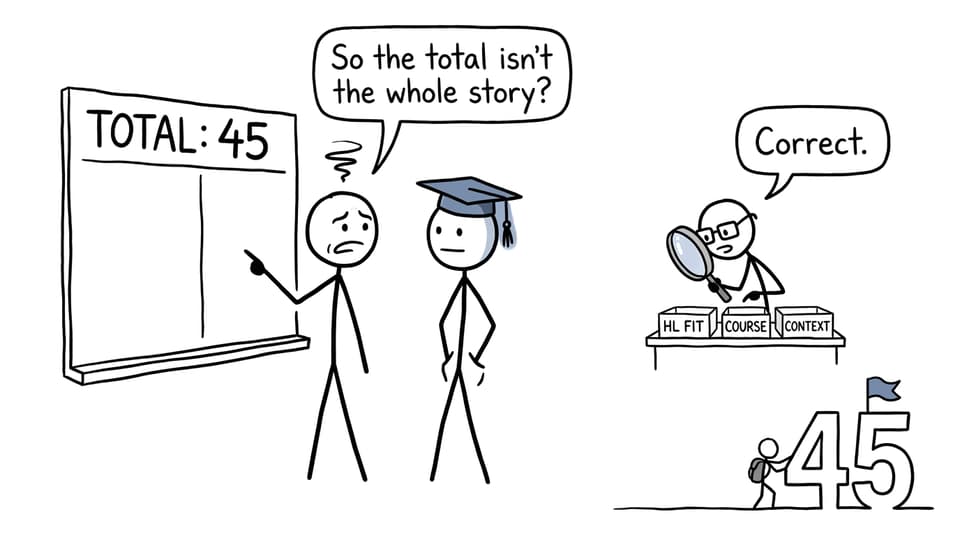
Average IB scores top universities publish or expect
The table below summarizes official published requirements available when this article was reviewed in August 2026. These are entry expectations or offer ranges, not verified averages of admitted students. Universities do not all publish average final IB results, so describing every figure as an admissions average would create false precision.
| University | Published IB position | What parents should notice |
|---|---|---|
| University of Oxford | Usually 38, 39 or 40, depending on the course | Offers include core points and normally require 6s and 7s at HL |
| University of Cambridge | Minimum offer levels commonly reach 41 to 42 | A typical HL condition is 776, although some colleges may ask for more |
| Imperial College London | Generally 38 to 42 across accepted qualifications and courses | Relevant HL subjects commonly require grades of 6 or 7 |
| University College London | Course equivalencies range from 34 to 40 | The most demanding A-level equivalent is 40 with 20 points across three HLs |
| London School of Economics | 37 to 39, depending on the programme | Published offers combine a total with HL profiles such as 666 or 766 |
| Harvard University | No published minimum IB total | Academic rigour is reviewed holistically; current applicants normally submit the SAT or ACT unless an exceptional-access provision applies |
| University of Toronto | No single university-wide competitive total | Requirements vary by faculty; some programmes recommend ranges from the low 30s to high 30s |
| University of British Columbia | No single guaranteed IB threshold | General, degree-specific and English requirements apply, and initial decisions may use interim grades |
The pattern is clear. For the most selective UK courses, 38 to 42 is a useful planning range, with Cambridge often occupying the upper end. Yet the range should never replace course-level research. Oxford History, Oxford Chemistry and an Imperial Physics application do not ask the same academic question, even when all three appear under the label “top university.”
Parents considering Oxford can explore RevisionDojo’s detailed guide to IB scores required for Oxford. Students comparing both institutions may also find the IB score guide for Oxbridge helpful.
Why the total score can mislead
An IB total compresses six subjects and the core into one convenient number. Universities often reopen that number and inspect what is underneath.
Imagine two applicants with 40 points. One has 7 in HL Mathematics and 7 in HL Physics; the other has 5s in those subjects but stronger grades elsewhere. For a mathematics-intensive engineering degree, their totals may be identical while their academic preparation is not. This is why subject prerequisites deserve as much attention as the headline score.
The same principle applies to the core. Theory of Knowledge and the Extended Essay can contribute up to three points, but a university may still insist on a particular HL pattern. A 39 with the required 766 can meet an offer that a differently constructed 40 does not.
Three distinctions help families interpret IB university requirements correctly:
Minimum requirement versus likely competitiveness
A minimum tells a student whether an application can be considered. It does not promise an offer. Competitive courses may receive many applications from students who meet or exceed the published level.
Predicted score versus final result
Schools commonly send predicted grades when students apply before completing the diploma. Universities may use those predictions to make conditional decisions, then require the final result to satisfy the offer. RevisionDojo’s explanation of how schools predict IB scores helps parents understand the evidence teachers may consider.
University reputation versus course requirements
Requirements can vary substantially inside one institution. A parent comparing university-wide summaries should treat them as navigation tools, not final answers. The official page for the exact programme and entry cycle remains decisive.
How requirements differ by country
United Kingdom
UK admissions are usually course-specific. Offers often state an overall total, an HL combination and required subjects. Additional assessments may also apply. Meeting the grade condition is essential, but competitive selection may consider admissions tests, interviews, written work or other course-specific evidence.
This structure makes planning relatively transparent. It also makes small details important. “38 points” is incomplete if the full offer says “38 with 666 at Higher Level,” or requires a 7 in Mathematics.
United States
Highly selective US universities generally do not publish a universal IB cutoff. Harvard, for example, says it has no rigid grade requirement. Its current first-year application policy normally requires the SAT or ACT, with alternatives such as predicted or actual IB results available only in exceptional access circumstances.
Consequently, unofficial claims that a particular IB total guarantees entry should be treated cautiously. A high score demonstrates academic strength, but selection can also involve curriculum rigour, essays, recommendations, activities and personal context. RevisionDojo’s guide to applying to top US universities with the IB provides more detail on that broader process.
Canada
Canadian requirements commonly vary by faculty and degree. The University of Toronto’s Arts and Science guidance, for example, recommends different ranges for humanities, computer science, life sciences and commerce. UBC similarly combines general admission criteria with degree-specific prerequisites.
A student should therefore check acceptable Mathematics pathways, required sciences, English conditions and supplemental applications. The total matters, but eligibility can depend on the subjects used to build it.
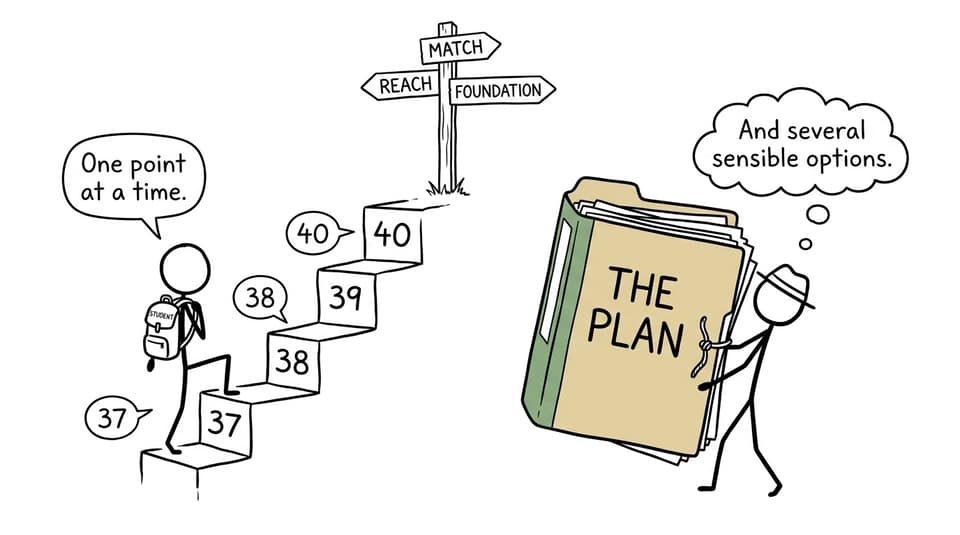
Turning a predicted score into a sensible university list
A balanced list does not mean lowering ambition. It means refusing to let one outcome carry the entire emotional weight of the application season.
Start by recording each course’s overall requirement, HL condition, prerequisites and additional selection steps. Then place choices into three practical groups:
- Ambitious: the current prediction is near the minimum, or selection is exceptionally competitive.
- Realistic: the prediction meets the published conditions with the required HL profile.
- More secure: the student is comfortably above the academic requirement and meets every prerequisite.
These categories are planning labels, not forecasts. A “realistic” option is not guaranteed, and an ambitious application is not automatically futile. They simply prevent the university list from becoming a collection of institutions with nearly identical risks.
If predictions are still changing, use RevisionDojo’s IB Grade Calculator to translate practice performance into a clearer estimate. Families can also read what to do after missing predicted grades before making abrupt decisions.
Closing the score gap without creating panic
The distance between 37 and 40 looks small on paper. In practice, those three points may be distributed across different subjects, command terms and recurring mistakes. That makes “work harder” poor advice. The student needs to know where marks are being lost and whether the gap comes from knowledge, recall, timing or answer construction.
A more useful improvement loop is:
- Diagnose one weak topic or question type.
- Review only the material needed to understand it.
- Complete targeted questions without notes.
- Compare the response with the assessment criteria.
- Record the error and attempt a similar task later.
- Add timed practice once accuracy becomes reliable.
This is where RevisionDojo helps turn an admissions target into daily actions. Study Notes and Flashcards rebuild understanding and recall. The Questionbank develops application, while AI Chat can clarify a difficult step. Grading tools make feedback more immediate, and Predicted Papers plus Mock Exams introduce realistic time pressure. For coursework or deeper support, students can use the Coursework Library and work with experienced Tutors.
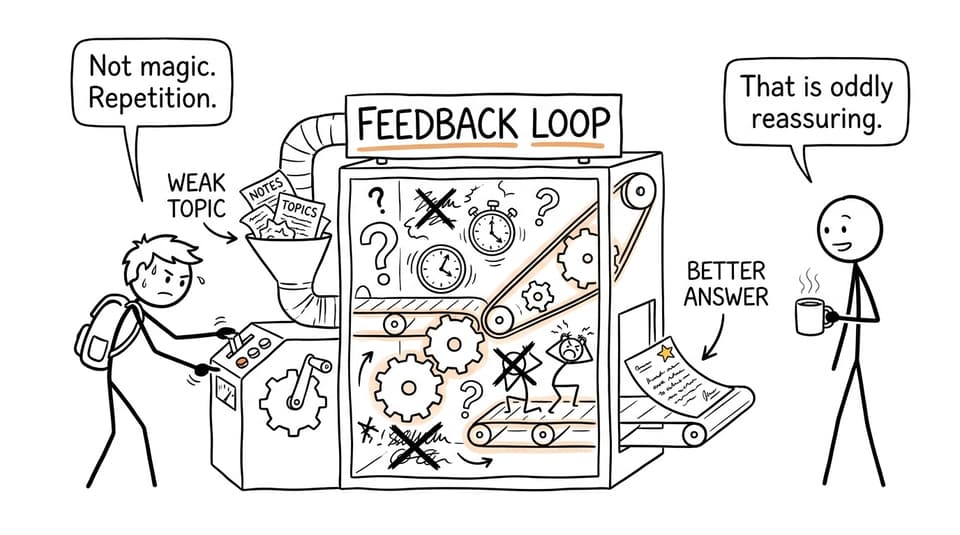
The purpose is not to promise that a platform can manufacture a university offer. No honest resource can. It is to help close the controllable part of the score gap: unclear concepts, inconsistent recall, weak technique and limited practice under pressure. RevisionDojo’s guide to using IB question banks effectively offers a practical place to begin.
A score is a target, not a verdict
For parents, the most helpful response to a predicted grade is calm specificity. Compare it with the exact course requirement. Check the HL subjects. Identify the gap. Build a balanced university list. Then help the student follow a revision system that produces evidence rather than anxiety.
Top universities often expect exceptional IB performance, commonly around 37 to 42 points for demanding UK courses. But the total is only the cover of the application. Subject fit, assessment conditions and the wider admissions process tell the rest of the story.
The natural next step is simple: choose one target course, write down its complete requirements and compare them with the student’s current subject-by-subject profile. Then use RevisionDojo to turn every visible gap into a focused plan for the next study session.