


You can feel it in the lab: the mixture that was doing nothing suddenly fizzes, warms, changes color. Same reactants. Same conditions. One tiny addition. In IB Chemistry, that moment is usually a catalyst at work, and it’s one of the most testable ideas in kinetics.
Catalysts are not “magic speed.” They’re quieter than that. They change the journey a reaction takes so fewer particles need to climb the highest energy hill. Once you see that story clearly, activation energy questions stop feeling like memorization and start feeling inevitable.
Quick checklist for IB Chemistry answers
When an exam question mentions a catalyst, aim to say (and, if needed, sketch) these points:
-
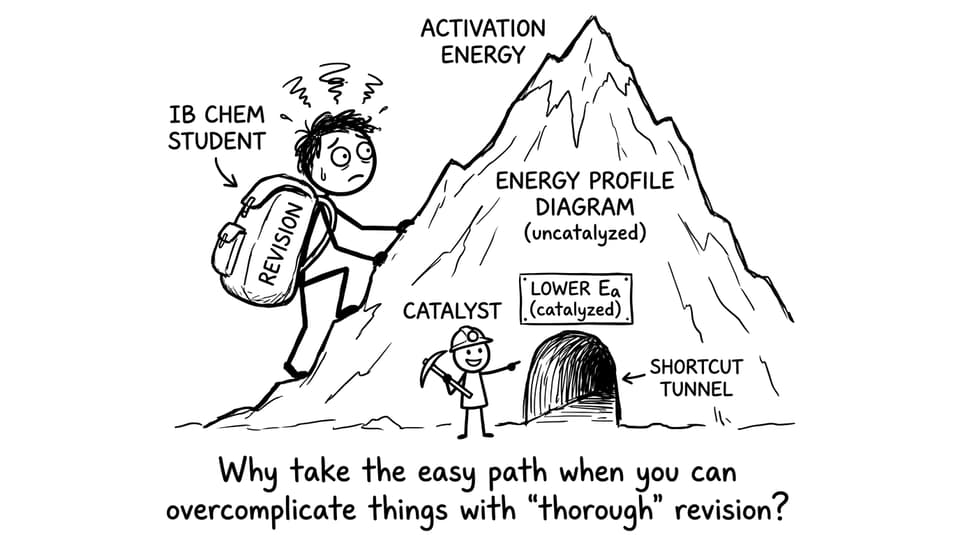
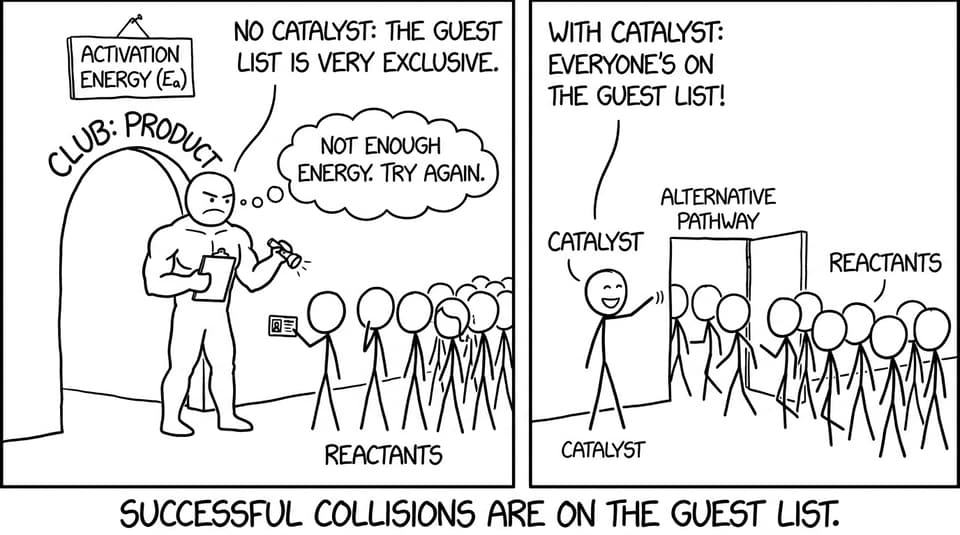
A catalyst provides an alternative pathway with lower activation energy (Ea).
-
Lower Ea means a greater fraction of particles can react at the same temperature.
-
Catalysts increase rate but are not consumed overall.
-
Catalysts do not change ΔH for the reaction.
-
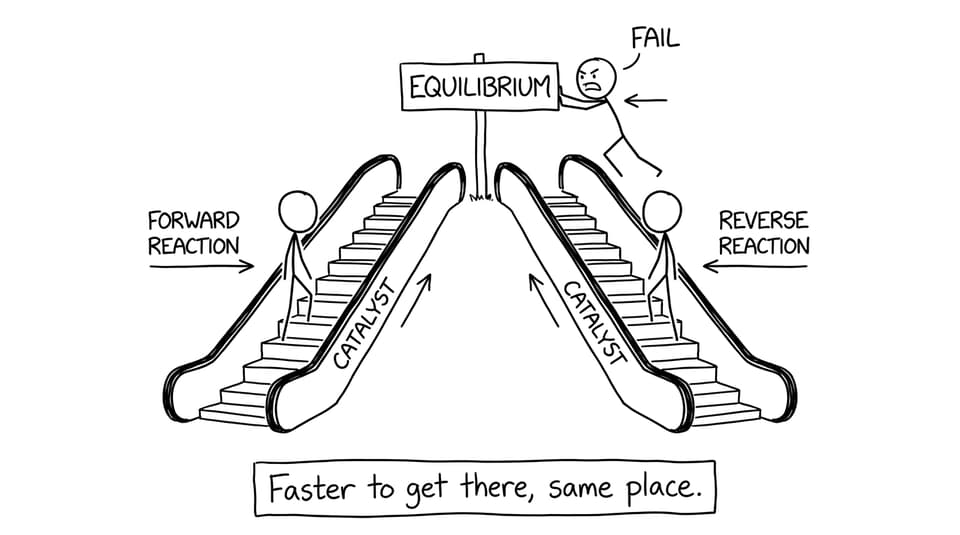
Catalysts do not change equilibrium position (they speed up both directions).
For definitions and diagram practice, revise activation energy with What Is Activation Energy? IB Chemistry Explained and the R2.2.4 Activation Energy Notes.
What activation energy really means in IB Chemistry
In IB Chemistry, activation energy (Ea) is the minimum energy needed for a collision to become a successful reaction. Many collisions happen. Most fail. Ea is the “entry fee” to reach the transition state.
That’s why heating usually speeds reactions up: not because Ea changes, but because more particles now have enough energy to reach the transition state.
If you want to link Ea to equations (especially HL kinetics), pair this with Arrhenius Equation Explained for IB Chemistry. It helps you explain why lowering Ea has such a big effect on the rate constant.
How catalysts lower activation energy
A catalyst lowers activation energy by reshaping the reaction mechanism. Instead of one steep hill, the reaction takes a route with smaller hills.
Alternative mechanism: a different route, lower peaks
In IB Chemistry, the phrase “alternative pathway” is not decoration; it’s the core mark. Many catalytic mechanisms involve multiple steps, and the highest step (the rate-determining step) becomes less energy-demanding.
Energy profile diagrams are where this becomes visual. If you need a quick refresher on reading peaks and steps, use R2.2.7 Energy Profiles and Transition States (HL) Notes.
Stabilizing the transition state
A catalyst can stabilize the activated complex (transition state), lowering the energy required to form it. In diagram terms: the peak is lower.
This explanation becomes sharper if you understand what the activated complex is. RevisionDojo’s Activated Complex Explained for IB Chemistry gives you the phrasing examiners expect.
Orientation and proximity: making collisions count
Some catalysts (especially enzymes) bind reactants in ways that improve orientation and bring them close together, increasing the probability that collisions lead to reaction. This shows up in the frequency factor idea (A) that appears in Arrhenius discussions.
Energy profile diagrams: what changes, what stays the same
A classic IB Chemistry trap is mixing up Ea and ΔH.
-
Ea changes with a catalyst (lower peak).
-
ΔH stays the same (reactants and products are still at the same energies).
So, when you draw an energy profile, keep the start and end levels identical. Only the pathway shape changes.
To drill this with exam-style prompts, try the R2.2.4 Activation energy Questionbank and review definitions using the R2.2.4 Activation energy Flashcards.
Catalysts in living things and industry (and why IB loves them)
Enzymes are biological catalysts: specific, efficient, and tuned for mild conditions. Industry uses catalysts for similar reasons: without them, the “reasonable” rate might require unreasonable temperatures, pressures, or costs.
And IB exam questions like to connect kinetics to real processes because it forces you to explain mechanism, not just state “rate increases.”
If you’re building exam stamina, RevisionDojo’s IB Predicted Papers and the Chemistry collection at IB Chemistry Predicted Papers help you practice the full rhythm: diagram, explanation, then application.
Catalysts and equilibrium: faster to reach, not moved
A catalyst speeds up both forward and reverse reactions. That means equilibrium is reached sooner, but the equilibrium position does not shift.
This is a frequent wording test in IB Chemistry: “Does a catalyst change the yield at equilibrium?” The correct logic is that equilibrium depends on thermodynamics (like ΔG and temperature), not on activation energy.
Bringing it home: how to score the marks
In IB Chemistry, catalysts and activation energy are a small topic with a big footprint. The fastest way to improve your score is to practice writing the same idea in three formats: definition, diagram, and explanation.
Use RevisionDojo’s Study Notes, Flashcards, and Questionbank to tighten the language, then pressure-test it under timed conditions with Predicted Papers and Mock Exams. If you get stuck, AI Chat can help you diagnose why your explanation lost marks, and Grading tools show what examiners expect.
Catalysts don’t change the destination. They change the route. In IB Chemistry, that’s the whole point, and the whole set of marks.