
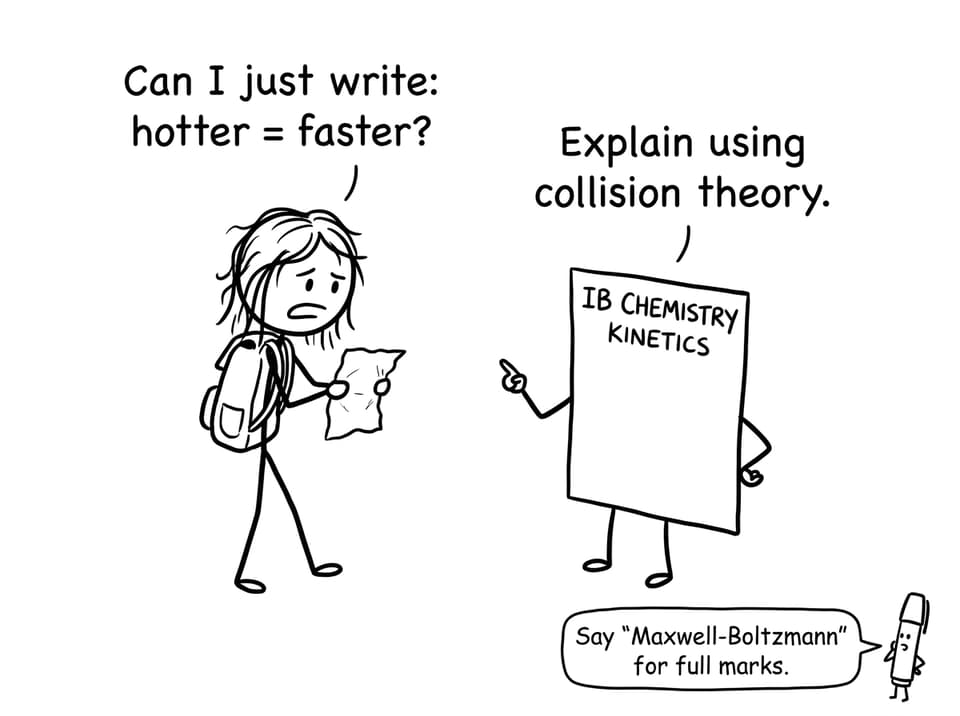
In the lab, heat feels like a shortcut. A slightly warmer water bath, a faster color change. And suddenly your brain whispers the most dangerous sentence in IB Chemistry: “I get it… higher temperature means faster reaction.”
Examiners do not hate that sentence. They just know it’s incomplete. In IB Chemistry, temperature questions are really questions about probability, how often particles collide, and how often those collisions have enough energy to matter.
The IB Chemistry checklist (what to say for full marks)
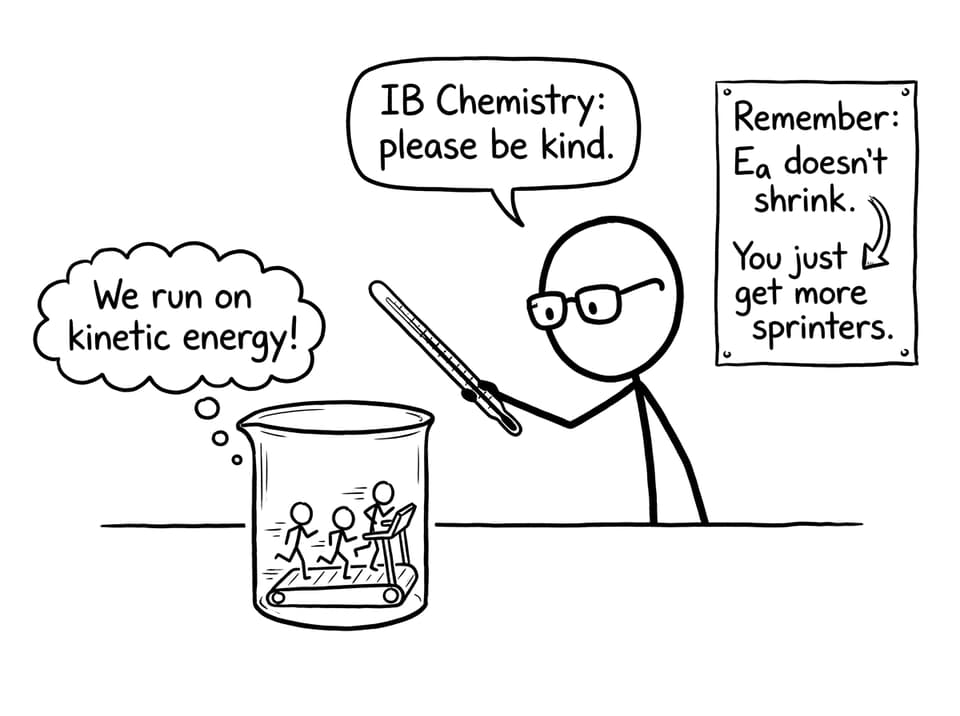
When temperature increases, the reaction rate increases because:
-
Particles have higher kinetic energy
-
Collisions happen more frequently
-
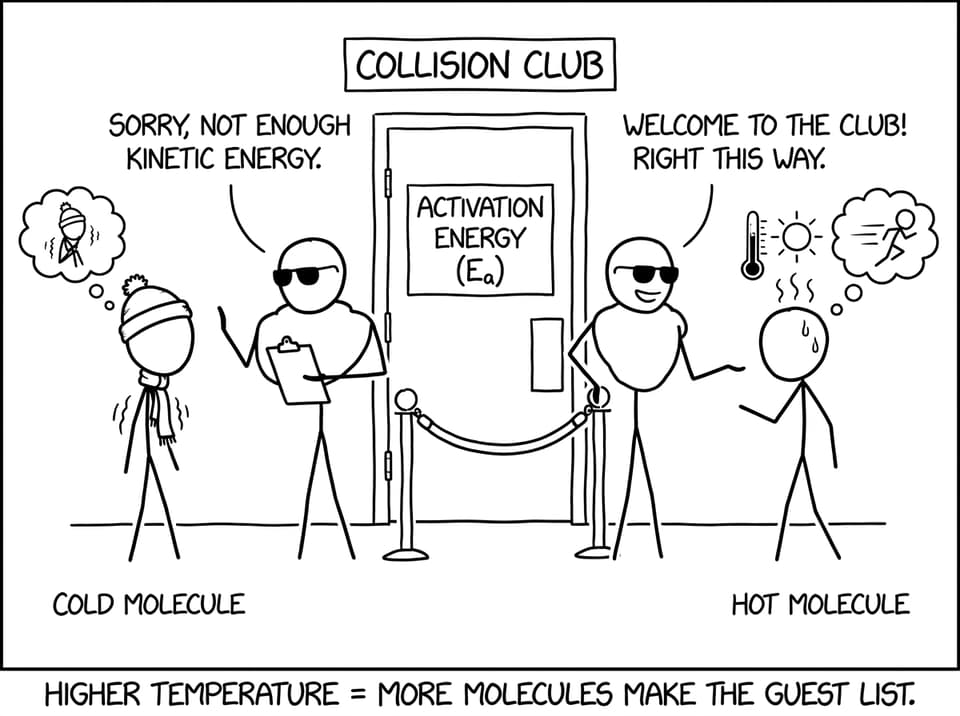
A much larger fraction of particles have energy greater than or equal to activation energy (Ea)
-
Therefore, there are more successful collisions per second
If you want the broader framing first, anchor it with Rate of reaction explained simply.
Why increasing temperature increases rate in IB Chemistry
Faster particles collide more often
Temperature is a measure of average kinetic energy. When you heat a system, particles move faster, so they meet (collide) more often. In collision theory terms, temperature increases collision frequency.
This is the first layer, and it earns some marks. But in IB Chemistry, the bigger story is what happens to collision energy.
More collisions cross the activation energy “entry fee”
Activation energy (Ea) is the minimum energy a collision needs to form products. Importantly: raising temperature does not lower Ea. Instead, it changes the distribution of particle energies.
A useful refresher is What is activation energy? IB Chemistry explained and the syllabus-aligned notes at R2.2.4 Activation energy.
The Maxwell-Boltzmann curve (what the graph is really saying)
In IB Chemistry, you’re expected to describe the Maxwell-Boltzmann distribution like a calm narrator:
-
Higher temperature curve becomes lower and broader
-
The curve shifts to the right (higher energies)
-
Total area stays the same (same number of particles)
-
The area beyond Ea becomes much larger (more particles can react)
That last bullet explains why a small temperature increase can cause a big rate increase: the “tail” beyond Ea grows quickly.
To practice exam-style prompts on this exact skill, use R2.2 How fast? Questionbank or the Chemical kinetics HL questionbank.
The HL bonus: Arrhenius in one clean sentence
At HL, you can connect temperature to the rate constant using Arrhenius:
-
(k = A e^{-E_a/RT})
As T increases, (-E_a/RT) becomes less negative, so (e^{-E_a/RT}) increases, so (k) increases. This is why rate increases exponentially, not linearly.
See Arrhenius equation explained for IB Chemistry and the HL notes at R2.2.11 Rate constant.
Common IB Chemistry mistakes (easy marks to protect)
-
“Temperature lowers Ea.” No, Ea is a property of the pathway. Temperature changes the distribution.
-
“More collisions means faster rate.” Only successful collisions count (energy, and sometimes orientation).
-
“Only the forward reaction speeds up.” Temperature increases both forward and reverse rates; equilibrium position is a separate question.
If collision theory feels shaky, lock it in with Collision theory explained simply and the syllabus notes 6.1 Collision theory and rates of reaction.
Conclusion: turn “hotter = faster” into an IB Chemistry answer
Increasing temperature increases reaction rate because particles move faster, collide more often, and, most importantly in IB Chemistry, a larger fraction of collisions have energy ≥ activation energy, creating more successful collisions each second.
If you want to turn this understanding into marks, RevisionDojo is built for it: drill kinetics in the Questionbank, learn the wording from Study Notes, reinforce definitions with Flashcards, and use AI Chat to polish explanations to markscheme style. When you’re ready, build timed practice with Mock Exams and Predicted Papers, and check your reasoning with Grading tools. That’s how IB Chemistry stops being a set of facts and becomes something you can actually use under exam pressure.