
Activation energy is the quiet reason some reactions feel like they “refuse” to happen. You mix, you swirl, you wait… and nothing. Then you warm it slightly, or add a catalyst, and suddenly everything wakes up. In IB Chemistry, that moment is not magic. It’s a threshold.
If you’re preparing for exams, activation energy is one of those ideas that shows up everywhere: kinetics, catalysts, Maxwell-Boltzmann, energy profiles, and HL Arrhenius questions. Get it clear once, and a lot of IB Chemistry becomes simpler.
Activation energy in IB Chemistry (quick checklist)
Use this as your “write-it-like-an-examiner” mini-script:
-
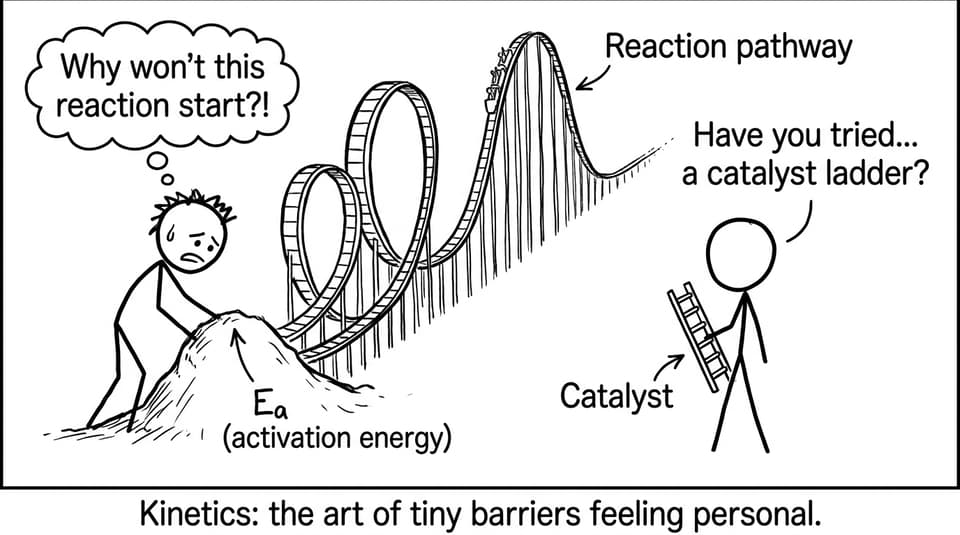
Activation energy (Ea) is the minimum energy needed for a collision to be successful.
-
It’s the energy needed to reach the transition state/activated complex.
-
On an energy profile diagram, Ea is from reactants up to the peak.
-
Catalysts lower Ea by providing an alternative pathway.
-
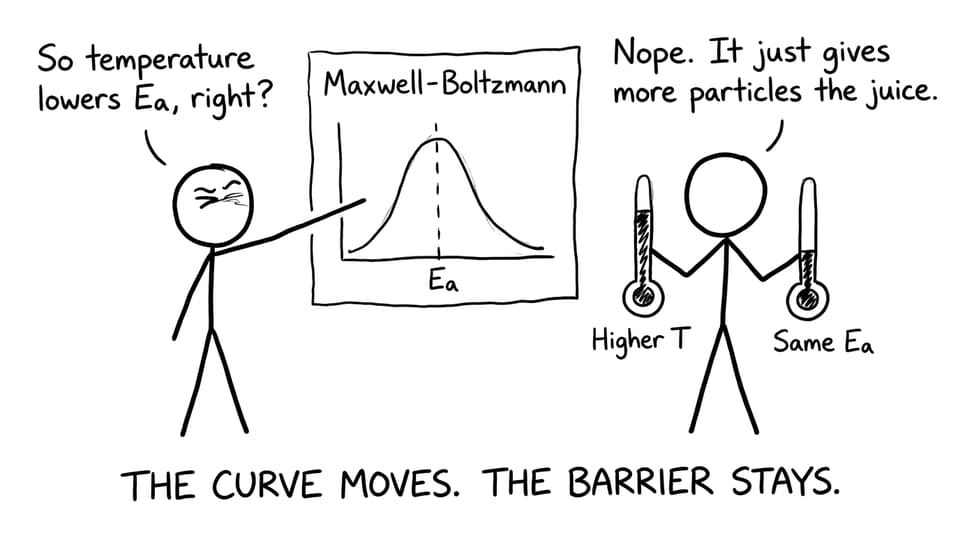
Higher temperature does not change Ea (it changes how many particles have energy ≥ Ea).
For a syllabus-aligned definition you can quote confidently, keep the IB Chemistry Key Definitions bookmarked.
What is activation energy? (the IB Chemistry definition)
In IB Chemistry, activation energy is defined as the minimum energy required for a successful collision between reactant particles.
That definition matters because it tells you what Ea is not. It’s not “the energy released” or “the energy of products.” It’s the entry requirement for reactants to reach a short-lived, high-energy arrangement where bonds can start breaking and forming.
If you want a clean, topic-specific recap with practice-ready phrasing, pair this article with R2.2.4 Activation energy Notes.
Why activation energy exists (even when reactions are exothermic)
A common exam trap in IB Chemistry is thinking: “If a reaction is exothermic, why does it need a push?”
It needs a push because:
Bonds must be disrupted before new ones form
Reactant bonds and electron arrangements are stable enough to “resist” change. To rearrange atoms, the system must climb to the transition state where bonds are partially broken and partially formed.
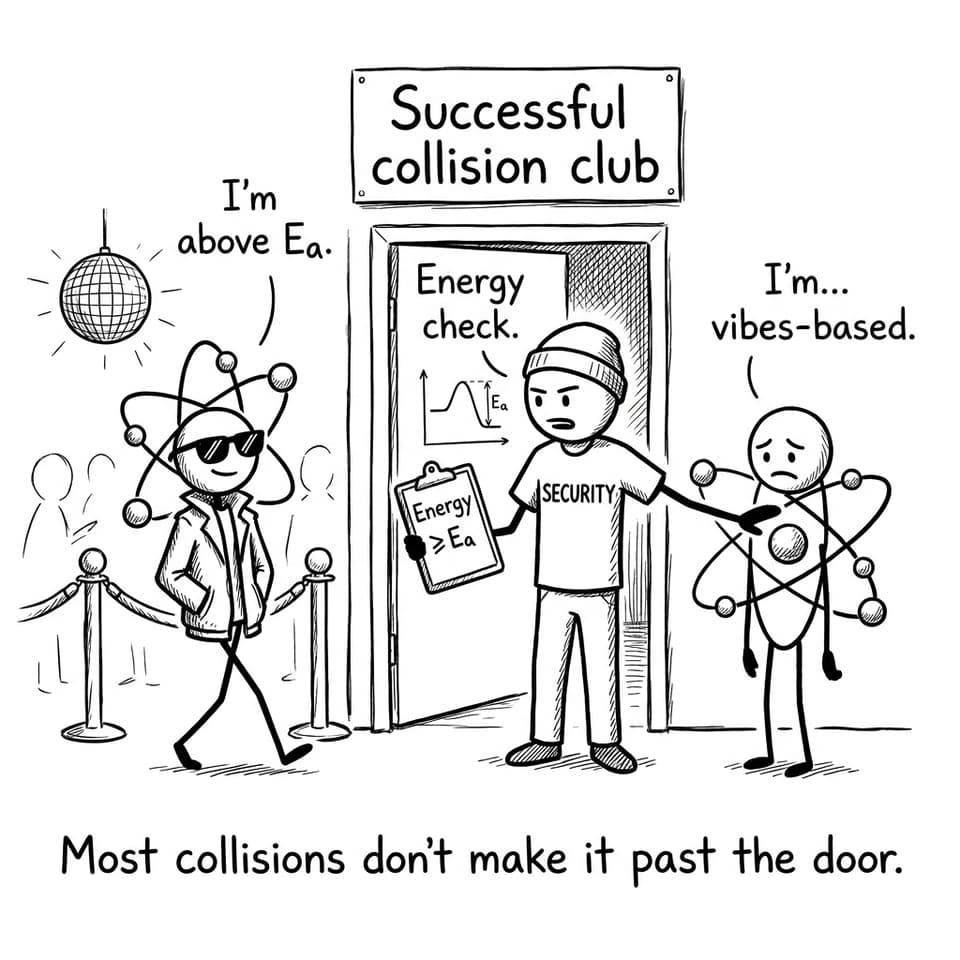
Most collisions are wasted
Particles collide constantly, but most collisions don’t have enough energy (and often not the correct orientation) to cross the barrier. That’s why kinetics is really about probability.
Ea controls rate (via probability)
Lower Ea means a larger fraction of particles can reach the transition state at the same temperature, so the reaction is faster. Higher Ea means fewer successful collisions per second, so the reaction is slower.
To connect activation energy to the bigger kinetics picture, read Rate of Reaction Explained Simply.
Activation energy on an energy profile diagram
On a potential energy (reaction coordinate) diagram:
-
Reactants begin at an initial potential energy.
-
The curve rises to a maximum (the transition state).
-
The vertical difference from the reactants to that maximum is Ea.
HL students should also connect this to the language “activated complex.” It’s the structure at the peak: unstable, momentary, and impossible to isolate.
For an HL-friendly extension, see Energy profiles and transition states notes (R2.2.7) and the clearer explanation in Activated Complex Explained for IB Chemistry.
What changes activation energy in IB Chemistry?
Catalysts (they lower Ea)
A catalyst provides an alternative pathway with a lower activation energy. In exam language, that means: more particles have energy ≥ Ea at the same temperature, so the rate increases. The catalyst is not used up overall.
If you want a quick “say this, draw that” guide, use How Catalysts Affect Activation Energy.
Temperature (it does not lower Ea)
Temperature increases average kinetic energy and changes the distribution of particle energies, so a larger fraction crosses the Ea threshold. But the barrier itself doesn’t move.
For the exact explanation examiners like, revise How Does Increasing Temperature Affect the Rate? (IB Chemistry).
Orientation (energy is necessary, not sufficient)
Collision theory in IB Chemistry requires both: enough energy and correct orientation. It’s possible to have energy ≥ Ea and still not react because the particles collide in an unproductive arrangement.
If you’re building full Topic 6/kinetics confidence, the home base is IB Chemistry Chemical Kinetics (HL).
Exam mistakes to avoid (IB Chemistry phrasing)
-
“Exothermic reactions don’t need activation energy.” They do. Ea is about the pathway and transition state, not the overall enthalpy change.
-
“Catalysts increase particle energy.” They don’t. Catalysts change the pathway so the required Ea is lower.
-
“Higher temperature lowers Ea.” In IB Chemistry, temperature changes the fraction of particles above Ea. Ea itself stays the same unless the mechanism/pathway changes.
If you want targeted practice that forces you to explain these ideas under exam pressure, use the R2.2.4 Activation energy Questionbank and the broader Chemical Kinetics HL Questionbank.
Closing: Make activation energy a point you can earn marks on
Activation energy is the minimum energy needed to reach the transition state, and in IB Chemistry it’s the clean bridge between diagrams, collision theory, catalysts, and temperature explanations. If you can define Ea, label it correctly, and explain what changes (and what doesn’t), you’ve turned a common confusion into reliable marks.
When you’re ready to go beyond understanding into exam performance, RevisionDojo is built for it: topic-by-topic Study Notes, targeted Flashcards, exam-style Questionbank practice with feedback, AI Chat for instant clarification, Grading tools for coursework drafts, plus Predicted Papers, Mock Exams, a Coursework Library, and expert Tutors to close gaps quickly. Start with the IB Chemistry Resources hub and make IB Chemistry feel predictable again.