
Catalysis is one of those IB Chemistry ideas that feels simple until the exam asks you to explain it in two tight sentences. You know the line: “It lowers activation energy.” Then the question adds one twist: heterogeneous or homogeneous? so and suddenly your brain starts negotiating with itself.
The good news is that this topic is predictable. If you can picture where the catalyst sits, how it meets the reactants, and what happens to the catalyst at the end, you can pick up marks quickly in IB Chemistry.
Quick exam checklist for IB Chemistry catalysis
Before you split into heterogeneous vs homogeneous catalysis, make sure you can say these five points cleanly (they show up everywhere in IB Chemistry kinetics):
-
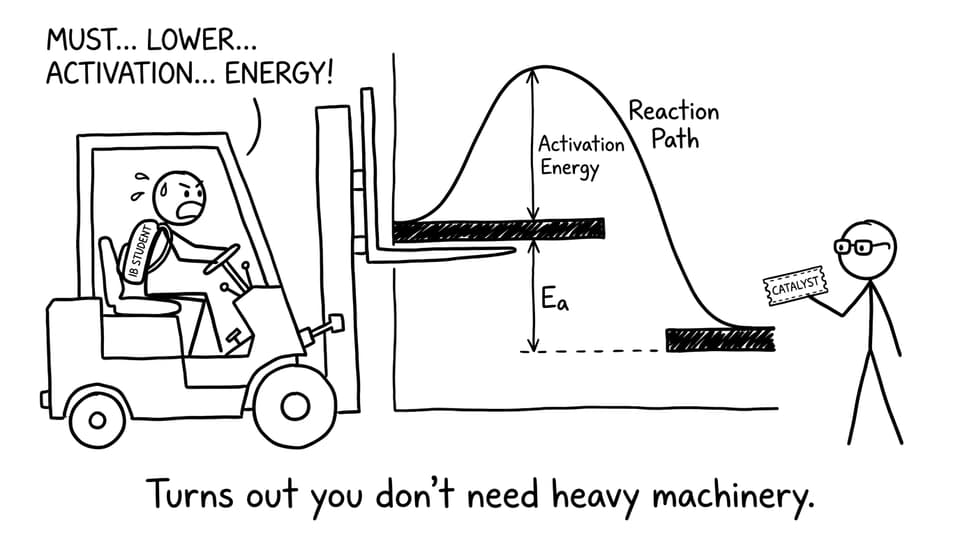
A catalyst increases reaction rate.
-
It provides an alternative pathway.
-
The alternative pathway has lower activation energy (Ea).
-
The catalyst is regenerated (not used up overall).
-
A catalyst does not change the equilibrium position, it only helps the system reach equilibrium faster.
If any of that feels fuzzy, warm up with What Is a Catalyst and How Does It Work? and the R2.2.5 Catalysts Notes.
Heterogeneous catalysis in IB Chemistry
What it means
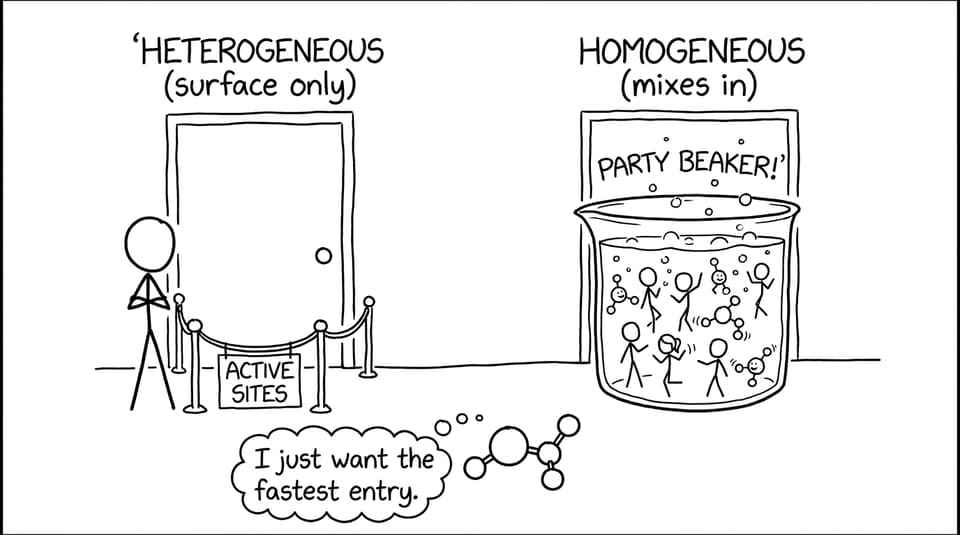
In IB Chemistry, heterogeneous catalysis means the catalyst is in a different physical state from the reactants.
Classic setup: reactants are gases or liquids, catalyst is a solid surface (often a transition metal or metal oxide).
How it works (surface story you should narrate)
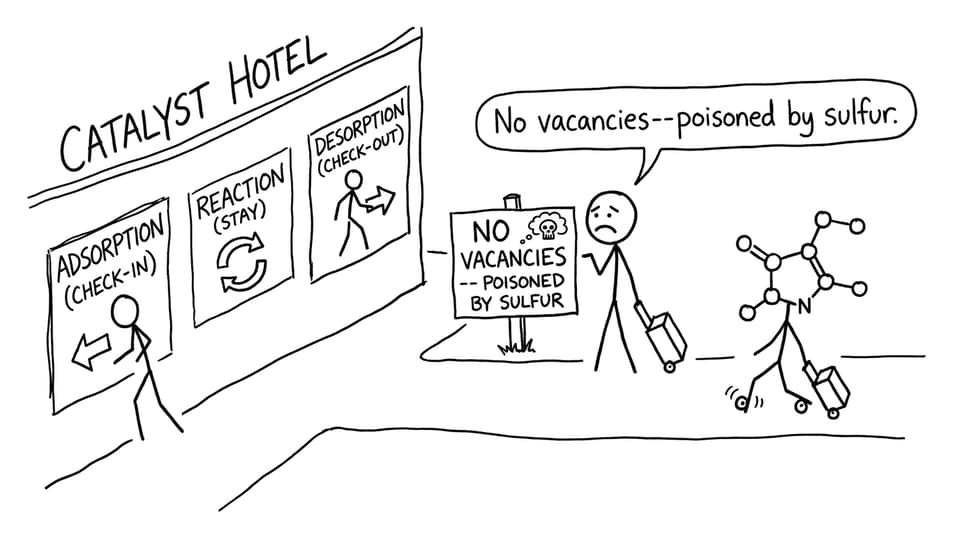
Heterogeneous catalysis is basically a “surface drama” happening in four steps:
-
Adsorption: reactant particles stick to the catalyst surface.
-
Activation: bonds weaken and particles align more effectively.
-
Reaction: products form more easily on the surface.
-
Desorption: products leave, freeing active sites.
This is why surface area matters so much in IB Chemistry explanations: more surface area means more active sites for adsorption.
For collision theory phrasing, connect this with 6.1 Collision theory and rates of reaction and the simpler refresher Rate of Reaction Explained Simply.
High-yield heterogeneous examples
These are the examples examiners love because they connect IB Chemistry kinetics to industry:
-
Haber process: iron catalyst; N₂ and H₂ react on a solid surface to form NH₃.
-
Contact process: V₂O₅ catalyzes oxidation of SO₂ to SO₃.
-
Catalytic converters: Pt/Pd/Rh speed up conversion of toxic gases (like CO and NO) into less harmful products.
To practise explaining these in exam language, the IB Chemistry Topic R2.2 Questionbank is built for exactly that kind of short-response mark scheme wording.
Pros and cons you can turn into evaluation marks
Advantages
-
Easy separation (solid catalyst can be filtered/left behind)
-
Reusable and stable at high temperatures
-
Ideal for continuous industrial processes
Disadvantages
-
Limited by surface contact (not all reactant molecules reach active sites)
-
Catalyst poisoning can block active sites
If “poisoning” feels vague, read Catalyst Poisoning Explained Simply and remember the key phrase: impurities bind to active sites, preventing adsorption.
Homogeneous catalysis in IB Chemistry
What it means
In IB Chemistry, homogeneous catalysis means the catalyst and reactants are in the same physical state.
Most commonly: everything is in aqueous solution, though gas-phase radical catalysis also counts.
How it works (the “intermediate pathway” angle)
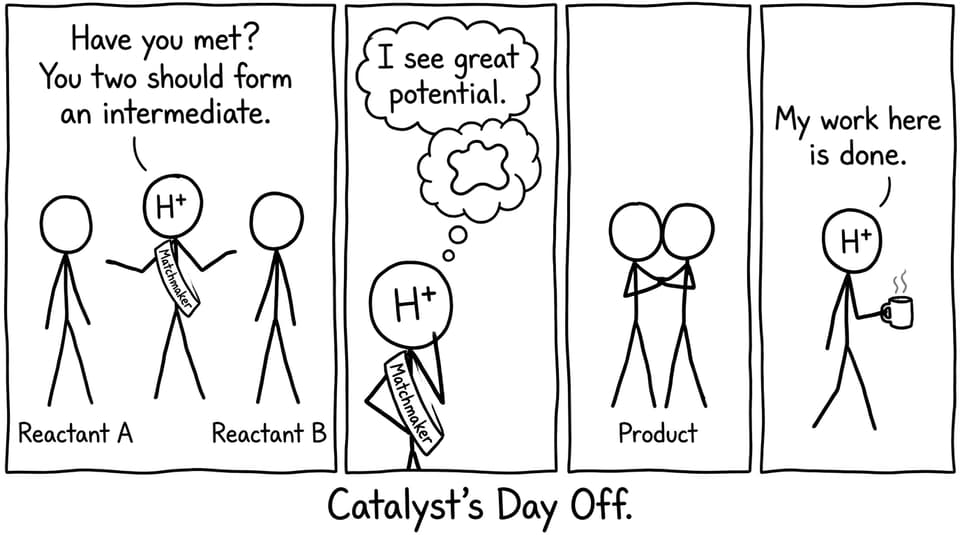
Instead of reacting on a surface, homogeneous catalysts tend to work by forming intermediate species:
-
Catalyst reacts with a reactant to form an intermediate.
-
Intermediate reacts further to form products.
-
Catalyst is regenerated.
That “intermediate” language is powerful in IB Chemistry because it shows you understand mechanism, not just definitions. If you want extra practice connecting catalysis to mechanisms and rate-determining steps, see R2.2.6 Reaction mechanisms and rate-determining steps.
High-yield homogeneous examples
-
Acid catalysis (H⁺) in organic reactions like esterification.
-
Base catalysis (OH⁻) in reactions such as ester hydrolysis.
-
Radical catalysis in atmospheric chemistry (e.g., ozone depletion cycles), where radicals are regenerated.
-
Iodine clock-type systems often involve solution-phase catalysis and make great IA inspiration.
For an IA-flavored extension, explore the Acid Catalysts and Iodine Clock Reaction exemplar.
Pros and cons (again: easy evaluation marks)
Advantages
-
Often very effective because reactants and catalyst mix uniformly
-
Can produce highly selective pathways (useful in complex mechanisms)
Disadvantages
-
Harder to separate from the reaction mixture
-
Catalyst contamination of products can be an issue
-
Reuse may be difficult
Heterogeneous vs homogeneous catalysis: the one-paragraph comparison
If you need one clean comparison for IB Chemistry Paper 2:
-
State: heterogeneous = different phase; homogeneous = same phase.
-
Mechanism: heterogeneous = adsorption/activation on a surface; homogeneous = intermediates in the same phase.
-
Separation: heterogeneous = easier; homogeneous = harder.
-
Best fit: heterogeneous = industrial continuous processing; homogeneous = solution mechanisms and catalytic cycles.
Conclusion: how to turn catalysis into easy IB Chemistry marks
Heterogeneous catalysis is about surfaces: adsorption, reaction, desorption. Homogeneous catalysis is about mixing and intermediates: catalytic cycles that regenerate the catalyst in the same phase. When you answer IB Chemistry questions, aim for two layers: a definition (states) and a mechanism clue (surface vs intermediate).
If you want to lock this in quickly, build a 15-minute routine on RevisionDojo: review the R2.2.5 Catalysts Notes, drill exam-style prompts in the R2.2 Questionbank, and use Flashcards + AI Chat to tighten your phrasing until it sounds like a mark scheme. That’s the quiet advantage in IB Chemistry: not just knowing the idea, but being able to say it with calm precision when the clock is loud.