
If you've ever finished a long night of IB revision and caught yourself thinking, "What if they just reuse the same questions?" you're not alone.
It's a particular kind of hope, half strategy, half superstition. You imagine the exam as a wheel that keeps turning, eventually bringing the same prompt back around. If you can just find the right set of previous questions, maybe you can predict the next turn.
But the IB doesn't reward wishful pattern-spotting. It rewards something quieter: understanding the structure of what gets assessed, and practicing the skills that show up again and again.
So, are previous IB questions cycled?
Not in the simple way people mean it. But in a more useful way, yes: the IB repeats ideas, command terms, mark-allocation logic, and familiar question shapes. When you revise properly, the exam starts to feel less like a roulette wheel and more like a language you can learn.
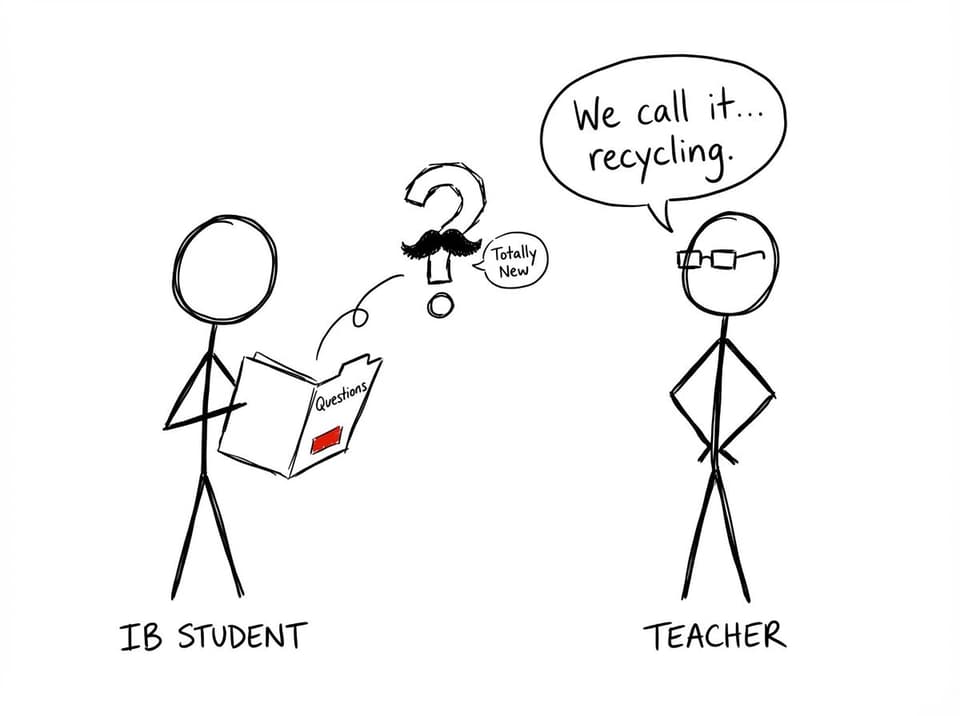
The quick answer: does the IB recycle exam questions?
The IB can reuse themes and formats, but you should not assume a question will reappear word-for-word. Across most subjects, what tends to "cycle" is:
- Core concepts (the syllabus doesn't change every session)
- Skill demands (explain, evaluate, compare, calculate, analyze)
- Common traps (misreading command terms, missing steps, shallow evaluation)
- Question structures (multi-part scaffolding, data response, unseen stimulus)
What does not reliably cycle:
- The exact wording of a prompt
- The same data set, text, or stimulus
- The same context examples
Your best plan is to study the patterns that actually repeat in IB marking, not chase a myth of identical repeats.
Why this rumor never dies in IB corridors
Two things make "cycled questions" feel true in the IB:
First, the IB syllabus is stable. If the same learning objectives exist year after year, then it's natural that questions will keep orbiting the same content.
Second, your memory plays tricks. When you've practiced enough, different questions begin to feel similar because they are testing the same underlying skill. That similarity can feel like repetition, even when the question is genuinely new.
That's not bad news. It's a clue.
The real insight is: the IB is consistent in what it rewards. If you train that, you stop needing the exam to be predictable.
What actually "cycles" in IB exams
When students ask whether IB questions are cycled, they're usually asking about exact repeats. The smarter question is: what elements recur often enough that I can prepare for them?
Concepts cycle because the IB syllabus is finite
A course has boundaries. Within those boundaries, the IB must keep assessing the same big ideas.
So yes, you'll see recurring concepts: equilibrium logic in sciences, interpretation moves in English, common model applications in econ, familiar proof and function behaviors in math.
The trick is to revise the concept until you can recognize it wearing different costumes.
Command terms cycle because the IB grades skills
The IB doesn't just test knowledge; it tests performance.
"Explain" and "evaluate" are not synonyms. "Compare" is not "describe both." And once you notice how often command-term mistakes cost marks, you realize the IB is not hiding the game. It's repeating it.
A practical way to train this is to do exam-style practice and ask: What would full marks look like under this command term? That's exactly what RevisionDojo's feedback loop is built to reinforce through the Questionbank.
Mark allocation cycles because the IB has a logic
If a question is 2 marks, it rarely wants a philosophical paragraph. If it's 8 marks, it rarely wants two bullet points.
The IB repeatedly tests whether you can match your response to the marks available. That skill is boring, mechanical, and massively profitable.
This is where high-volume practice matters. The more IB questions you do, the more your brain starts to "feel" what 4 marks demands versus 10.
The dangerous way to use older IB questions
Let's be honest: the temptation is to treat older IB questions like lottery numbers.
You search for repeats. You highlight "frequent topics." You build a revision plan around what you hope will come up.
Sometimes you get lucky.
More often, you end up with:
- Overconfidence in narrow areas
- Underpreparedness in quieter topics
- Weak exam technique because you practiced recognition, not thinking
In the IB, luck doesn't scale. Skill does.
The disciplined way to use older IB questions
Older IB questions are still gold, if you use them as training tools, not prediction tools.
Here's a simple checklist you can apply to any IB subject.
A practical IB question checklist
- Can you name the topic + subtopic being tested?
- Can you identify the command term and its success criteria?
- Can you predict the markscheme shape (definitions, steps, evaluation, evidence)?
- Can you explain why a common wrong answer is tempting?
- Can you rewrite your answer to be 20% clearer?
When you do this, you're not just collecting answers. You're learning the IB's patterns.
To build this into a routine, start from the RevisionDojo IB hub and anchor practice around a system: notes for clarity, questions for application, and feedback for correction.
What "cycled" really means: the IB repeats question shapes
Students preparing for IB exams often notice recurring templates:
- A stimulus, then a chain of sub-questions
- A short definition question followed by a longer "discuss"
- A data table that looks innocent but hides two conceptual steps
- A familiar math setup with a twist in the final line
These are not recycled questions. They're recycled forms.
That's why doing a lot of exam-style practice matters more than rereading notes.
If you want a full workflow, borrow the structure from How to Study for IB Exams: Step-by-Step Guide and plug it into daily practice.
How RevisionDojo helps you prepare without relying on repeats
A good IB prep system should make you less dependent on prediction.
RevisionDojo is designed for that kind of stability. It connects:
- Study Notes to learn the concept cleanly (without rewriting marathons)
- Flashcards to keep retrieval alive daily
- Questionbank to drill the exam-shaped skill
- AI Chat (Jojo AI) to unblock confusion fast
- Mock Exams and Predicted Papers to build timing and calm
- Grading tools and the Coursework Library to keep coursework stress from spilling into exam season
- Tutors for human guidance when you need it most
If you want the overview of that ecosystem, this is the clearest starting point: RevisionDojo App: The Smarter Way to Prep for IB Exams.
And if you specifically want practice breadth (so you're not stuck repeating the same handful of questions), this pairs well with Comprehensive IB Question Bank: Thousands of Practice Questions.
A calm strategy: train "repeatable skills," not repeatable questions
If you're worried about whether IB questions cycle, the deeper worry is usually this: "What if I revise the wrong things?"
Here's the calmer answer: you won't revise the wrong things if you focus on what the IB always rewards.
The three repeatable IB skills
Clear recall
Definitions, formulas, key vocabulary. You need fast access.
Daily Flashcards sessions keep this alive without turning your week into a panic.
Accurate application
This is where marks are won. You recognize the concept, but you also perform it under the IB format.
That's what the Questionbank trains: topic-filtered practice with feedback.
Feedback-driven correction
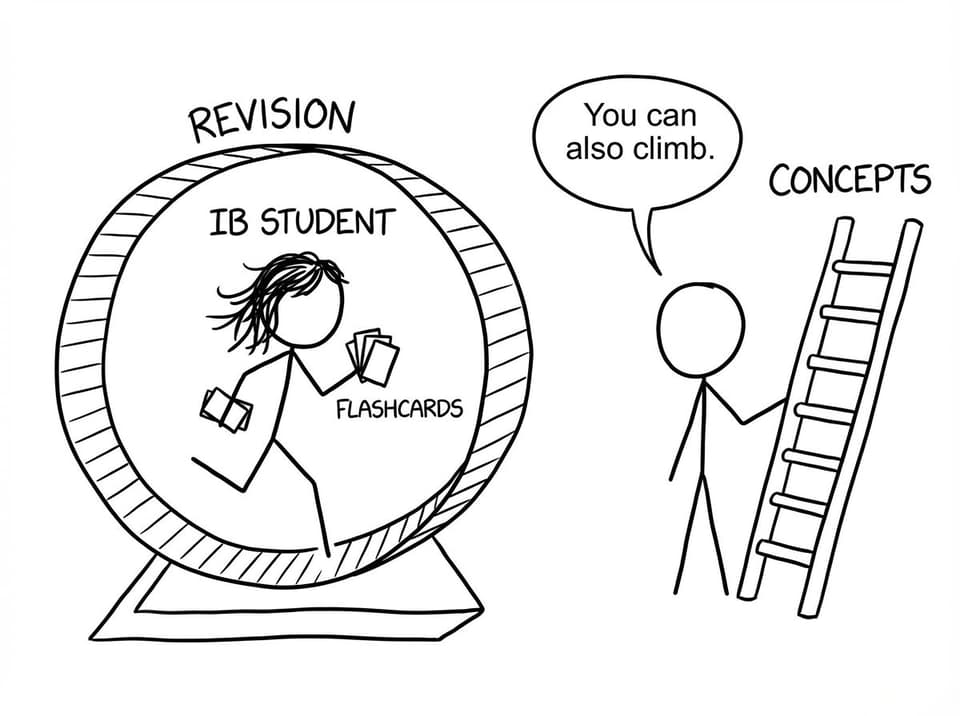
Most students repeat revision. High scorers repeat correction.
This is where Jojo AI becomes useful: ask why your answer misses the markscheme, then repair and retest. If you're curious what that looks like, see Meet Jojo AI: Your Personal IB Study Assistant.
How to use predicted papers without turning them into superstition
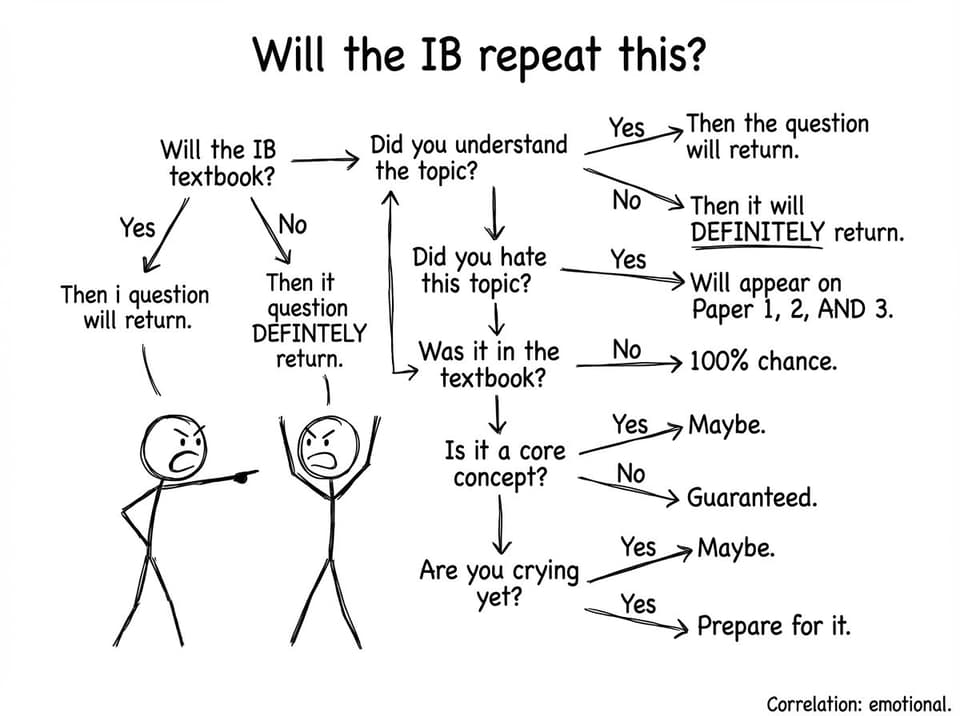
Predicted papers can be helpful for IB students because they simulate realistic structure and timing. But they should be used as rehearsal, not prophecy.
A good use-case:
- Take a timed paper to test pacing
- Diagnose weak topics and command terms
- Loop back into targeted Questionbank practice
RevisionDojo supports this with subject-specific predicted sets (for example, Math AI Papers) and timed practice guidance like How to Run Timed IB Mock Exams in RevisionDojo.
Closing: the IB doesn't cycle questions, it cycles demands
If you take one thought into your next IB study session, let it be this:
The IB doesn't need to repeat questions to be predictable. It repeats standards.
It repeatedly asks you to understand a concept, apply it cleanly, obey the command term, and match the mark allocation. That's the cycle that matters.
If you want a revision setup that trains those repeatable demands every week, build your loop in RevisionDojo: use Study Notes for clarity, Flashcards for recall, the Questionbank for exam-shaped practice, Jojo AI Chat for quick fixes, Mock Exams and Predicted Papers for stamina, and Grading tools plus the Coursework Library to keep everything else from derailing you.
When you revise like that, you stop asking whether the IB will repeat a question.
You start knowing you can handle whatever it asks.