


The biggest adjustment shock in IB Business Management is not the volume of content. It is discovering that knowing the content is only the beginning.
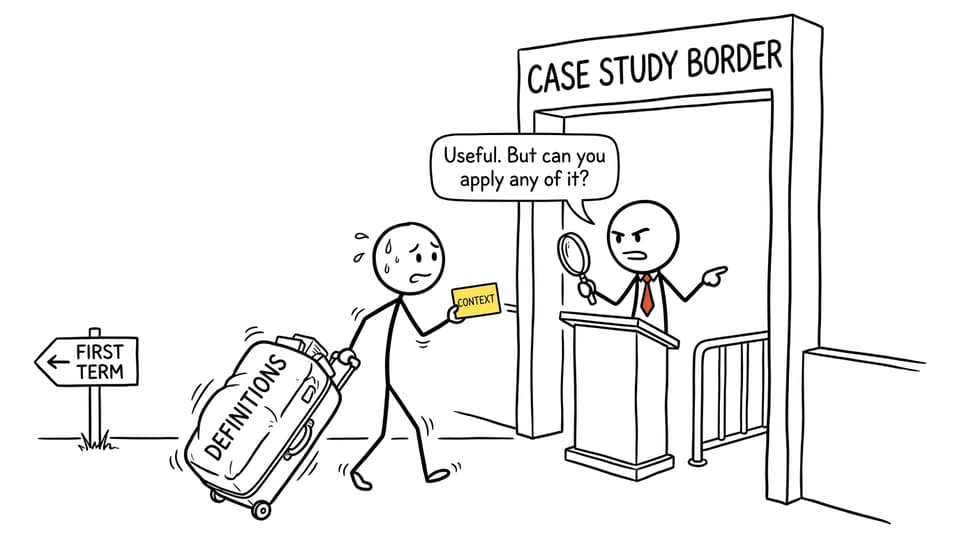
Many new students can define a stakeholder, explain a private limited company, or list the features of an objective. Then an assessment asks them to apply that knowledge to a particular business. Suddenly, a memorized definition does not produce a strong answer.
That gap between knowing and applying causes many IB Business Management first term struggles. The solution is to change how you study: learn each concept, connect it to case evidence, develop its consequences, and match your answer to the command term.
The first-term adjustment checklist
Concentrate on these habits during your first term:
- Learn concise definitions rather than whole paragraphs.
- Identify the command term before answering.
- Use precise evidence from the stimulus.
- Explain why that evidence matters to the business.
- Connect consequences to objectives or stakeholders.
- Practise short answers before long evaluations.
- Rewrite weak paragraphs after receiving feedback.
These are not separate tasks. Together, they form the chain of reasoning that strong Business Management answers require.
Why memorization stops being enough
Business Management initially looks familiar. Companies, profit, employees, marketing, and leadership appear in ordinary life. That familiarity can be deceptive because it encourages sensible but general comments.
The IB course expects knowledge, application, analysis, evaluation, and appropriate communication. In practice, an answer must often move beyond stating what a concept means. It should show what the concept means for this organization, facing this decision, under these conditions.
Consider a business debating expansion. Writing that expansion can increase sales is plausible but generic. A stronger answer explains that opening another location could increase the customer base and revenue, although additional rent and recruitment costs might create short-term cash-flow pressure.
The second answer moves from action to consequence and recognizes a trade-off. This is where analysis begins.
Students can build their foundation through the IB Business Management resources hub and Topic 1.1: What Is a Business?. Apply every new definition immediately rather than waiting for revision season.
The source of first-term struggles
The hardest early skill is case-specific application. Students may understand the theory but write answers that could apply to almost any company.
Repeating the organization's name is not enough. Application means selecting a detail that changes the argument. Useful evidence could concern ownership, size, objectives, finances, customers, employees, production, or competition.
Suppose a family-owned café is considering a second location. Saying expansion may create economies of scale shows knowledge. Explaining that larger ingredient orders may reduce the average cost per meal applies the concept. Noting that the owners have limited management capacity, which could weaken quality control across two locations, adds analysis and balance.
A reliable paragraph follows this sequence:
- Make a clear business point.
- Select one relevant case detail.
- Explain the immediate consequence.
- Develop the effect on an objective or stakeholder.
- Add a limitation when judgment is required.
The guide to AO2 application and analysis explores this skill further. Students can then use the IB Business Management Questionbank for focused, topic-based practice.
Command terms shape the answer
Two questions about the same topic may require different responses. The command term tells you what kind of thinking to demonstrate.
Define requires precision. Explain requires causes or reasons. Analyse asks you to develop relationships and consequences. Evaluate requires weighing strengths and limitations before reaching a supported judgment.
Students sometimes write everything they know because they fear leaving something out. Yet relevance matters more than volume. A long descriptive response does not become analytical merely because it contains more words.
Before writing, identify three things:
- Task: What does the command term require?
- Topic: Which concept must you use?
- Context: Which case details affect the answer?
The RevisionDojo command terms guide helps distinguish these demands. Flashcards can support recall, but each card should also prompt a sentence demonstrating the relevant skill.
A study routine that fixes the problem
Effective routines are small enough to repeat. For each topic, complete four stages.
Understand the concept
Use Study Notes to learn the definition, purpose, advantages, limitations, and affected stakeholders. Keep summaries compact enough to retrieve under pressure.
Attach it to a business
Choose a classroom case or Questionbank stimulus. Ask which organizational feature makes the concept useful, risky, or inappropriate. Abstract knowledge then becomes conditional reasoning.
Write and inspect one paragraph
Answer one focused question. Highlight the case evidence and each cause-and-effect connection. If the paragraph contains theory but no meaningful stimulus detail, rewrite it.
RevisionDojo's AI Chat can clarify why a sentence remains descriptive, while Grading tools can identify where application or evaluation needs development. Write independently first so feedback strengthens your thinking rather than replacing it.
Repeat after feedback
Do not simply read a correction. Rewrite the weakest paragraph without looking at the original. This converts feedback into a reproducible skill.
Predicted Papers and Mock Exams can build timing and stamina later. During the first term, targeted practice is usually more useful than completing full assessments before the foundations are secure.
Progress and mistakes to watch
By the end of the first term, aim to define concepts accurately, distinguish command terms, use meaningful case details, develop logical consequences, identify affected stakeholders, and write conditional judgments.
Avoid definition dumping, false application, and unsupported opinions. Do not stop after the first consequence. If lower prices increase demand, ask what higher demand means for revenue, capacity, employees, or quality.
Keep an error log with labels such as weak context, missing consequence, wrong command term, and unsupported judgment. The guide to earning a 7 in IB Business Management offers a broader framework for turning recurring weaknesses into focused practice.
Make the adjustment early
A weak first-term paragraph is not a verdict on your ability. It is information about which link in your reasoning needs attention.
RevisionDojo brings that learning process together. Study Notes and Flashcards establish knowledge. The Questionbank develops application. AI Chat and Grading tools support reflection. Predicted Papers and Mock Exams build readiness later, while the Coursework Library and Tutors can help as assignments become more complex.
Business Management becomes less mysterious when you stop asking, “Do I know this topic?” and begin asking, “Can I use it to explain this business decision?” Making that adjustment early changes everything that follows.