Join 650k+ students breezing through the IBReady to breeze through the IB?
Metabolism looks neat on a textbook page: arrows, boxes, and tidy enzyme names. But inside a living cell, it feels more like a kitchen during a dinner rush. Ingredients run low. Orders change. Someone keeps opening the fridge.
That is why feedback inhibition matters so much in IB Biology. Cells cannot afford to run every metabolic pathway at full speed just because the enzymes exist. Instead, they use a simple rule: when the final product is abundant, it taps the brakes at the start.
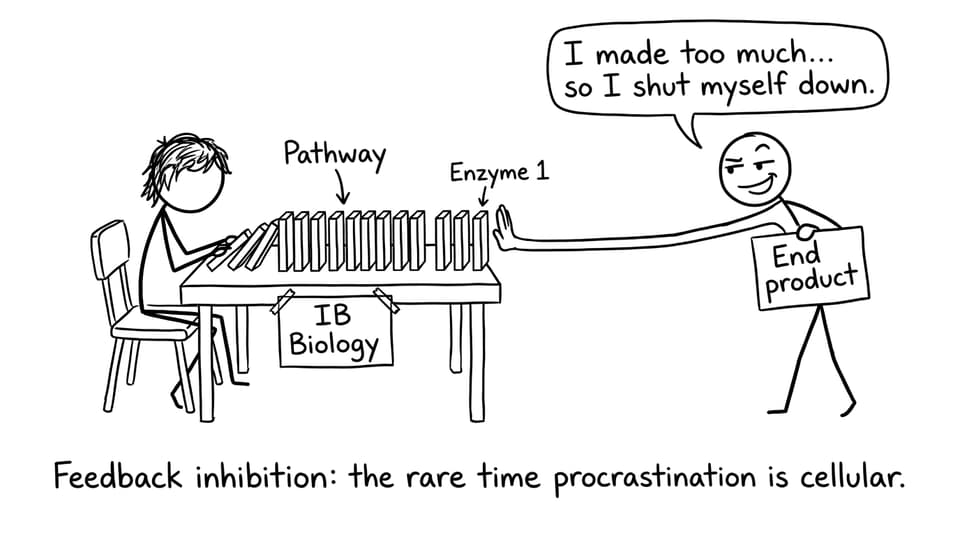
Feedback inhibition domino joke
Quick IB Biology checklist: what to say in an exam answer
If an exam question asks why metabolic pathways are regulated by feedback inhibition, hit these points clearly:
The end product inhibits an enzyme near the start of the pathway
Inhibition happens at an allosteric site (not the active site)
Binding causes a conformational change, reducing enzyme activity
This prevents overproduction and conserves ATP and substrates
It supports homeostasis by stabilizing product concentration
min read
min read
min read
min read
It is reversible and can respond quickly as levels change
For crisp definitions you can copy into your own wording, use the IB Biology glossary.
How feedback inhibition works (the mechanism you should describe)
In IB Biology, feedback inhibition is usually taught as a classic negative feedback loop. A metabolic pathway contains multiple enzyme-controlled steps, and the final product accumulates as the pathway runs. When there is enough product, it binds to an allosteric site on an early enzyme (often the first “committed step”).
That binding changes the enzyme’s shape. The active site becomes less effective, so the substrate binds less well or catalysis slows. The whole pathway then reduces output. When the product concentration drops again, the product dissociates, the enzyme returns to its original shape, and the pathway restarts.
Why feedback inhibition is so common in IB Biology: three big reasons
Energy efficiency: cells hate waste
A pathway is not just a set of arrows. It costs energy and materials. Each step may require ATP, reducing power, and valuable substrates that could be used elsewhere.
Feedback inhibition prevents a cell from making molecules it does not currently need. In exam language: it conserves resources. It also reduces the risk that the cell will drain important intermediates from other pathways.
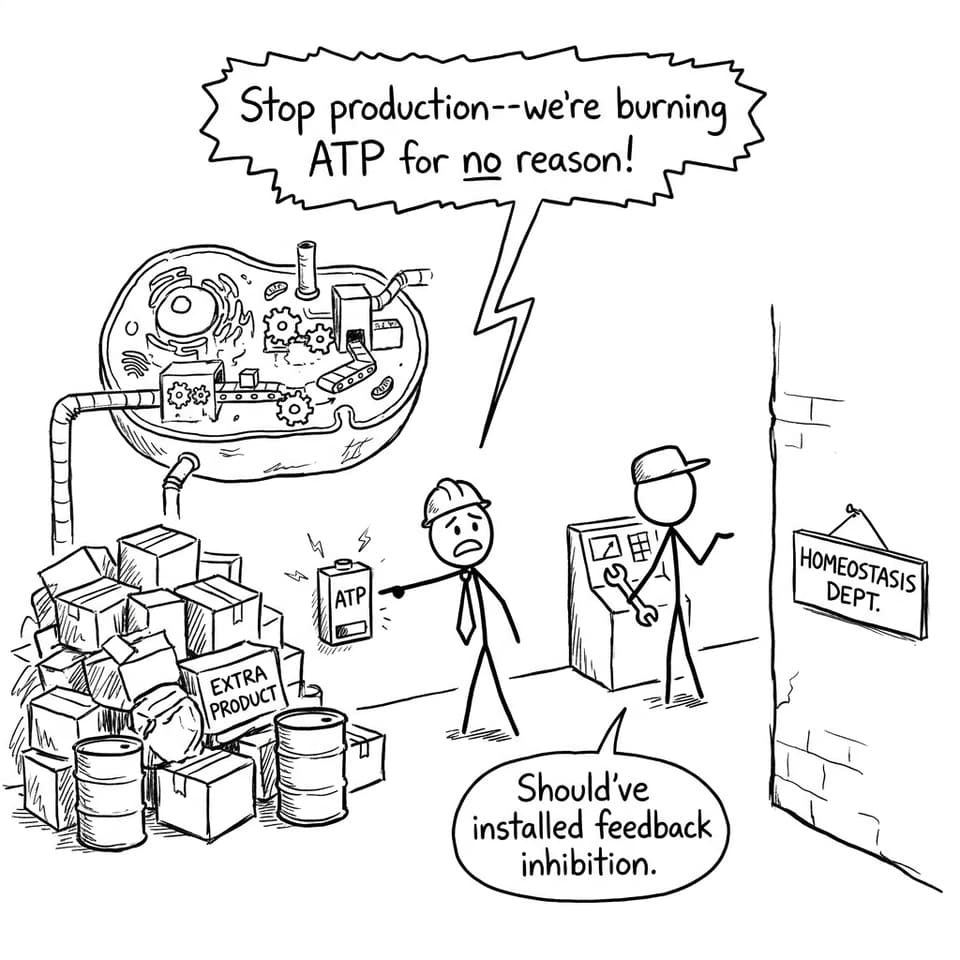
Cell factory wasting ATP joke
Homeostasis: keeping concentrations in a safe range
Many biomolecules are useful only within certain limits. Too little and key processes slow. Too much and the cell can experience osmotic problems, altered pH effects, or disruption of other reactions.
Feedback inhibition is basically “automatic regulation.” The pathway self-adjusts based on product concentration. This is why it is such a clean example of negative feedback in IB Biology. For a wider link to feedback concepts, RevisionDojo’s positive and negative feedback notes are a helpful comparison.
Coordination: metabolism is a network, not a single road
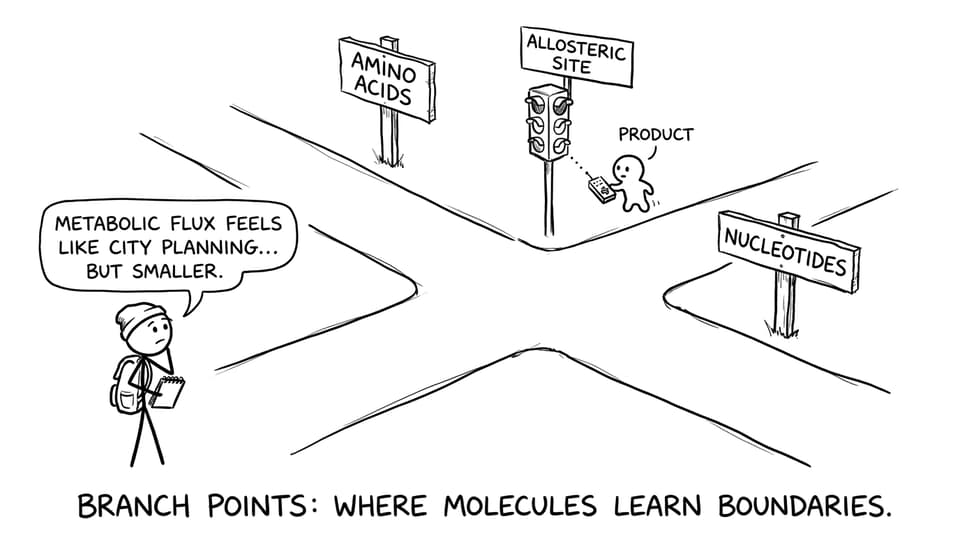
Real metabolism has branch points where one intermediate can feed multiple outcomes. If one product is already abundant, it makes sense to redirect flow to a different pathway.
Feedback inhibition helps regulate “metabolic flux” at these decision points. The end product becomes a signal that says: stop sending carbon and energy in my direction for now.
Common IB Biology exam pitfall: mixing up inhibition types
Students often confuse feedback inhibition with competitive inhibition. Competitive inhibition involves an inhibitor competing for the active site. Feedback inhibition usually involves the product binding to an allosteric site and changing enzyme shape.
Bringing it home: use IB Biology logic, then practise it
Feedback inhibition is everywhere because it is elegant: it saves energy, protects homeostasis, and keeps a network of metabolic pathways coordinated without needing constant genetic changes. For IB Biology exam questions, it is also a gift because the logic is always the same: “enough product means slow the first step.”
To lock it in, use RevisionDojo as your daily system: practise exam-style prompts in the Questionbank, refine explanations with AI Chat, and test recall using Flashcards and Study Notes. When you are ready to simulate pressure, use Mock Exams and Predicted Papers, then check your clarity with the Grading tools. If you want targeted help, the Tutors and Coursework Library can keep your biology answers precise and confident.
If you only revise one mechanism today, make it feedback inhibition in IB Biology.