


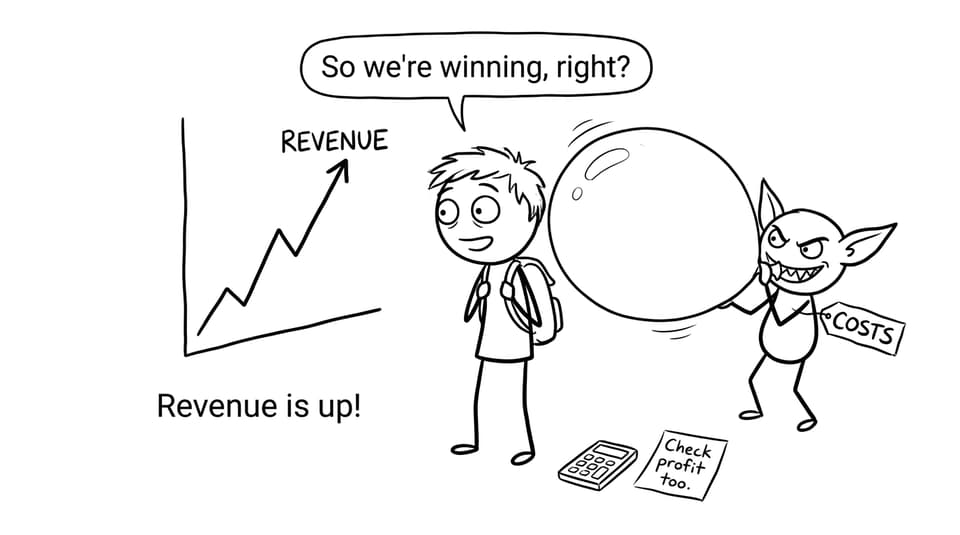
In the middle of a case study, revenue can feel like a friendly number: bigger is better, right?
But IB Business Management quietly asks for something harder. Not just whether revenue is rising, but what that rise means, why it happened, and which decision should follow. Revenue is the story of customer demand, competitive pressure, and managerial choices, told in a single line of data.
What revenue actually tells you in IB Business Management
Revenue is the income a business earns from selling goods or services (before costs are deducted). In IB Business Management, revenue is often the first clue in a bigger puzzle: performance, pricing, operations, and strategy.
If you want the syllabus-aligned definitions (useful for clean 2-mark answers), keep the IB Business Management Key Definitions open while you revise.
Quick exam checklist: what to do when you see revenue data
-
Identify the trend (up, down, volatile, seasonal)
-
Link revenue to a likely cause (price change, promotion, market growth, quality issues)
-
Pair revenue with at least one other variable (costs, profit, cash flow, capacity)
-
Make a decision with a trade-off (short vs long term, finance vs ethics, growth vs risk)
For Topic 3 alignment, revise alongside 3.3 Costs and revenues and practise on the 3.3 Costs and revenues Questionbank.
IB Business Management decisions that depend on revenue
Managers rarely make decisions based on a single number. Still, revenue is the starting point for several high-frequency IB Business Management exam angles.
Revenue shows market performance (and market fit)
Rising revenue often signals stronger demand, improved competitiveness, or successful marketing. Falling revenue can hint at weak promotion, intense rivalry, poor quality, or changing consumer tastes.
In Paper 1 style responses, your analysis sharpens when you connect revenue changes to objectives and strategy. That’s why it helps to practise broader decision chains too, like those in the Business Objectives Questionbank.
Revenue supports forecasting and planning
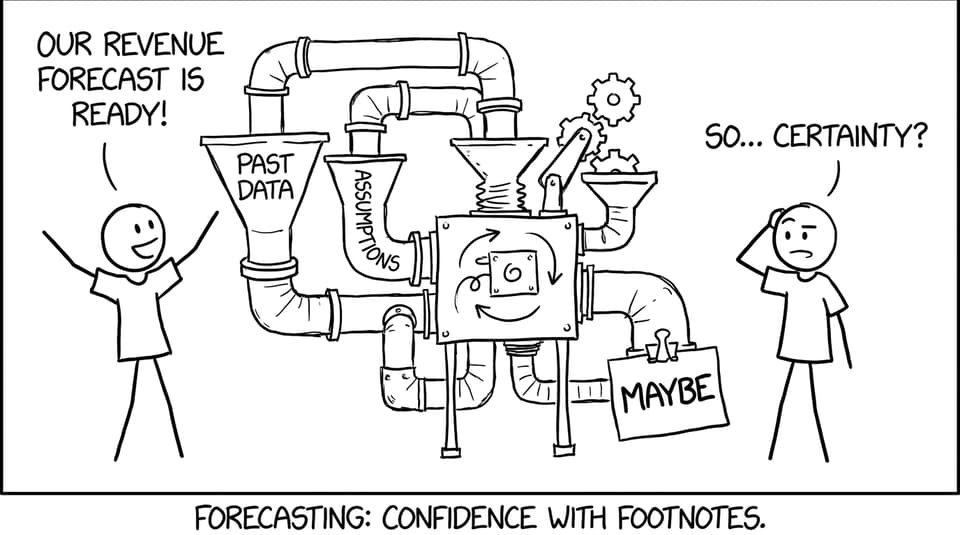
Hiring staff, opening a branch, expanding capacity; these choices rely on estimates of future revenue. In IB Business Management, forecasting is less about perfect accuracy and more about showing logical assumptions and acknowledging risk.
If you want to build this skill, pair revenue content with financing decisions, because growth plans often require funding: 3.2 Sources of finance Questionbank.
Revenue shapes pricing decisions (and elasticity signals)
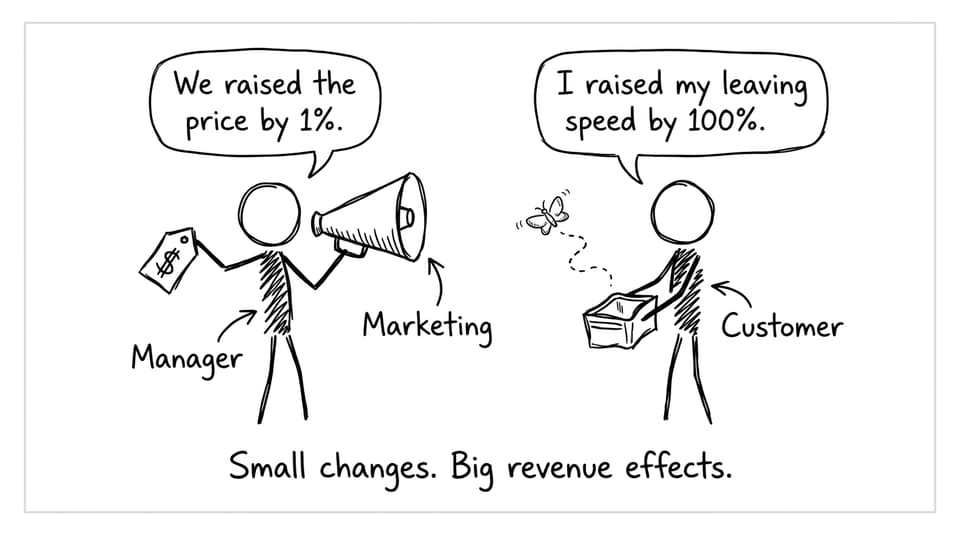
Pricing is one of the fastest levers a business can pull. A small increase can raise revenue if demand is inelastic. Or it can push customers away if demand is elastic and competitors are close.
That’s why revenue analysis should include customer behaviour, not just arithmetic. RevisionDojo’s AI Chat is useful here: paste a mini scenario and ask for two pricing options with evaluation points you can adapt in your own words.
Revenue links to break-even, profit margins, and survival
A business can control costs well and still fail if revenue is too low or too unstable. Revenue is central to break-even analysis, and it’s also a reality check on sustainability: without enough revenue, there is no long-term plan.
When you revise this, connect it forward to final accounts so you can explain the difference between revenue and profit clearly: 3.4.2 Final Accounts Notes and the 3.4 Final Accounts Questionbank.
How to revise revenue effectively with RevisionDojo
In IB Business Management, marks come from using revenue in context: definition, application, analysis, and a balanced judgment.
A fast routine inside RevisionDojo looks like this:
-
Learn the concept with Notes for 3.3.2 Total Revenue and Revenue Streams
-
Lock in recall with Flashcards for Total Revenue and Revenue Streams
-
Drill exam technique using the Questionbank (then use Grading tools to see what “good analysis” actually looks like)
-
Pressure-test with Mock Exams and Business Management Predicted Papers
Conclusion: revenue is a decision tool, not just a number
In IB Business Management, understanding revenue is how you turn business data into business judgment. It helps you spot demand, plan growth, price intelligently, and test whether a business can survive long enough to improve.
If you want to practise turning revenue figures into high-mark analysis, build a short loop in RevisionDojo: Study Notes for clarity, Flashcards for recall, Questionbank for repetition, AI Chat when you’re stuck, and Grading tools plus Mock Exams and Predicted Papers when it’s time to perform under pressure.