


Sampling sounds like a small idea: ask a few people, then make a decision about many. But in IB Business Management, sampling is one of those concepts that quietly explains why some companies launch products that fit perfectly, and why others spend a fortune building something nobody wanted.
Market research is always a trade-off between what you wish you could know (everything) and what you can realistically measure (something). Sampling is how businesses turn that gap into a method, not a guess.

Sampling in IB Business Management (quick overview)
In IB Business Management, sampling means selecting a subset of a population to represent the whole market. If the subset is chosen well, managers can make valid inferences about customer preferences, demand, and behavior.
A strong sampling plan usually checks these boxes:
-
A clear target population (who exactly are we studying?)
-
A sampling method that fits the goal (random, quota, stratified, etc.)
-
A sample size large enough to reduce extreme randomness
-
Steps to reduce sampling bias
For syllabus-aligned coverage, see IB Business Management 4.4 Market Research and the dedicated Sampling Methods Notes.
Why sampling is important in market research
It saves time and cost without sacrificing usefulness
The simplest reason sampling matters is practical: surveying an entire population is often impossible. Even when it’s possible, it’s rarely worth it.
In IB Business Management, exam questions often push you to think like a manager: time is limited, budgets are tight, and decisions still need evidence. Sampling lets a business collect primary data efficiently, then move on to planning the marketing mix.
To revise how sampling fits into the broader research toolkit, connect it with Methods of Primary Market Research and Notes for Primary Market Research.
It improves accuracy by focusing on representativeness
Accuracy in market research isn’t about having the most responses. It’s about having responses that reflect the population.
A well-constructed sample mirrors key characteristics of the wider market: age groups, income ranges, locations, usage habits, or other relevant variables. When the sample is representative, results can be generalized with much more confidence.
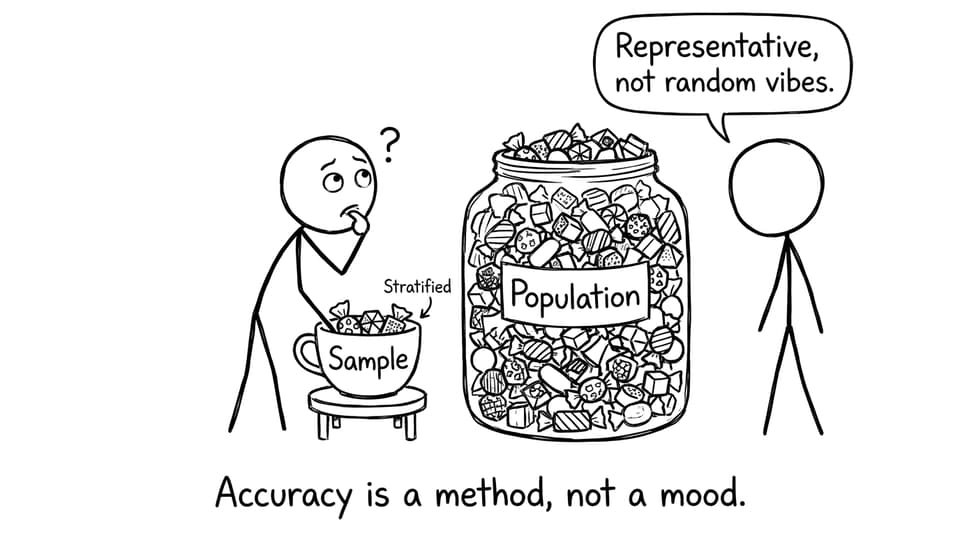
This is why IB Business Management emphasizes sampling methods like:
-
Random sampling (reduces selection bias)
-
Stratified sampling (ensures key subgroups are included)
-
Quota sampling (fast and structured, but can introduce bias)
If you want a one-stop revision hub for this whole area, use 4.4 Market research Questionbank practice to see how sampling gets tested in exam-style prompts.
It reduces bias (and protects decision-making)
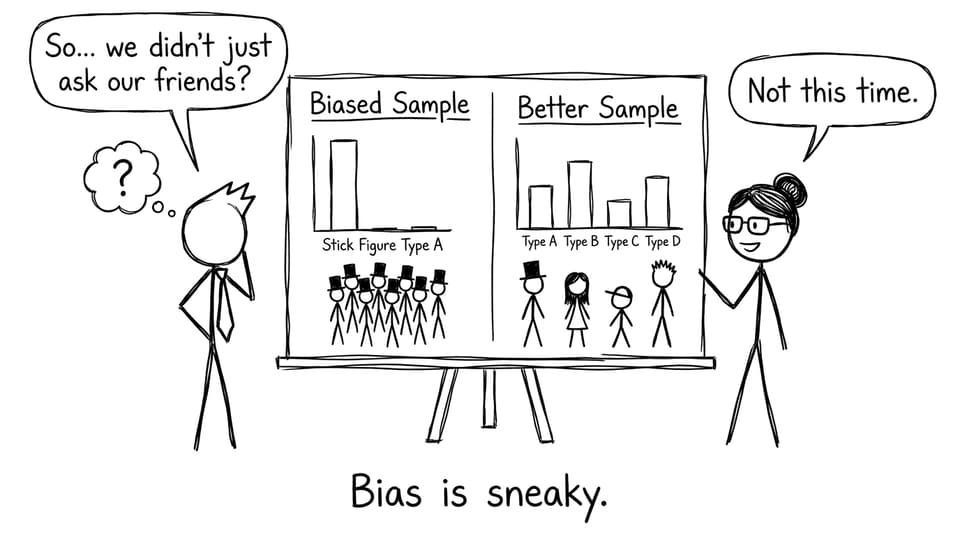
Sampling is also a bias control tool. Without a plan, research often becomes “whoever answers first” or “people we can reach easily.” That can tilt results toward a loud minority.
In IB Business Management, you can earn evaluation marks by identifying how bias weakens validity. If a business only surveys existing customers, it may miss non-customers’ objections. If it only polls one neighborhood, it may misread national demand.
How sampling improves exam answers in IB Business Management
Sampling isn’t just theory; it’s a reliable “analysis lever” in Paper responses.
When you see a case study mention “a survey of 50 customers,” you can instantly discuss:
-
Whether the sample size seems sufficient
-
Whether the sampling method is likely representative
-
How bias could affect conclusions
-
How the business could improve reliability (e.g., stratify by customer segment)
To strengthen your application skills, use IB Business Management resources alongside RevisionDojo’s Study Notes, Flashcards, and AI Chat to practise explaining sampling choices clearly. For fast recall, the 4.4 Market research Flashcards help you lock in definitions and method pros/cons.
Bring it home: use sampling like a strategist
Sampling matters because it makes market research realistic: cheaper, faster, and more accurate when done properly. And in IB Business Management, it gives you a clean way to evaluate evidence, not just describe it.
If you want to turn this into exam marks, build a quick routine: learn the definitions with RevisionDojo Flashcards, practise method selection with the Questionbank, ask AI Chat to challenge your evaluation, and then test yourself with Mock Exams, Predicted Papers, and the Grading tools to sharpen your structure. Sampling is small on the page, but it’s huge in how businesses avoid mistakes.


