
International cooperation is one of those ideas that sounds polite until you meet a real crisis.
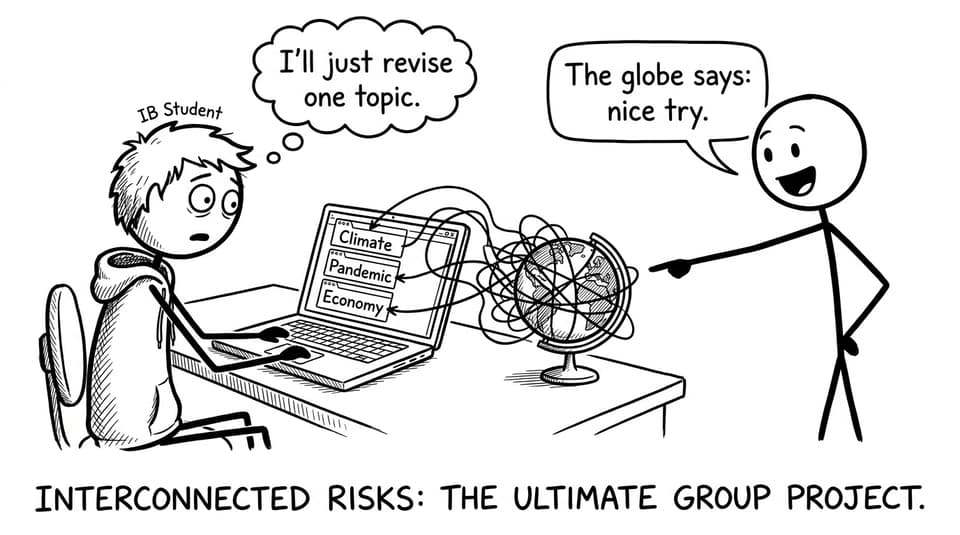
A cyclone crosses borders. A virus boards a plane. A supply chain hiccup empties shelves on the other side of the world. In IB Geography, this is the uncomfortable point of the Global Risks and Resilience unit: the world does not respect national boundaries, so resilience can’t be built by one country acting alone. If you’re preparing for exams, international cooperation is an easy concept to define, and a surprisingly powerful one to evaluate.
Quick exam checklist for IB Geography
Use this as a fast plan for any 6-, 10-, or essay-style response in IB Geography:
-
Define global resilience: capacity to anticipate, cope, recover, and adapt.
-
Name 2-3 global risks: climate change, pandemics, financial crises, conflict.
-
Explain why cooperation is necessary: risks are interconnected and transboundary.
-
Add mechanisms: global governance, treaties, funding, data sharing, early warning.
-
Evaluate: national interests, unequal power, slow decision-making.
For a deeper refresher, use IB Geography Resources to jump between Study Notes, Flashcards, and targeted practice.
IB Geography: global risks are interconnected, not isolated
In IB Geography, you score higher when you show systems thinking: one risk triggers others.
Climate change is a clean example. It shifts rainfall patterns, raises sea levels, and increases heat extremes. Those physical changes then pressure food production, water security, migration flows, and even political stability. If one country reduces emissions but its neighbors don’t, the atmosphere doesn’t “average it out” in your favor. Cooperation stops problems from being exported and encourages shared targets, timelines, and accountability.
To revise the wider resilience concept, pair this article with What Is the Role of Resilience in Managing Global Risks?.
IB Geography: cooperation spreads resources, knowledge, and technology
A harsh truth sits under many IB Geography case studies: vulnerability often tracks income.
Lower-income states may face higher exposure (coastal flood risk, drought risk) while also having fewer buffers (healthcare capacity, emergency services, resilient infrastructure). International cooperation helps close that gap through climate finance, technical expertise, satellite monitoring, and shared research.
That matters for exam evaluation: global resilience is only as strong as its most vulnerable regions. A weak health system can become a global outbreak. A fragile economy can become a regional shock.
If you want to practise how to phrase this under exam timing, drill the exact syllabus language in the Global Risks and Resilience Questionbank.

IB Geography: global governance makes cooperation usable
International cooperation becomes real through global governance: organisations, agreements, and partnerships that coordinate collective action.
In IB Geography, you can describe governance as the “infrastructure of cooperation.” It provides meeting spaces, monitoring systems, rules, and (sometimes) enforcement. It can be slow, political, and imperfect, but it creates shared frameworks that prevent every crisis response from starting at zero.
A strong way to revise how to structure examples is to use a template like the one in IB Geography Case Studies: A Comprehensive Exam Guide.
IB Geography: prevention and early warning reduce damage
Resilience isn’t only recovery. In IB Geography, high-scoring answers often show the prevention logic:
-
shared hazard mapping and forecasting
-
cross-border data sharing
-
joint emergency drills and planning
-
coordinated stockpiles and supply chains
Early action saves lives and lowers long-term costs. It also reduces the chance that one country’s delayed response becomes everyone’s problem.
To connect this with broader climate content, revise alongside 2.3 Responding to climate change and building resilience.
IB Geography: cooperation supports fairness and climate justice
One of the most examinable evaluation angles in IB Geography is equity.
Many countries most affected by climate-related hazards have contributed least to historic emissions. Cooperation enables burden-sharing through adaptation funding, disaster assistance, and inclusive recovery planning. Without it, inequality deepens, and inequality itself becomes a risk multiplier: weaker institutions, higher displacement, and more instability.
To build your vocabulary for this, explore environmental risk framing in How Do Environmental Risks Threaten Human Security?.
Common limitations (and how to evaluate them in IB Geography)
Evaluation is where IB Geography marks are earned.
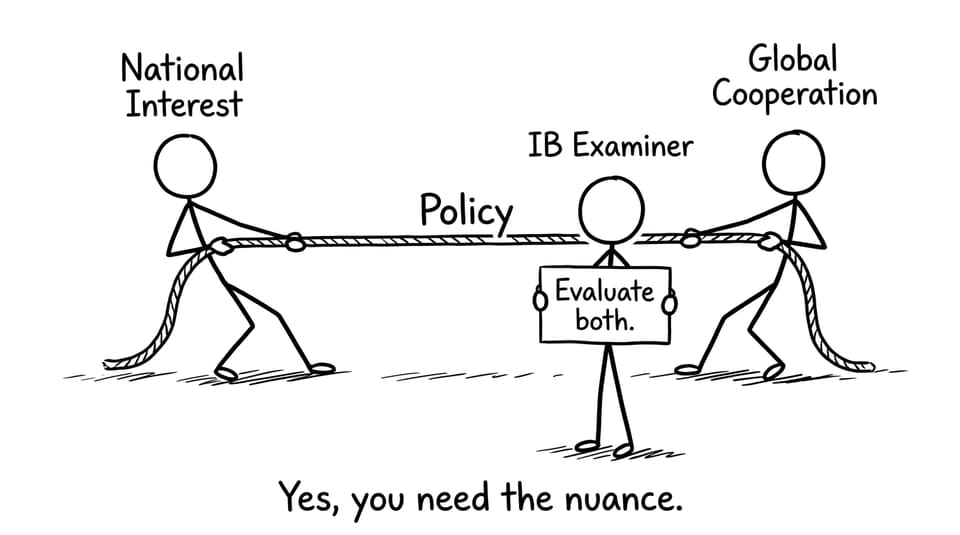
International cooperation can be blocked by national interest, geopolitical tension, and unequal power. Some states may sign agreements but under-deliver. Others may shape rules to protect their own industries. Your job in an answer isn’t cynicism; it’s balance: cooperation is essential, but not automatically effective.
A clean evaluation line you can adapt:
International cooperation is necessary for transboundary risk management, but its effectiveness depends on political commitment, funding, and fair representation in global governance.
Conclusion: make IB Geography answers feel like the real world
International cooperation is essential for global resilience because the risks shaping the 21st century are shared, networked, and unevenly experienced. In IB Geography, that’s the core insight: resilience isn’t a solo project; it’s coordination under pressure.
If you want to turn this topic into confident exam writing, use RevisionDojo as your home base: practise with the Global Risks and Resilience Questionbank, memorise key terms with Global Risks and Resilience Flashcards, and consolidate concepts using 6 Global Risks and Resilience. RevisionDojo’s Study Notes, Flashcards, AI Chat, Grading tools, Predicted Papers, Mock Exams, Coursework Library, and Tutors help you move from “I get it” to “I can write it under time pressure”, which is the real goal.