


If you have ever built something in Computer Science and then felt a weird pause right after -- a quiet question like “Wait… should we be building this?” -- you already understand why IB Digital Society belongs in the same conversation.
Computer Science teaches you to think in systems: inputs, outputs, constraints, efficiency. IB Digital Society teaches you to think in consequences: who benefits, who is harmed, what changes, what becomes normal. Together, they make you the kind of IB student who can write answers that feel both sharp and human.
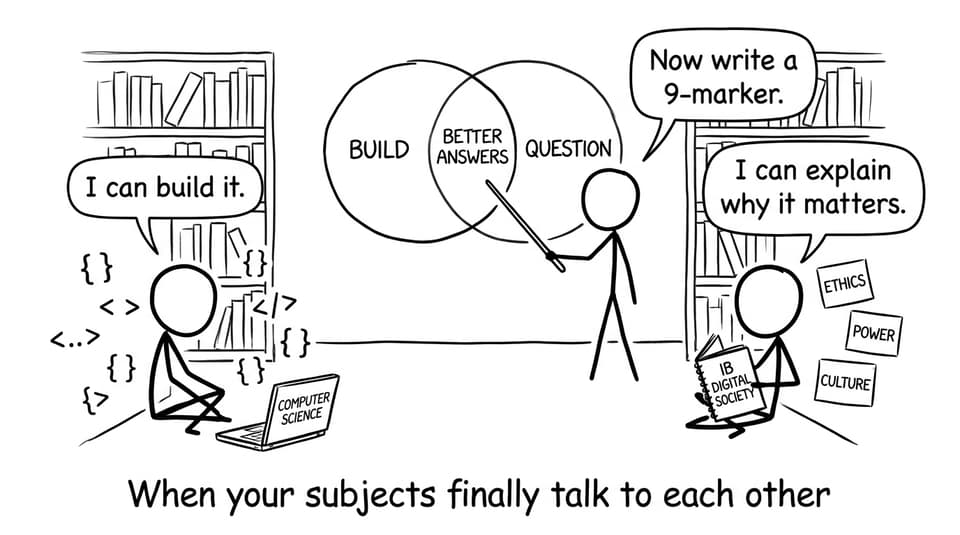
Quick checklist: how IB Digital Society + CS work together
Use this as your fast map before you plan revision:
-
Computer Science gives you technical vocabulary (algorithms, data structures, networks, databases).
-
IB Digital Society gives you analytical vocabulary (power, inequality, identity, responsibility, change).
-
The overlap is where top answers live: clear system description + real impact + reasoned judgement.
-
This combo strengthens coursework choices (more thoughtful ideas, clearer evaluation).
-
It also improves exam performance because your examples become easier to explain, not just name.
If you want a central place to organize your revision, start with the IB Digital Society resources hub and the IB Computer Science resources hub.
The technical lens: what Computer Science gives you
Computer Science is training in precision. You learn to break messy problems into steps that can be executed reliably. That mindset is powerful in IB exams because it helps you write answers that are structured, not vague.
But Computer Science answers can sometimes stay inside the machine. You might describe how a system works without fully addressing why it matters. That is not a flaw in the subject -- it is simply a different purpose.
A good way to revise CS efficiently is to combine Study Notes with quick retrieval. RevisionDojo makes that loop easier: learn a concept, test it in the Questionbank, then lock it in with Flashcards. If you are aiming for a top grade, read Are RevisionDojo Notes Enough to Get a 7 in IB Computer Science?.
The human lens: what IB Digital Society adds
IB Digital Society is where you learn to treat technology as a social force, not just a tool. The subject asks you to look at digital systems and say: what do they do to privacy, opportunity, trust, culture, and power?
This is why IB Digital Society complements Computer Science so well. If CS is the blueprint, Digital Society is the impact report.
To revise the subject the way it is actually assessed, it helps to anchor your thinking in themes and concepts. Two strong starting points are Key Themes in IB Digital Society Explained and Understanding Change in Digital Society: IB Concept Explained.
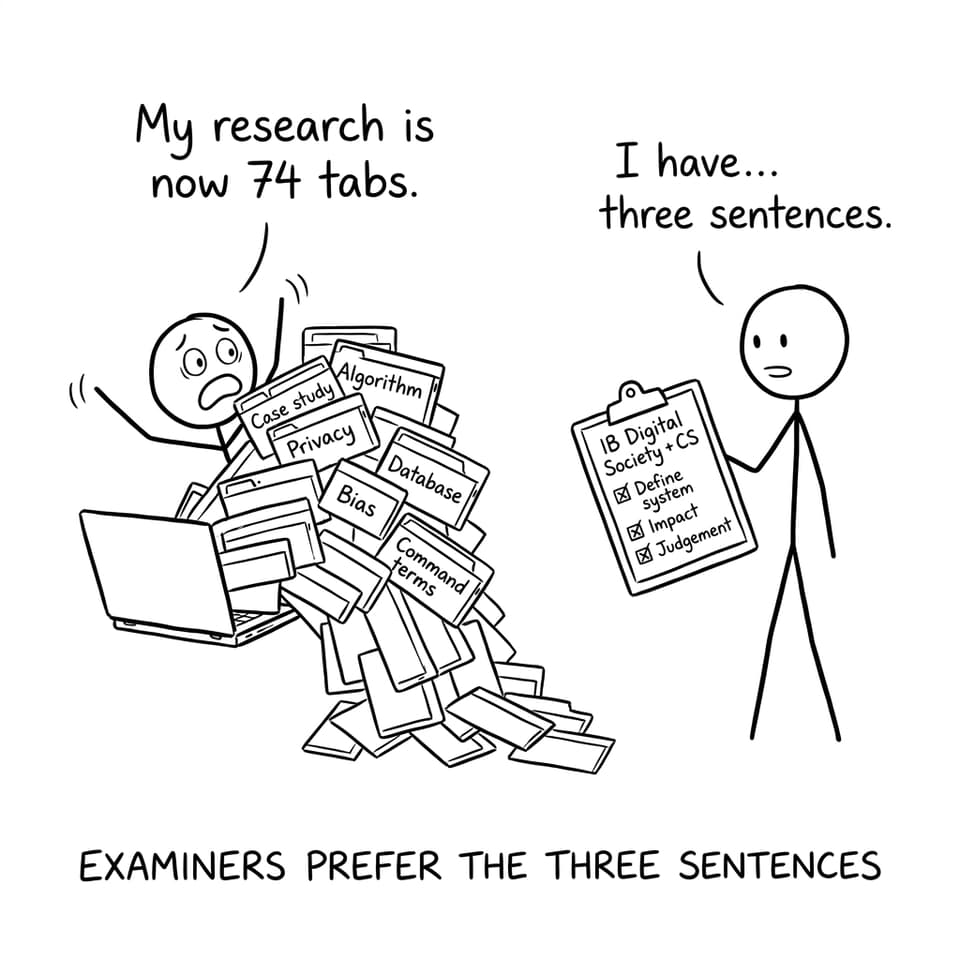
Why the combination scores better in exams
Examiners reward answers that do three things clearly:
Describe the system (CS strength)
In IB Digital Society, you still need to be concrete. What digital system are you talking about? What feature? What mechanism? Students who also study CS often describe this more cleanly.
Analyze impact (Digital Society strength)
Then you move from function to effect: who is influenced, what behaviours change, what risks appear, what inequalities grow or shrink.
Make a judgement (the high-mark difference)
Top-band answers do not just list pros and cons. They evaluate with criteria and reach a reasoned conclusion.
That is why command terms matter. If you want your paragraphs to match what the question is asking, use How to Use Command Terms Effectively in IB Exams and, for deeper structure, Structure IB Answers to Maximize Marks.
How to revise both subjects without doubling your workload
The trick is reuse -- not copy-paste.
Pick one digital system (for example: recommender algorithms, biometric ID, end-to-end encryption). Study it twice:
-
In Computer Science, focus on the mechanism: data flows, algorithmic steps, security, storage.
-
In IB Digital Society, focus on the meaning: ethics, power, access, accountability, cultural effects.
On RevisionDojo, you can build this as a weekly loop:
-
Study Notes to learn the content quickly
-
Flashcards for daily recall
-
Questionbank for exam-style practice
-
AI Chat when you cannot explain something clearly yet
-
Mock Exams and Predicted Papers when you need timing and stamina
-
Grading tools to get feedback that actually changes your next draft
-
Coursework Library and Tutors when you need real examples or a human diagnosis
If you want a realistic schedule for high-pressure weeks, see IB: The Last 2 Weeks Before Exams (What Matters).

Conclusion: build it, then explain it
Computer Science teaches you to build systems that work. IB Digital Society teaches you to notice what those systems do once they leave the classroom and meet real people.
If you want an exam advantage, this is the pairing: technical clarity plus ethical, cultural, and political reasoning. And if you want to revise both efficiently, RevisionDojo is built for the full loop -- Questionbank, Study Notes, Flashcards, AI Chat, Grading tools, Predicted Papers, Mock Exams, Coursework Library, and Tutors.
Start with IB Digital Society, keep your examples concrete, practise the command terms, and let your two subjects reinforce each other until your answers sound inevitable.
