


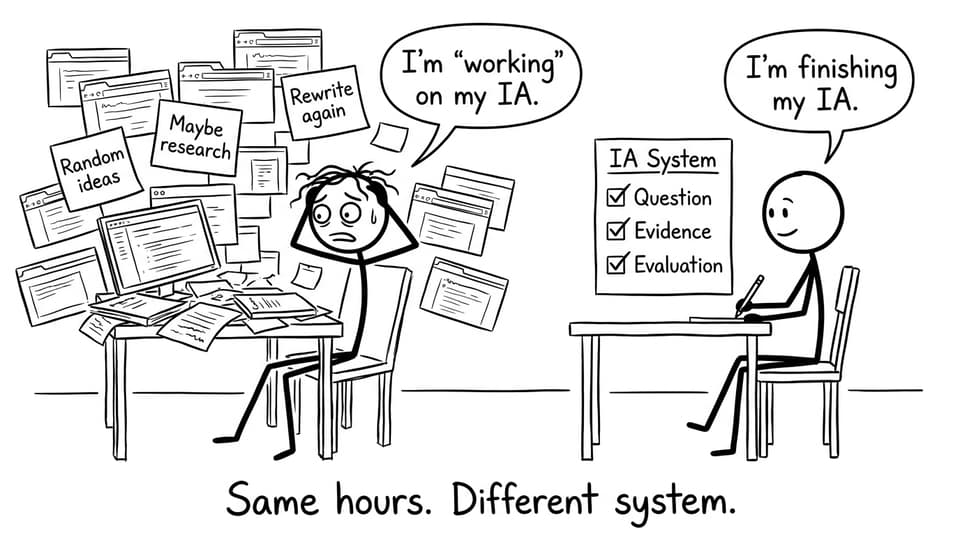
Your IA doesn’t usually fall apart because you “don’t understand the content.” It falls apart because the work has no rails.
One week you’re researching. The next you’re rewriting an introduction that was fine. Then a teacher comment lands like a meteor and suddenly the whole IA feels questionable. The difference between students who stay calm and students who spiral is rarely talent. It’s having a repeatable IA system that tells you what to do next.
What a clear IA system actually does
A good IA system isn’t a fancy template. It’s a small set of decisions you reuse every time:
-
Define the question (what exactly are you proving or investigating?)
-
Collect only mark-relevant evidence (not “interesting” evidence)
-
Analyse, then evaluate (don’t leave evaluation for the last night)
-
Draft in stages so feedback has a place to go
-
Run quick grading loops so you stop guessing
If you want a structured starting point, the IB IA Guides are built around the rubric logic examiners actually use.
Why an IA system lowers stress (without lowering standards)
Most IB stress is uncertainty wearing a lab coat. You don’t know whether your IA is “good enough,” so you compensate with hours: more tabs, more sources, more rewriting.
A system replaces emotional effort with strategic effort. You move from “I’ll work until I feel safe” to “I’ll work until I hit the next checkpoint.” That single change makes your workload feel finite.
If you’ve been drifting, start with a stage-based plan like How to Plan an IB IA Without Falling Behind. It’s the difference between paddling and navigating.
Feedback stops being scary when your IA has structure
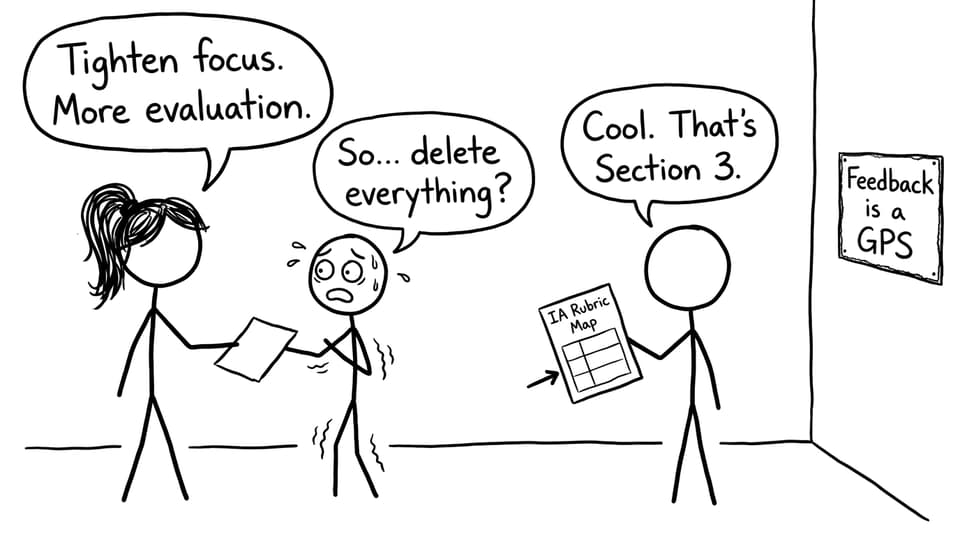
When your teacher writes “more evaluation,” it can feel like they’re saying “be smarter.” But with an IA system, feedback becomes directional.
You know where comments belong:
-
Is the focus too broad?
-
Is the analysis too descriptive?
-
Is the evaluation missing limitations and implications?
-
Is the structure hiding your best thinking?
To build that clarity early, tighten the foundation with How to Write a Strong IA Research Question. A sharper question makes every later draft easier.
Consistency across subjects: the underrated advantage
Many students do one strong IA, then the next one goes sideways because they improvise again. A system makes success repeatable.
Use real models to internalize what “top-band” looks like:
-
IB Coursework Guides for criteria-based structure
-
IB Coursework Examples: IA, EE and TOK Exemplars to see how high scorers organise analysis and evaluation
-
Subject-specific examples like IB Biology IA Examples or IB Maths AA IA Examples
And when you need fast, rubric-aligned direction, the IB Coursework Grader turns vague drafts into actionable next steps.
Your IA & EE system in 5 steps (steal this)
Lock the scope
Choose a question you can answer cleanly. Then prove it’s workable.
Build a “claim to evidence” map
Every paragraph should earn marks, not just sound academic.
Draft in rounds
Round 1: structure. Round 2: analysis. Round 3: evaluation. Round 4: clarity.
Get feedback fast
Use the IB Coursework Grader plus RevisionDojo’s AI Chat to ask one precise question at a time.
Protect exam season
Coursework should not eat your revision. Keep your exam loop alive with Study Notes, Flashcards, Questionbank, and timed Mock Exams plus IB Predicted Papers.
A calm finish: build the rails, then move faster
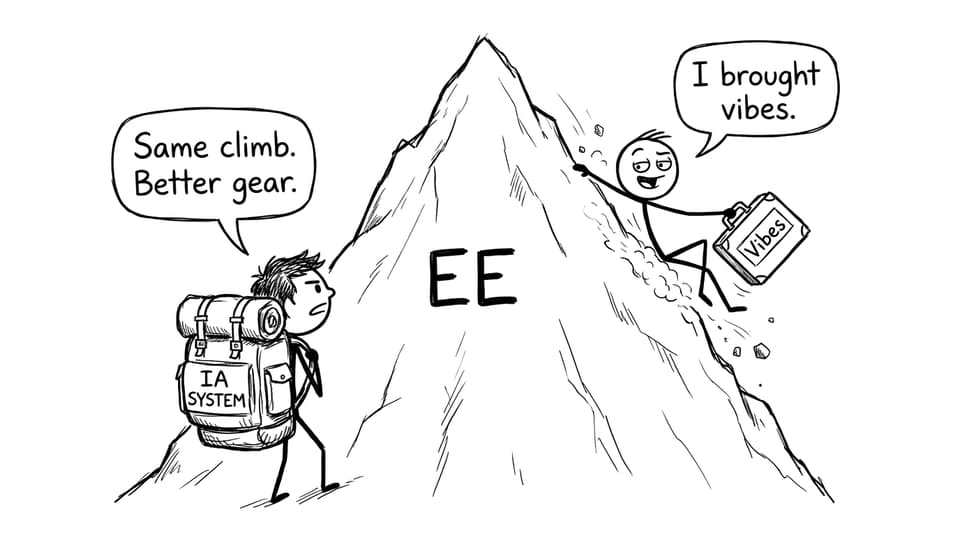
A clear IA system changes everything because it removes guesswork. You stop “working on your IA” and start completing specific moves that earn marks.
If you want the whole journey in one place, build your system with RevisionDojo: IA Guides, EE Guides, the Coursework Library, AI Chat, and the Coursework Grader for fast feedback loops. Then protect your exam performance with Study Notes, Flashcards, Questionbank, Predicted Papers, and Mock Exams.
Your IA doesn’t need more panic. It needs rails.