
The moment the bond “won’t cooperate”
In IB Chemistry, there’s a quiet trap that shows up when you’re tired and rushing: you see a reaction that releases heat overall, and your brain whispers, “So breaking bonds must release energy too.” But then your teacher says the opposite. You try to memorize it. It doesn’t stick.
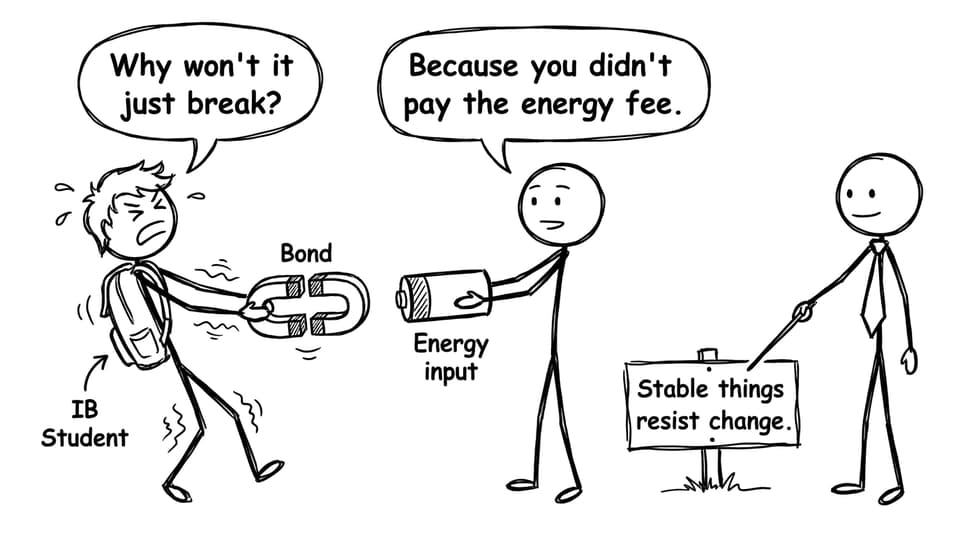
Here’s the steadier truth: breaking chemical bonds requires energy because bonds are low-energy, stable arrangements. Separating atoms means working against the attraction that made the bond favorable in the first place. That idea is the backbone of bond enthalpy, reaction profiles, and energetics questions in IB Chemistry.
Quick IB Chemistry checklist (what to say in exams)
-
Bond breaking is endothermic: energy in, step has +ΔH.
-
Bond making is exothermic: energy out, step has -ΔH.
-
Stronger bonds have larger bond enthalpy (deeper stability).
-
Overall reaction ΔH depends on bonds broken vs bonds formed.
If you need the syllabus definition and examples, keep Bond enthalpy notes (R1.2.1) open while you practise.
IB Chemistry explanation: bonds are “energy wells”
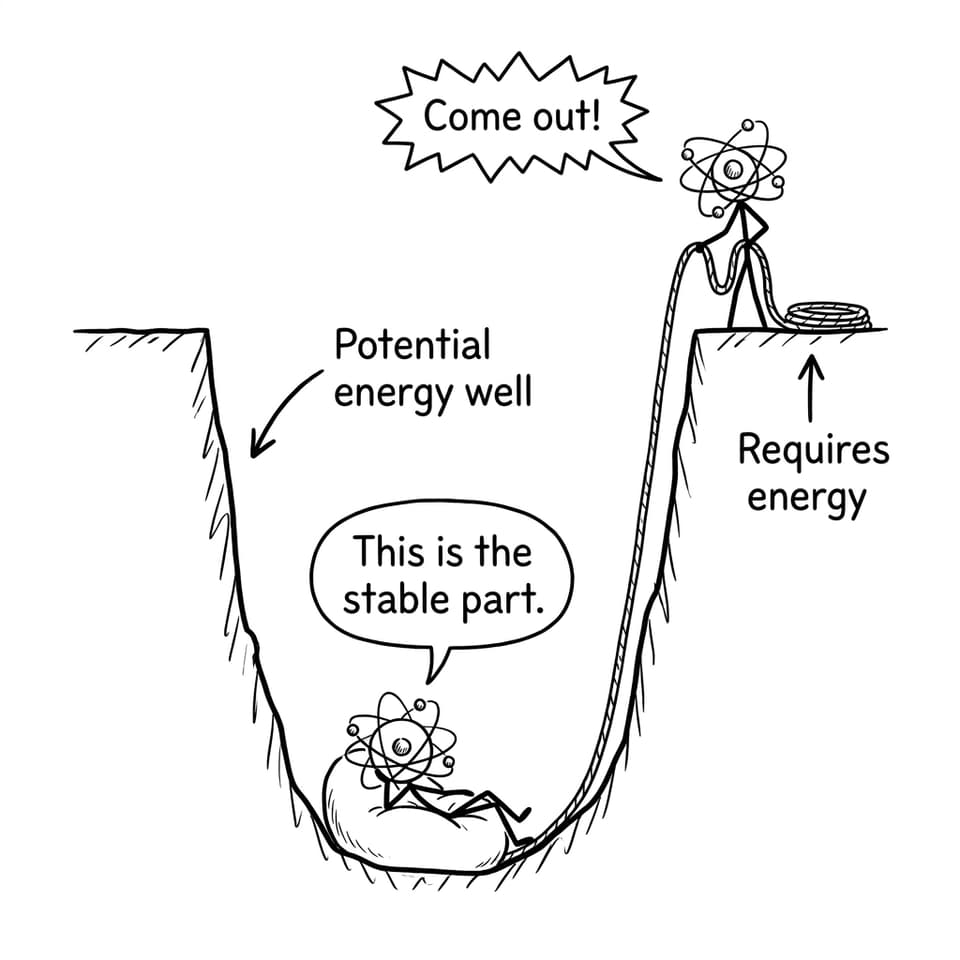
A chemical bond forms because the system can move to a lower potential energy state. Think of it like rolling into a valley: once you’re down there, you’re stable.
To break the bond, you must climb out of that valley. That climb costs energy. In IB Chemistry language, the amount you need (for covalent bonds, in the gas phase) is the bond enthalpy or bond dissociation enthalpy.
For a fast refresher on how ΔH is described and measured, see Enthalpy change explained for IB Chemistry and the course-aligned R1.1 Measuring enthalpy change topic page.
Why some bonds “cost more” to break
In IB Chemistry, not all bonds are equal. A triple bond like N≡N is famously strong because the attractions holding the atoms together are intense and the bond is short. That means a deeper “energy well” and a larger bond enthalpy.
Weaker bonds (for example, relatively weak O-O links in certain molecules) sit in shallower wells. They still require energy to break, just less.
When you’re doing calculations, the Chemistry Data Booklet is your best friend for bond enthalpies and units.
The big exam connection: reactions break and make bonds
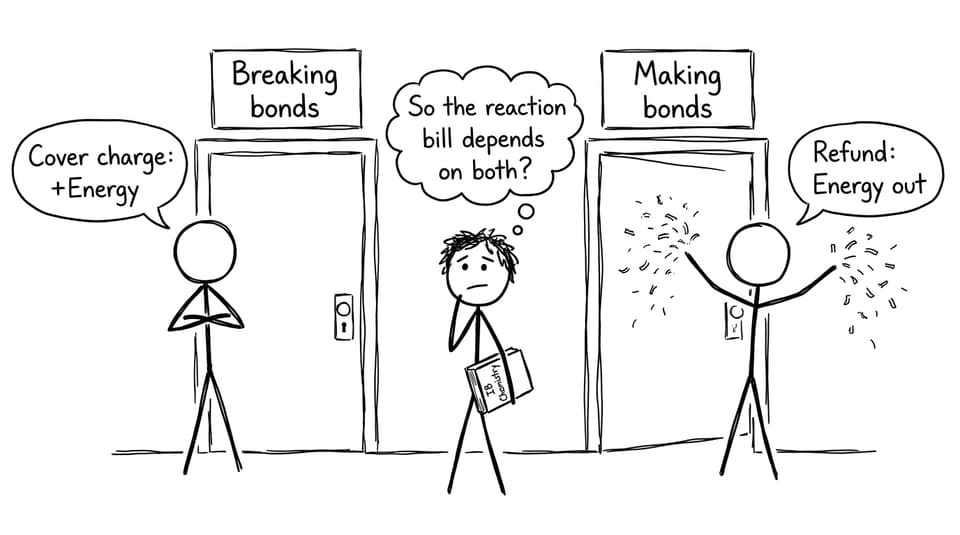
Every reaction is two stories at once:
-
You pay energy to break bonds in reactants.
-
You get energy back when new bonds form in products.
So the overall ΔH depends on the balance:
-
More energy released in bond making than absorbed in bond breaking → overall exothermic.
-
More energy absorbed in bond breaking than released in bond making → overall endothermic.
This is exactly the thinking behind energetics questions in IB Chemistry, and it’s why practising with structured problems matters. Use IB Chemistry Energetics and Thermochemistry Questionbank and R1.2 Energy cycles in reactions Questionbank to make the “budget” method automatic.
Closing: turn the idea into marks
If you remember one line for IB Chemistry, make it this: breaking chemical bonds requires energy because bonds are stable, low-energy arrangements. Everything else in energetics builds from that one calm principle.
When you’re ready to lock it in, RevisionDojo helps you practise it the way exams demand: targeted Questionbank sets, crisp Study Notes, quick Flashcards, and AI Chat for checking your explanations. Add Grading tools, Mock Exams, Predicted Papers, the Coursework Library, and expert Tutors, and IB Chemistry stops feeling like memorization and starts feeling like reasoning.