


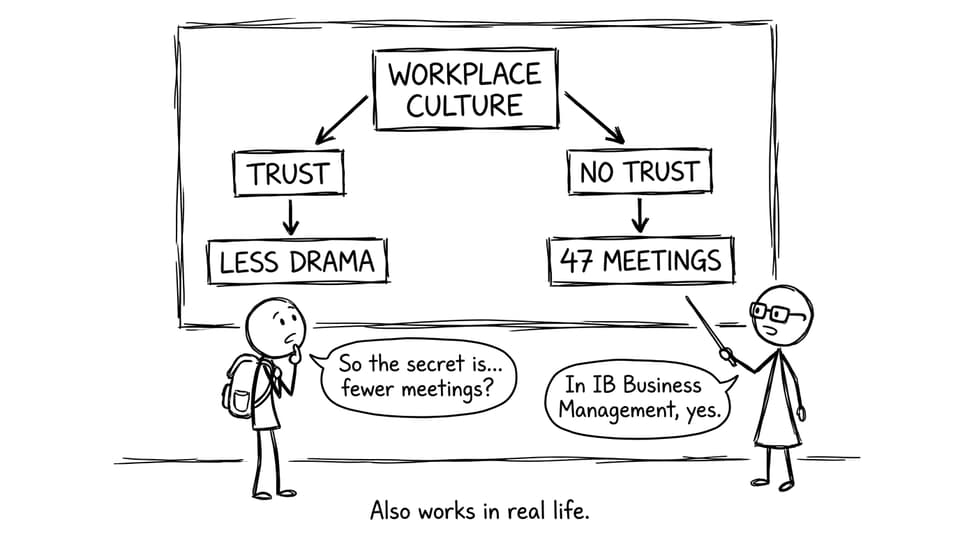
Strong relationships at work rarely look dramatic. They look boring in the best way possible: fewer awkward emails, fewer “quick” meetings that become an hour, and fewer problems that quietly grow teeth.
In IB Business Management, that calm matters because employer-employee relationships sit underneath motivation, communication, culture, productivity, and even reputation. If you’re revising Unit 2, this topic is basically the invisible thread connecting half the syllabus.
What examiners want when you discuss relationships (quick checklist)
-
Define the idea: trust, respect, and fairness between managers and staff.
-
Link to communication, motivation, productivity, change, and conflict.
-
Add a mini example (factory team, retail store, tech startup).
-
Evaluate: short-term costs vs long-term benefits (training, better pay, time spent communicating).
To anchor your theory, revisit the HR foundations in Unit 2: HR Management - Motivation, Structure, Hierarchy on RevisionDojo.
Why strong relationships drive business success (IB Business Management view)
Communication becomes faster (and less expensive)
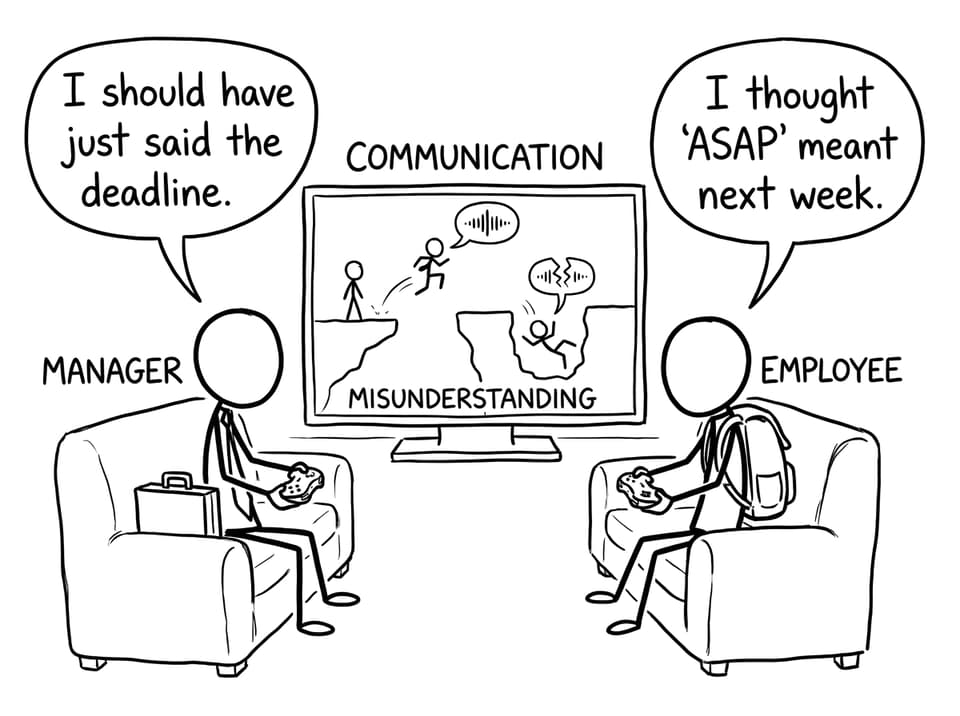
When employees feel safe speaking up, information moves. Small issues get flagged early. Ideas travel upward, not just orders traveling downward. In exam terms, strong relationships improve communication flow and reduce message distortion.
If you want precise phrasing for answers, practice with 2.6 Communication Questionbank and reinforce the concepts using 2.6 Communication Lessons.
Motivation and morale stop being “posters on a wall”
A business can pay well and still have low morale if people feel ignored or treated unfairly. Strong employer-employee relationships make recognition believable and expectations clearer. That’s where intrinsic motivation has room to exist, not just extrinsic rewards.
For theory you can actually apply, use Notes for 2.4.1 Motivation Theories and the broader topic hub 2.4 Motivation and demotivation.
Productivity rises because trust lowers “hidden friction”
When managers trust staff, supervision costs drop. When employees trust managers, initiative rises. That combination improves efficiency and quality, and it usually reduces labour turnover (saving recruitment and training costs). In IB Business Management, it’s a clean chain: relationship quality influences motivation, which influences performance.
Change feels less like a threat
New tech, restructuring, new competitors: change is constant. Strong employer-employee relationships reduce resistance because staff believe the process will be fair. This links naturally to organizational culture: cultures built on respect adapt faster.
To connect that clearly in essays, read Notes for 2.5.1 Organizational Culture.
Conflict is easier to solve before it becomes expensive
Disagreement is normal; escalation is optional. Strong relationships make negotiation possible and reduce industrial action risk. If you’re HL, this becomes especially relevant in industrial/employee relations.
Practice exam-style scenarios with 2.7 Industrial/employee relations (HL only) Questionbank and revise specific triggers with Notes for 2.7.1 Sources of Conflict in the Workplace.

Exam tip: link relationships to stakeholders
Employees are internal stakeholders, so their satisfaction shapes decisions, culture, and long-term performance. A fast way to earn marks is to explicitly use stakeholder language.
Use Notes for 1.4 Stakeholders and the syllabus page 1.4.1 Internal and External Stakeholders to build those connections.
Final takeaway for IB Business Management revision
Strong employer-employee relationships matter because they quietly power everything businesses care about: communication speed, motivation, productivity, adaptability, and reputation. If you want to turn that understanding into exam marks, use RevisionDojo’s Study Notes, Flashcards, and Questionbank to practise phrasing and application, then pressure-test your explanations with AI Chat and Grading tools. Add Mock Exams and Predicted Papers when you’re close to finals, and use the Tutors feature when you want feedback that feels like an examiner.
Build the relationship logic once, and you can reuse it across half of IB Business Management.