


A quick hook: the beaker that “decides” for you
In IB Chemistry, dissolving can feel like magic: salt disappears on contact, but oil stubbornly floats like it has a personal grudge. The good news is it’s not random. Whether something dissolves spontaneously is really a story about what the universe “prefers” at a given temperature: lower free energy.
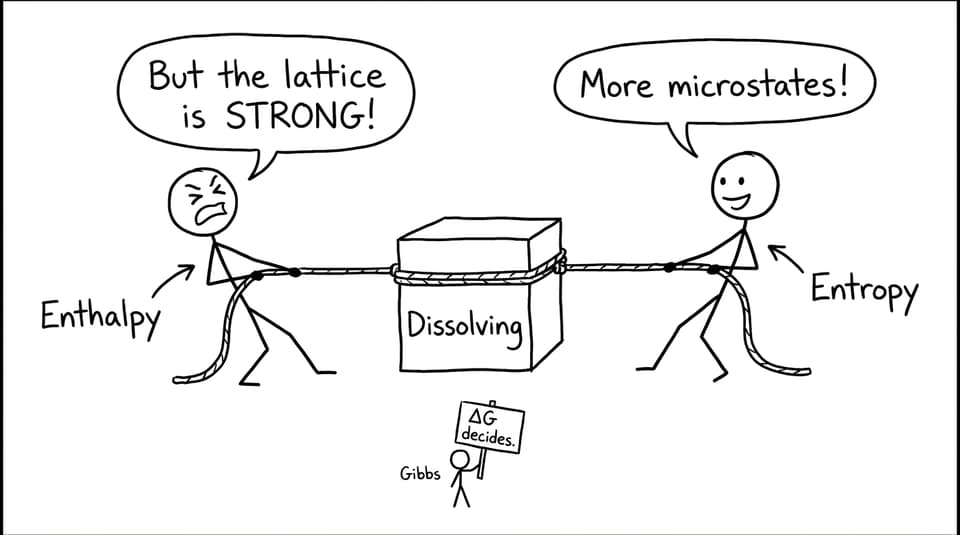
That preference shows up through two familiar characters: enthalpy (energy in/out) and entropy (how spread-out and free particles are). When they team up to make (\Delta G) negative, dissolving happens on its own. When they don’t, the beaker stays unimpressed.
IB Chemistry checklist: what decides if dissolving is spontaneous?
Use this fast checklist before you dive into details:
-
Are the new solute to solvent attractions strong? (ion to dipole, hydrogen bonding, dipole to dipole)
-
How strong is the solute’s original structure? (ionic lattice, intermolecular forces)
-
Does disorder increase overall? (usually yes for solids dissolving; not always for gases)
-
What does (\Delta G = \Delta H - T\Delta S) predict? If (\Delta G < 0), it’s spontaneous.
If you want the clean syllabus framing for this, the R1.4 Entropy and spontaneity (HL) hub on RevisionDojo lines up the exact skills the exam expects.
Enthalpy: the “cost” and “payback” of dissolving (IB Chemistry)
In IB Chemistry, dissolving is never a single step. You pay energy to:
-
Separate solute particles (for ionic solids, overcoming the lattice)
-
Disrupt some solvent to solvent interactions
Then you get energy “paid back” when you:
- Form new solute to solvent interactions
If the new interactions are strong enough, the enthalpy change of solution can be favorable (or at least not too unfavorable). That’s why ionic solids like NaCl can dissolve: hydration (ion to dipole attraction) can offset the lattice cost. The reasoning is laid out clearly in Why NaCl Dissolves in Water, and it’s worth reading once because it mirrors how markschemes want explanations.
For deeper structure thinking, pair it with Lattice Enthalpy Explained for IB Chemistry.
Entropy: why “spreading out” can overpower energy
Entropy is the quiet force that often makes dissolving feel inevitable. When a crystal turns into separated ions or molecules in solution, particles gain freedom and the number of possible arrangements (microstates) rises. That positive (\Delta S) can be so helpful that even endothermic dissolutions can still be spontaneous.
This is the point students miss under pressure: spontaneous does not mean exothermic. It means (\Delta G < 0). If you need a crisp refresher, Entropy Explained Simply is a fast read that translates directly into exam phrasing.
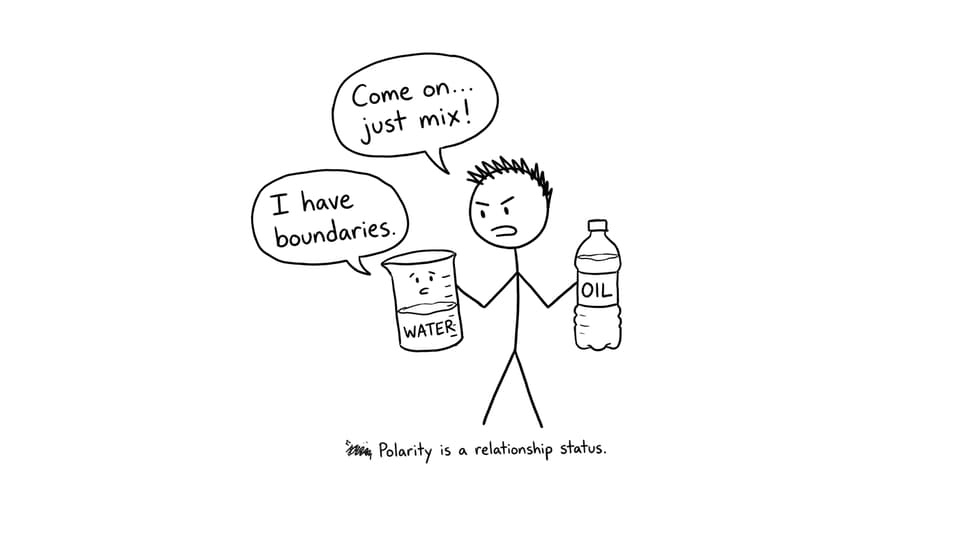
Why oil doesn’t dissolve in water: “like dissolves like” with consequences
Oil and water is the classic IB Chemistry example because it connects bonding to thermodynamics.
-
Water is polar and held together by strong hydrogen bonding.
-
Oil is nonpolar, so water cannot form equally strong attractions with it.
So dissolving oil would require disrupting water’s favorable interactions without getting much enthalpy “payback.” Entropy also doesn’t rescue the situation the way it often does for ionic solids. The result is not that mixing is “forbidden,” but that it’s not thermodynamically favored.
Gases in warm water: when dissolving can reduce entropy
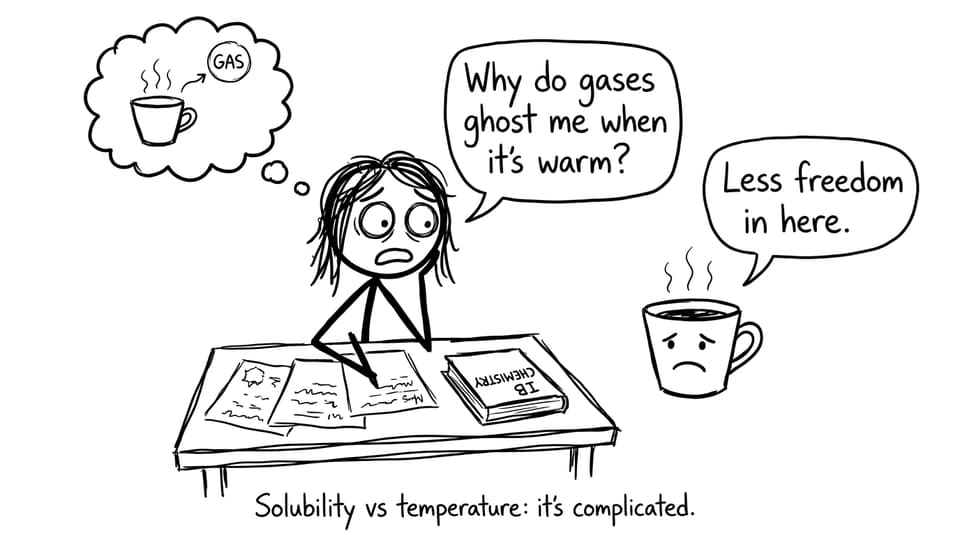
Gases are the twist ending. A gas particle in air has huge freedom. When it dissolves, it becomes constrained in the liquid, so entropy can drop. That’s one reason gas solubility often decreases as temperature increases.
If you’re revising solutions, it helps to connect this to pressure too (Henry’s Law style questions). RevisionDojo’s How Pressure Affects Gas Solubility for IB Chemistry shows exactly how to write that explanation in exam language.
Quick exam moves (what to write in Paper questions)
-
Name the competition: (\Delta H) vs (\Delta S), combined by (\Delta G).
-
Mention interactions: “breaking solute to solute and solvent to solvent forces; forming solute to solvent forces.”
-
Use the correct direction language: “spontaneous when (\Delta G < 0).”
-
If it’s about slightly soluble salts, link to equilibrium thinking and Ksp using Solubility Product (Ksp) Explained Simply.
To practice the exact style of prompts examiners use, do timed sets in the IB Chemistry 15.2 Entropy and Spontaneity Questionbank or the broader IB Chemistry R1.4 Questionbank.
Closing: turn “dissolving” into a predictable IB Chemistry skill
Once you see dissolving as (\Delta G = \Delta H - T\Delta S), it stops being a mystery and becomes a repeatable IB Chemistry explanation. When strong solute to solvent attractions and increasing entropy work together, dissolving is spontaneous. When the energy cost is too high or entropy doesn’t help (hello, oil and warm fizzy drinks), it isn’t.
If you want this to feel automatic before exams, use RevisionDojo’s Study Notes, Questionbank, Flashcards, and AI Chat to practice explanations, then test yourself with Mock Exams, Predicted Papers, and the Grading tools to tighten your wording. When you’re ready for targeted help, RevisionDojo Tutors can spot the exact sentence that turns a 2/4 into a 4/4.


