

Lattice enthalpy is one of those IB Chemistry ideas that feels unfair at first. You read a definition, see a sign convention flip in a different textbook, then get asked to explain melting point and solubility using the same number. It’s like being told one key opens every door in a building you haven’t mapped yet.
The good news: lattice enthalpy isn’t mysterious. It’s just a story about how strongly ions want to be together, and how much energy the universe is willing to pay (or receive) to make that happen. Once that story clicks, a lot of IB Chemistry energetics questions start to look… predictable.
Lattice enthalpy in IB Chemistry: the definition that matters
In IB Chemistry, lattice enthalpy is defined as:
The enthalpy change when one mole of an ionic solid is formed from its gaseous ions.
Because opposite charges attract, forming the lattice releases energy, so the value is exothermic (negative).
The common trap: formation vs separation
Some resources define lattice enthalpy the other way around:
Same magnitude, opposite sign. In IB Chemistry, stick to the formation definition unless the question explicitly uses the separation convention. If you want a clean reference point while revising, keep the IB Chemistry Data Booklet handy.
Quick checklist for IB Chemistry exam questions
Use this 20-second scan before you commit to any lattice enthalpy calculation or explanation in IB Chemistry:
-
Are they using formation (negative) or dissociation (positive)?
-
Are the ions gaseous in the definition or cycle step?
-
Did you connect lattice enthalpy to a property (melting point, solubility, stability) with a clear cause?
-
If a Hess cycle appears, did you label each step with the correct sign?
For more energetics foundations, pair this with Enthalpy Change Explained for IB Chemistry.
Why lattice enthalpy matters in IB Chemistry
Lattice enthalpy is basically a strength meter for ionic bonding. In IB Chemistry, it helps you explain:
-
Stability of ionic solids (stronger attraction == more stable lattice)
-
Melting points (stronger lattice == more energy needed to melt)
-
Solubility trends (strong lattice can resist dissolving)
A more negative lattice enthalpy generally means ions are held more tightly in the crystal lattice. You’ll see this idea directly in lattice-structure questions like S2.1.3 Lattice structures and properties and its video lessons.
Factors that change lattice enthalpy in IB Chemistry
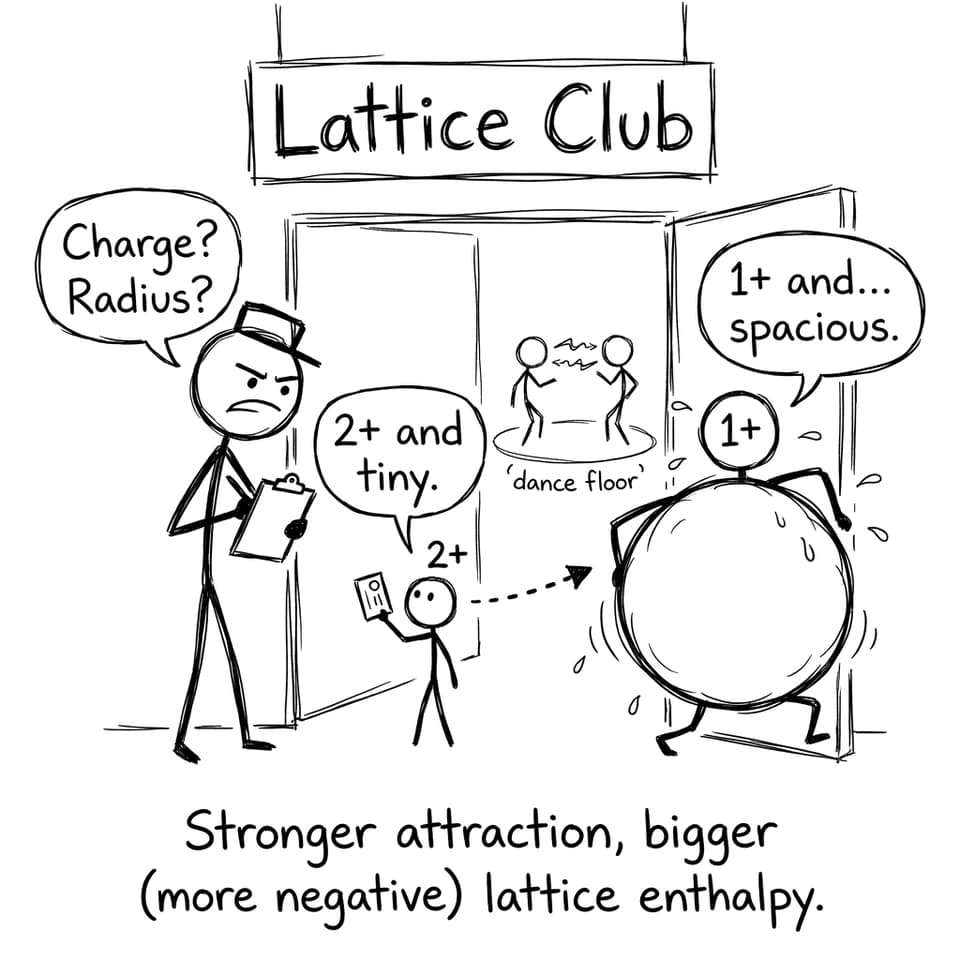
In IB Chemistry, lattice enthalpy depends mainly on two levers: ionic charge and ionic radius.
Higher charge means a stronger lattice
Bigger charges pull harder. So compounds with 2+ and 2- ions tend to have very large magnitude lattice enthalpies.
Example logic:
-
MgO contains Mg²⁺ and O²⁻
-
NaCl contains Na⁺ and Cl⁻
-
So attraction is much stronger in MgO, making |ΔH| larger
Smaller ions mean a stronger lattice
Shorter distance between charges increases attraction. So smaller ions typically lead to more negative lattice enthalpy.
Classic comparison:
- LiF has a larger magnitude lattice enthalpy than KF because Li⁺ is smaller than K⁺
If you want a focused trend explanation, see How Is Lattice Energy Affected by Ion Size?.
Born-Haber cycles: how IB Chemistry actually gets the value
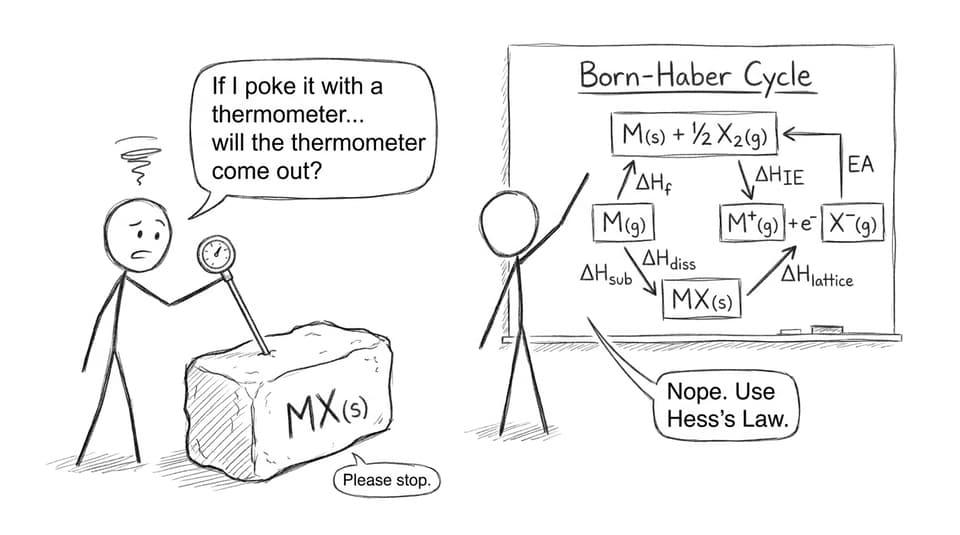
You can’t realistically measure lattice enthalpy directly because isolated gaseous ions are not something you casually bottle in a lab. So IB Chemistry uses Hess’s Law to calculate it via a Born-Haber cycle.
A Born-Haber cycle links:
-
Enthalpy of atomization
-
Ionization energy
-
Electron affinity
-
Enthalpy of formation
-
Lattice enthalpy
If Born-Haber cycles are your weak spot, use the syllabus-aligned notes at R1.2.5 Born-Haber Cycle (HL only) Notes, then drill it with the R1.2.5 Born-Haber Cycle Questionbank and Born-Haber Cycle Flashcards.
Lattice enthalpy vs solubility: the tug-of-war idea
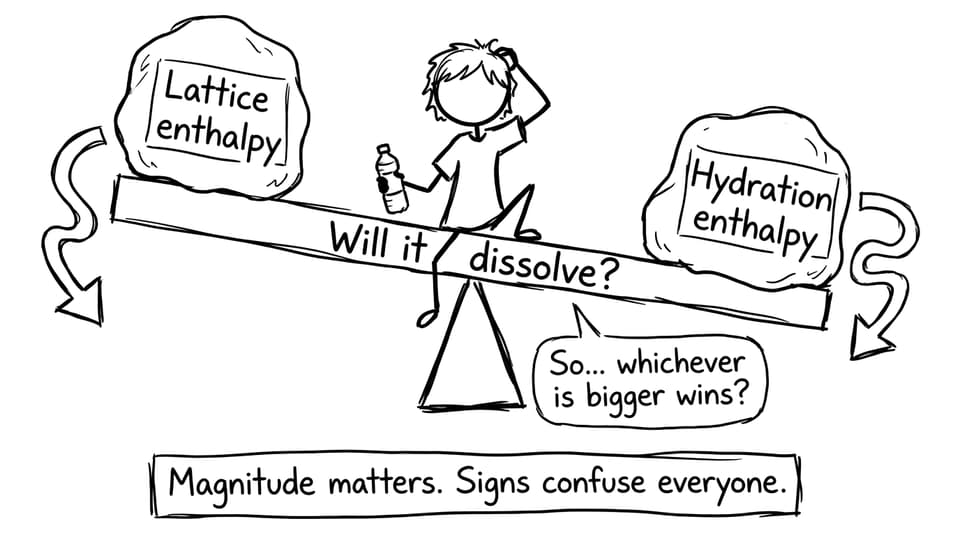
Dissolving an ionic solid is a competition between two big energy changes:
-
Lattice enthalpy (works against dissolving) because the lattice must be broken apart
-
Hydration enthalpy (helps dissolving) because water stabilizes the ions and releases energy
A common rule of thumb used in IB Chemistry explanations:
If |ΔH(hydration)| is greater than |ΔH(lattice)|, dissolving is more likely to be favorable.
For a concrete example that examiners love, read Why NaCl Dissolves in Water.
Closing: turn lattice enthalpy into easy IB Chemistry marks
Lattice enthalpy in IB Chemistry is ultimately about one question: how strongly do the ions attract? Higher charge and smaller radius pull ions closer, making lattice enthalpy more negative and ionic solids harder to melt and often harder to dissolve. Born-Haber cycles exist because we can’t measure the value directly, but we can still calculate it with disciplined Hess’s Law thinking.
If you want this to stick under exam pressure, RevisionDojo is built for it: use the Study Notes to lock the definitions, the Flashcards for quick recall, the Questionbank and Mock Exams to practice setup, and the AI Chat plus Grading tools to diagnose exactly where your reasoning breaks. Add Predicted Papers, the Coursework Library, and Tutors when you need targeted support. When IB Chemistry feels big, the right system makes it feel manageable, one clear step at a time.