



In IB Physics, there’s a moment almost everyone has: you draw a charged particle entering a magnetic field, you apply the right-hand rule, and then you pause.
“If the force keeps pointing sideways… why doesn’t the particle just… keep going?”
The answer is surprisingly comforting: the magnetic field isn’t trying to speed the particle up or slow it down. It’s only trying to steer. And steady steering is exactly how you get circles and spirals.
The IB Physics idea that explains everything
A moving charge in a magnetic field experiences the magnetic (Lorentz) force:
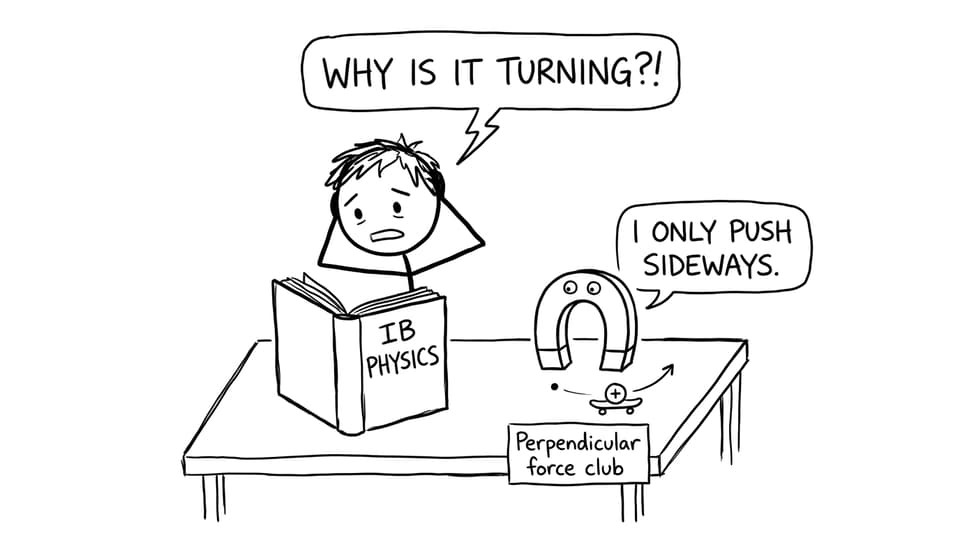
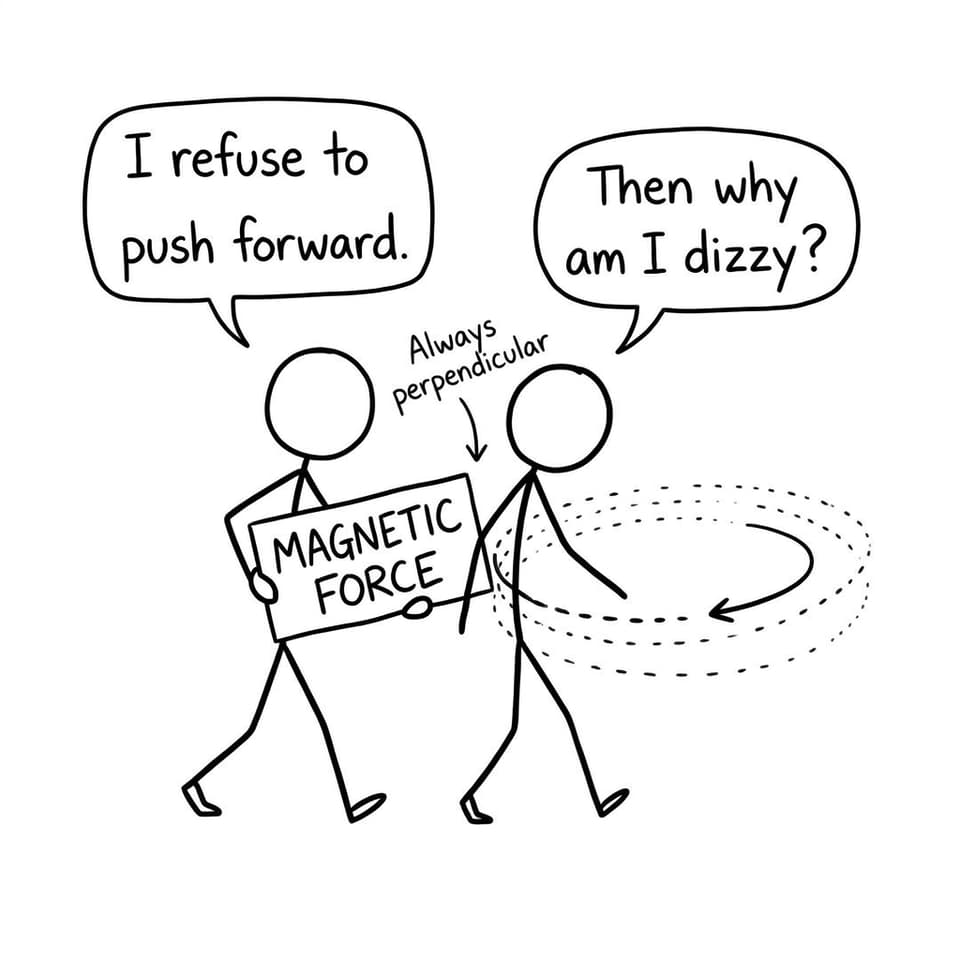
In IB Physics, the key phrase is this: the force is always perpendicular to the velocity (and perpendicular to (\vec{B})). That single geometry fact drives the whole story.
Because the force is perpendicular, it does no work on the particle. No work means no change in kinetic energy, so the speed stays constant. Only the direction changes.
If you want the syllabus-aligned version to revise from, start with IB Physics D.2 Electric and Magnetic Fields Notes and then move into IB Physics D.3.2 Charged Particle Motion in Magnetic Fields.
When IB Physics gives you a circle
If the velocity is entirely perpendicular to the magnetic field ((\theta = 90^\circ)), then (\sin\theta = 1) and the force magnitude is (F=qvB).
That force keeps pointing “sideways,” but because the velocity direction keeps changing, the “sideways” direction keeps rotating too. So the force continually points toward the center of curvature: a centripetal force.
Set magnetic force equal to centripetal force:
This is classic IB Physics exam territory: faster particles make bigger circles; stronger fields (larger (B)) make tighter circles; larger charge magnitude tightens the curve.
When IB Physics gives you a helix
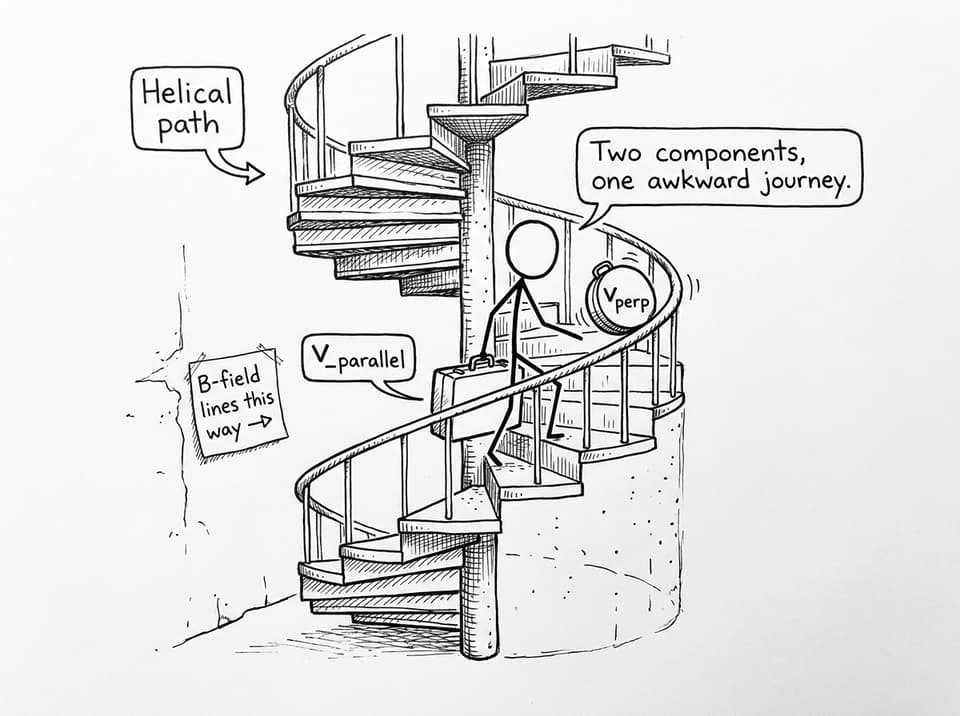
Most particles don’t enter perfectly perpendicular. Split the velocity into components:
-
(v_\perp) (perpendicular to (\vec{B}))
-
(v_\parallel) (parallel to (\vec{B}))
Here’s the twist students love in IB Physics: the magnetic force depends on (\sin\theta), so it only “sees” the perpendicular component. That means:
-
(v_\perp) produces circular motion.
-
(v_\parallel) continues unchanged (no force along (\vec{B})).
Combine “circle” + “constant forward motion” and you get a helical path (a spiral around the field lines). The pitch (spacing between loops) depends on (v_\parallel).
To connect this to the wider unit, How Electromagnetic Fields Guide the Motion of Charged Particles is a helpful bridge article.
Quick exam checklist (IB Physics)
-
State that magnetic force is perpendicular to velocity.
-
Conclude speed constant (magnetic field does no work).
-
For circular motion: use (qvB = mv^2/r).
-
For helical motion: resolve velocity into (v_\perp) and (v_\parallel).
For targeted practice, use the D.3 Motion in Electromagnetic Fields Questionbank. It’s built around the exact reasoning chains examiners reward.
Bring it home with RevisionDojo
In IB Physics, circular and helical paths aren’t a weird exception. They’re what happens when a force is forever sideways. Once you see that, the diagrams stop feeling like magic tricks and start feeling inevitable.
If you want this topic to become automatic under exam time pressure, RevisionDojo combines syllabus-mapped Study Notes, a focused Questionbank, rapid Flashcards, Mock Exams, Predicted Papers, and support from Tutors when you want a human walkthrough. Start with IB Physics Revision Notes (SL/HL) and make IB Physics magnetism feel like a strength, not a guess.