




In IB Physics, few ideas feel as “obvious in hindsight” as this one: a charged particle doesn’t need rails to follow a path. It only needs a field. One moment it’s moving freely; the next, an invisible instruction set nudges it to speed up, slow down, or curve like it’s tracing a pre-drawn track.
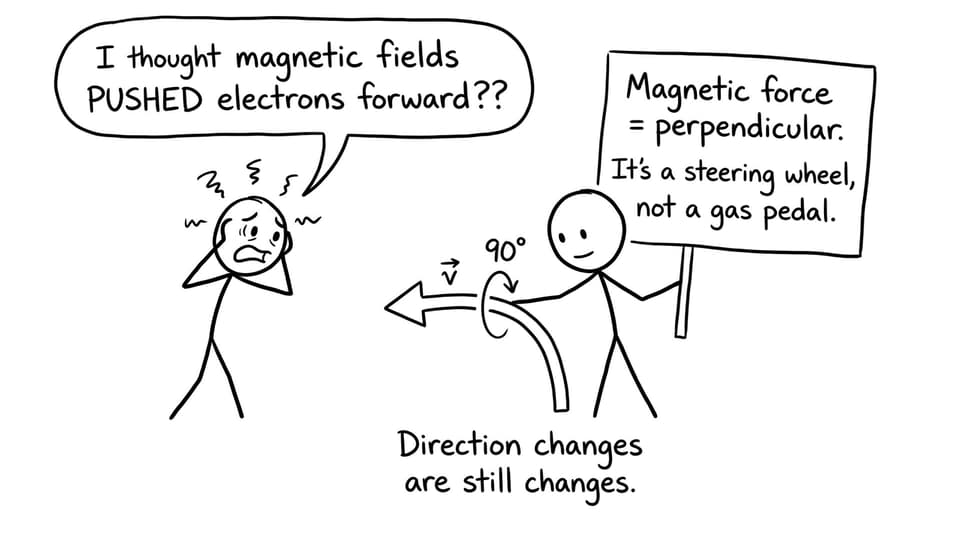
That’s the heart of how electromagnetic fields guide motion in IB Physics: electric fields change speed and energy, while magnetic fields change direction. If you can hold that distinction under exam pressure, a lot of the topic becomes calmer.
Quick IB Physics checklist (what to remember)
-
Electric force: (\vec{F}_E = q\vec{E}) (acts even if the particle is stationary)
-
Magnetic force: (\vec{F}_B = q\vec{v}\times\vec{B}) (needs motion, and is perpendicular)
-
Magnetic fields do no work on a point charge (speed stays constant if only (\vec{B}) acts)
-
Combined fields can accelerate and steer at the same time
If you want focused practice, the Motion in electromagnetic fields Questionbank is built for the exact reasoning these questions require.
IB Physics: how electric fields push charges
An electric field is the straightforward one in IB Physics: it pushes (or pulls) along the field direction.
-
For a positive charge, force is in the direction of (\vec{E}).
-
For a negative charge, force is opposite (\vec{E}).
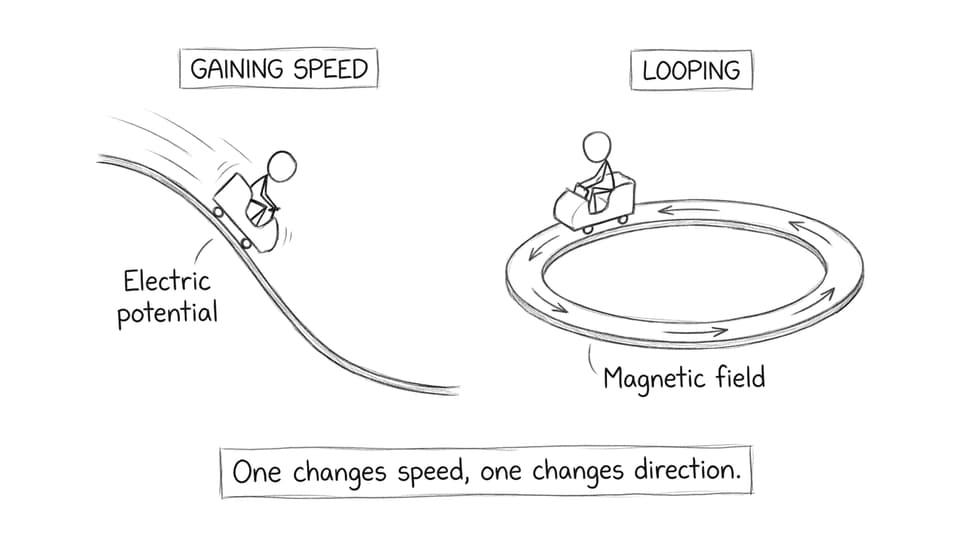
Because the force doesn’t depend on velocity, an electric field can speed up, slow down, or stop a particle. It’s also why potential difference matters: electric fields act like an energy slope, converting electric potential energy into kinetic energy.
To tighten your fundamentals, pair this article with D.3.1 Charged particle motion in electric fields Notes and the broader Topic D: Fields Notes.
IB Physics: how magnetic fields bend paths (without changing speed)
A magnetic field is more subtle in IB Physics because it doesn’t “push forward.” It turns the velocity vector.
The magnetic force is always perpendicular to velocity, so it acts like a continuous sideways shove. That sideways force becomes the centripetal force, producing circular motion (or helical motion if there’s also a velocity component parallel to (\vec{B})).
For the core derivations and the radius relationship (r = \frac{mv}{qB}), use D.3.2 Charged particle motion in magnetic fields Notes. For force direction and the (\sin\theta) factor, see D.3.3 Motion in combined electric and magnetic fields Notes.
IB Physics: what happens when E and B act together
When (\vec{E}) and (\vec{B}) are present, IB Physics questions become “story problems” about the same two roles:
-
(\vec{E}) supplies energy (changes speed)
-
(\vec{B}) shapes the path (changes direction)
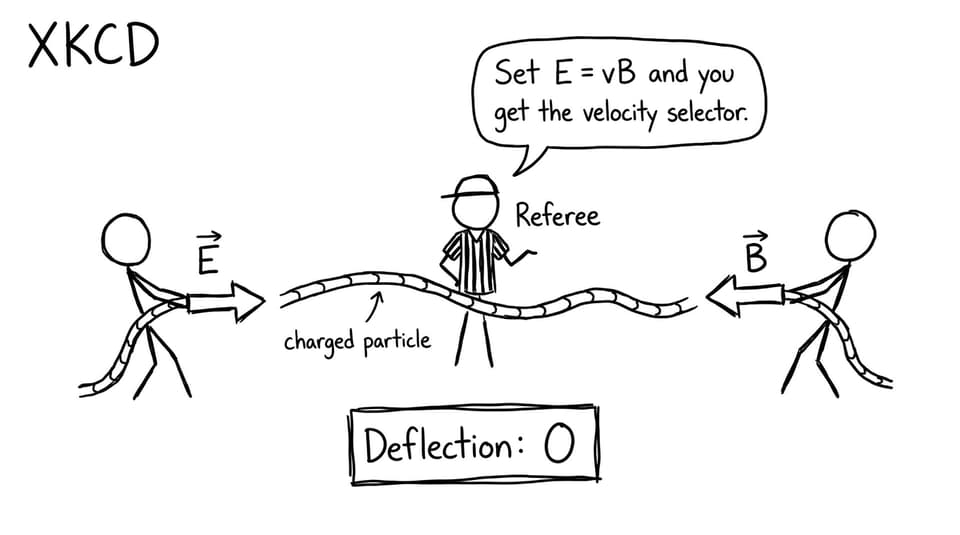
In special setups, they can balance so the particle travels straight. A classic case is a velocity selector, where magnitudes satisfy (qE = qvB), giving (v = \frac{E}{B}). That’s not magic; it’s simply two influences cancelling sideways deflection.
To revise applications and how these ideas appear in devices, review D.2.3 Applications of electric and magnetic fields Notes and the full hub IB Physics D.3 Motion in Electromagnetic Fields.
Bring it home with RevisionDojo (and lock in IB Physics marks)
If this topic feels slippery, it usually isn’t because the math is hard; it’s because the story is happening in vectors. RevisionDojo helps you rehearse that story the exam way: use the Topic D: Fields Questionbank for targeted practice, check formulas in the IB Physics Data Booklet, and reinforce meaning with Lessons for D.2 Electric and magnetic fields.
The best part about IB Physics is that once you trust what (\vec{E}) and (\vec{B}) each “care about,” charged-particle motion stops being a memorization task and becomes something you can predict, calmly, quickly, and consistently.