


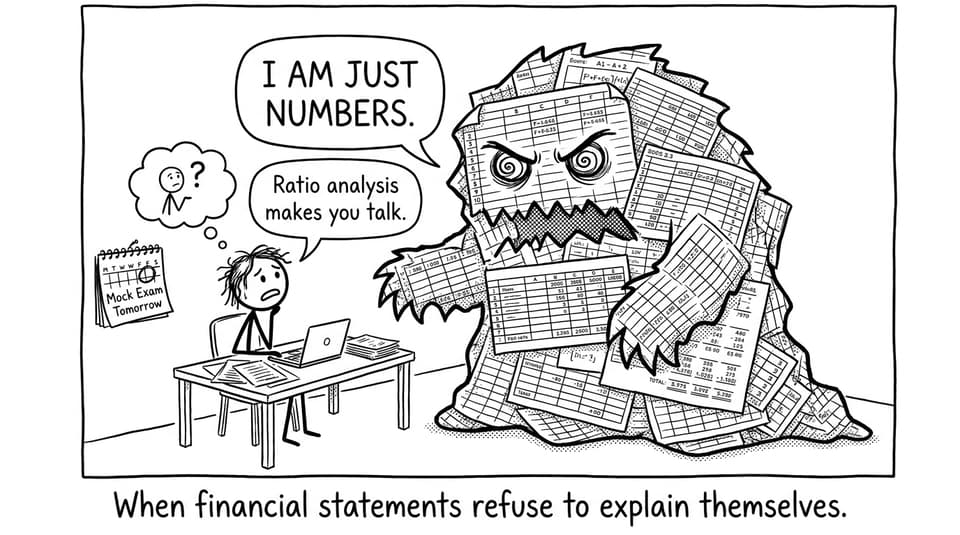
Ratio analysis is what happens when a business stops staring at its financial statements and starts asking better questions.
In IB Business Management, you might be handed an income statement and a statement of financial position and feel like you’re looking at a wall of numbers. Managers often feel the same. Revenue, costs, assets, liabilities, allall true, but not always useful. Ratio analysis turns those raw figures into relationships you can interpret, compare, and act on.
What ratio analysis helps a business do (fast checklist)
In IB Business Management, ratio analysis matters because it helps businesses:
-
Measure profitability (are we actually making money from sales and capital?)
-
Check liquidity (can we pay short-term debts on time?)
-
Improve efficiency (are we using resources wisely?)
-
Judge financial stability (how risky is our financing mix?)
-
Spot trends over time and benchmark against competitors
If you want the syllabus-aligned version, RevisionDojo’s unit hub for finance topics is a strong starting point: IB Business Management Resources.
IB Business Management and profitability ratios: “Are we earning enough?”
Profitability ratios tell a story about how well a business turns sales into profit. In IB Business Management, the classics are gross profit margin, profit margin, and ROCE.
A falling margin doesn’t automatically mean “bad management.” It could be higher costs, discounting to gain market share, or inflation. But the ratio acts like a spotlight: it tells managers where to investigate next.
To revise the exact definitions and exam phrasing, use:
IB Business Management and liquidity ratios: “Can we survive the next month?”
Liquidity ratios are about breathing room. A business can be profitable on paper and still fail because it cannot pay suppliers, wages, or rent in time.
That’s why current ratio and acid-test ratio are so practical in IB Business Management case studies: they’re early-warning signals for cash stress. If the acid-test looks weak, it may show the business depends too heavily on inventory to pay debts.
Go deeper with:
IB Business Management efficiency and stability: “Are we running smart, or just busy?”
Efficiency ratios (HL only) expose operational habits: stock turnover, debtor days, creditor days. If debtor days are rising, the business may be giving customers too much time to pay, which quietly damages cash flow.
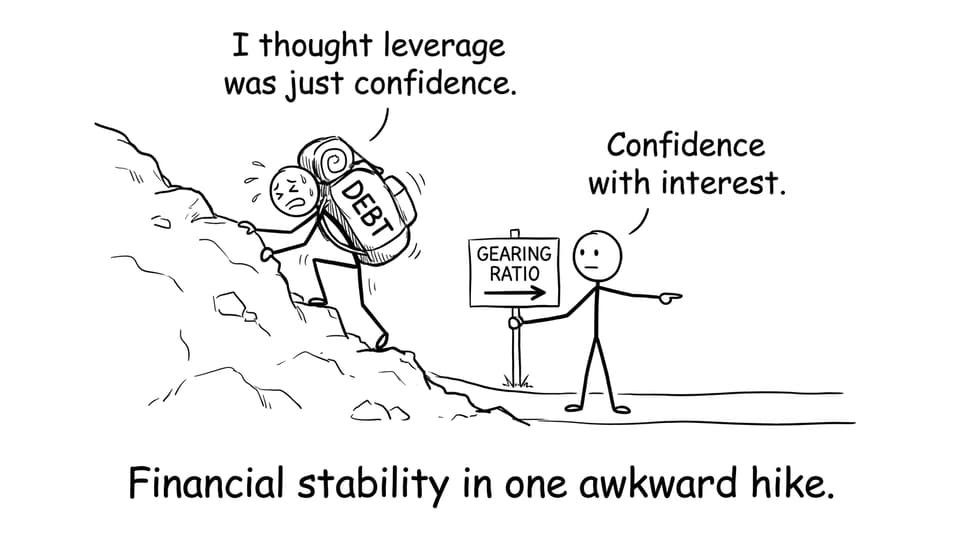
Financial stability is often captured through gearing. Higher gearing can mean faster growth, but also higher risk because debt repayments don’t care if sales had a bad month.
Helpful RevisionDojo links:
How ratio analysis helps decision-making in exams
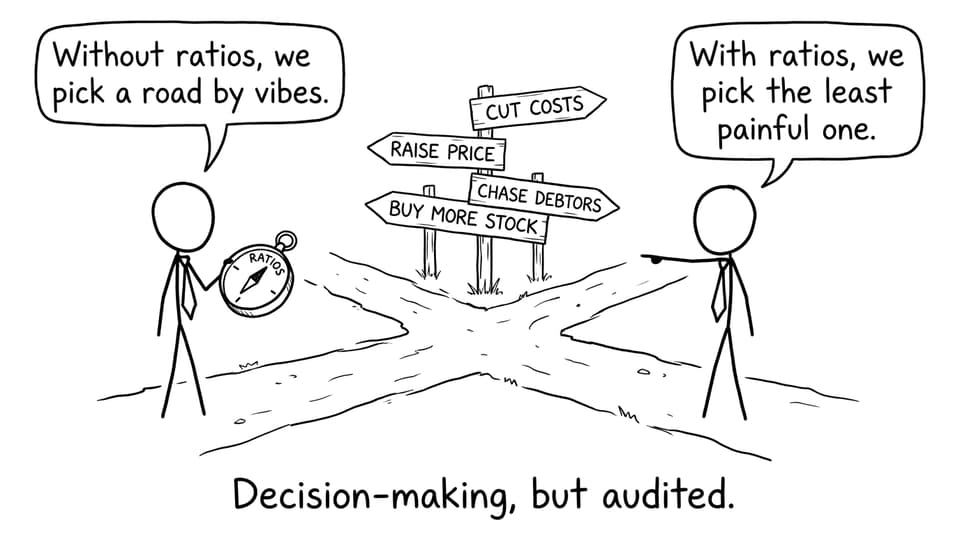
In IB Business Management, exam answers score higher when ratios lead to decisions.
A strong chain looks like this: calculate (or interpret) the ratio to explain what it suggests to give a reason to recommend an action (and maybe a limitation). RevisionDojo supports that whole chain with its Questionbank, Study Notes, Flashcards, AI Chat, and Grading tools so you can practise interpretation, not just memorise formulas. If you’re building timed practice, Mock Exams and Predicted Papers help you train under pressure.
Conclusion: use ratios to turn numbers into choices
Businesses use ratio analysis because it transforms financial statements into decisions: cut costs, change pricing, negotiate longer credit terms, reduce inventory, or rethink financing risk. For IB Business Management students, that’s the real goal too, notnot just calculating ratios, but explaining what they mean.
If you want to practise like the exam, build a routine with RevisionDojo: revise with Study Notes, drill with the Questionbank, lock in formulas with Flashcards, ask “what does this imply?” using AI Chat, and sharpen structure with Grading tools. It’s the fastest way to make ratio analysis feel less like math and more like management.