Business goals look neat on paper.
Then reality walks in.
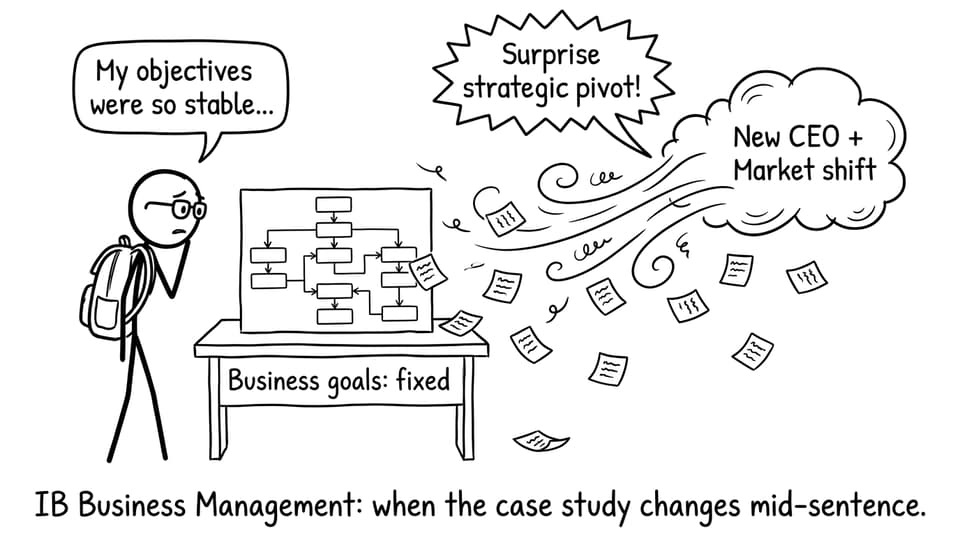
A competitor launches something better. A recession squeezes cash flow. A new CEO arrives with a different definition of “success.” In IB Business Management, this is one of the most useful truths to remember: goals are not permanent promises. They are moving targets that help a business survive changing conditions.
The exam-ready idea: goals shift to stay aligned
In IB Business Management, you can explain goal changes with one clean chain:
-
The external environment changes (market, economy, tech, regulation)
-
The business’s constraints and opportunities change
-
Leadership updates strategy and priorities
-
Goals are rewritten so the firm stays competitive and feasible
If you want the syllabus-aligned language for “objectives” and “strategy,” keep the IB Business Management Key Definitions open while you revise.
How environmental change forces new objectives
Most goal shifts start outside the business.
Markets and competition
Customer preferences move fast. When demand changes, the goal might switch from “increase sales volume” to “protect market share” or “differentiate through quality.” This is especially easy to apply in case studies: one new competitor can make last year’s growth target unrealistic.
To practice how this appears in exam questions, try Business Objectives Questionbank (Topic 1.3).
Economic conditions and cash flow pressure
In a downturn, businesses often pivot from growth to survival: controlling costs, protecting liquidity, and improving cash flow. That is not “failing” to pursue growth; it is adjusting to a new constraint.
If you want a finance-adjacent link you can use in evaluation, revise Costs and Revenues (Topic 3.3) and connect it back to changing targets.
Regulation and compliance
Rules can change the playing field overnight: data protection, environmental standards, labor laws, taxes. When compliance becomes urgent, goals can shift toward risk reduction, training, auditing, or redesigning products and processes.

Why leadership change triggers new goals
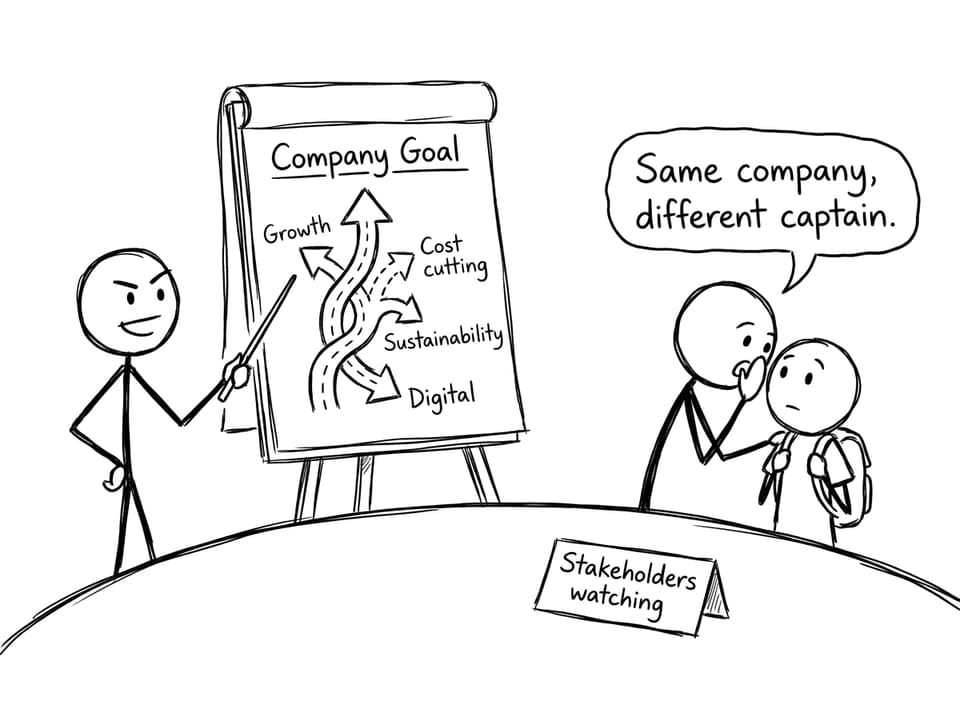
When leadership changes, the business doesn’t just get a new manager. It often gets a new story about what matters.
A new vision of success
A new CEO may prioritize innovation, sustainability, global expansion, or stakeholder outcomes differently. In IB Business Management, that’s a strategic shift: goals change because the business is now optimizing for a different definition of long-term value.
This is also where students confuse “leadership” with “management.” If you want a crisp way to explain the difference, see Leadership vs Management.
Culture and expectations
Leaders reshape culture through what they reward: collaboration, accountability, speed, experimentation. New culture creates new KPIs and new objectives, even if the product stays the same.
How to write this in an IB response (fast)
Use this mini-structure for IB Business Management:
-
State: Business goals change when the environment or leadership changes.
-
Explain: External change alters opportunities/constraints; leadership change alters vision/priorities.
-
Apply: Use one case detail (competitor, law, tech, recession, new CEO).
-
Evaluate: Short-term disruption vs long-term resilience; impact on stakeholders.
To build that skill under time pressure, use the IB Business Management Resources hub and rotate between Study Notes, Flashcards, AI Chat, and the Questionbank.
Bring it back to RevisionDojo
If you want this topic to feel automatic in exams, practice it like a skill: define goals clearly, apply them to a case detail, then evaluate trade-offs. RevisionDojo helps you do that with Questionbank practice, Study Notes, Flashcards for key terms, AI Chat for quick explanations, Grading tools for feedback, plus Predicted Papers and Mock Exams to train timing. Start with the Business Objectives Questionbank, then connect leadership points using Leadership and Management Questionbank (Topic 2.3). That combination makes your IB Business Management answers sound like a real strategist, not a memoriser.



